 comparison
Best Astrology Calculators: A 2026 Accuracy Comparison
Table of Contents
- How We Evaluated the Best Astrology Calculators
- Astrology Calculator Comparison Table
- Mansions of the Moon: Best for Lunar Mansions
- Astrodienst: The Gold Standard for Free Natal Charts
- Professional Software Options: Astro Gold and Sirius
- Why Astrology Chart Accuracy Varies Between Tools
- Which Astrology Calculator Should You Choose?
- Frequently Asked Questions
Last Updated: September 9, 2026
Finding the best astrology calculators in 2026 means weighing accuracy, interpretive depth, and usability. An astrology calculator computes planetary positions and house cusps from birth data to generate a natal chart, but output quality varies significantly between platforms. This guide from Mansions of the Moon evaluates the leading options, focusing on where results diverge and which tool serves which purpose best.
How We Evaluated the Best Astrology Calculators
The evaluation criteria prioritized calculation precision, interpretive depth, platform accessibility, and data privacy. We tested each tool's handling of time zone offsets, longitude and latitude inputs, and obscure house systems to see which could handle edge cases without errors.
We verified each chart against an ephemeris, the same standard astrologers apply. Tools that produced consistent planetary positions and ascendant calculations across different birth data sets scored higher than those relying on simplified algorithms. We also weighed whether a tool offered classical techniques like dignities and debilities or aspect patterns.
Data handling played a role as well. Some platforms require accounts and store birth data on servers, while others like Mansions of the Moon run calculations entirely in the browser with no sign-up required. For users concerned about birth information security, that distinction is decisive.
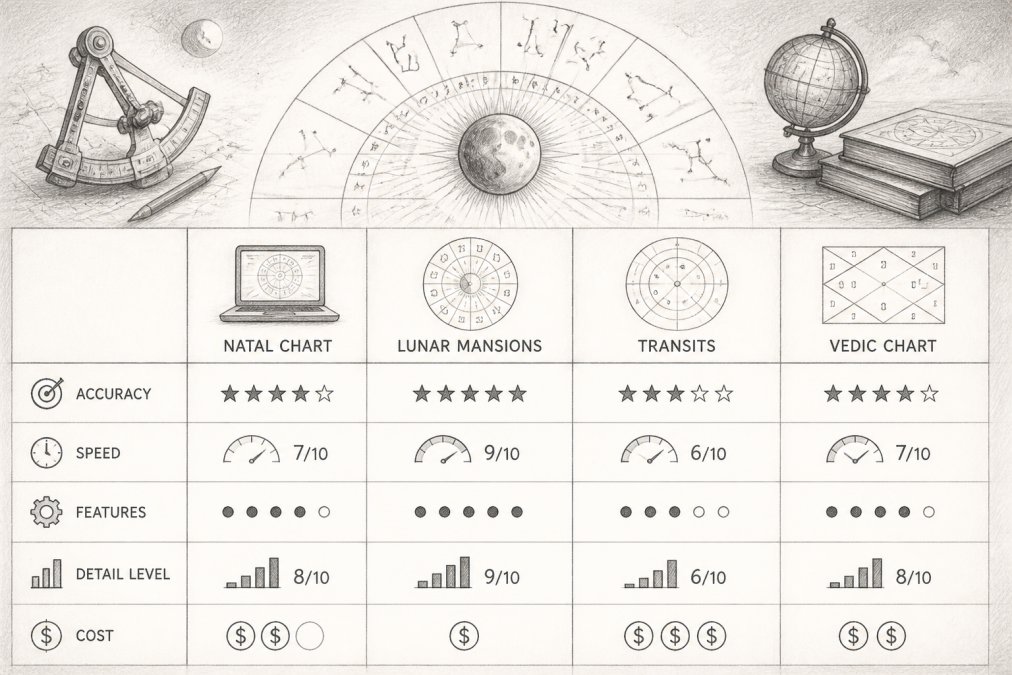
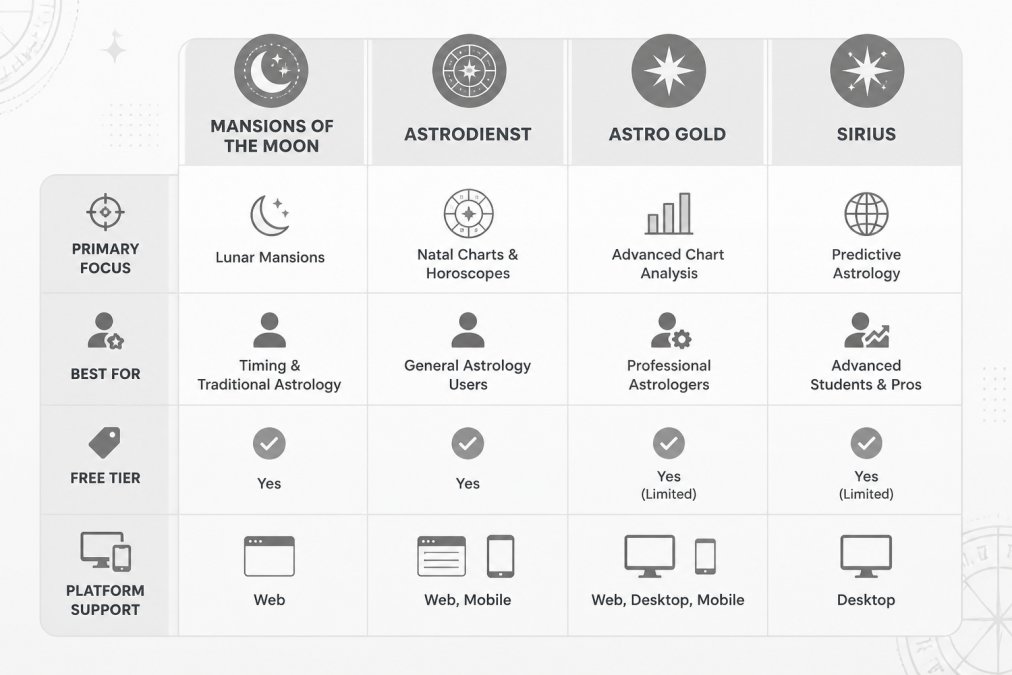
Astrology Calculator Comparison Table
| Tool | Primary Focus | Best For | Free Tier | Platform |
|---|---|---|---|---|
| Mansions of the Moon | Lunar mansions, electional timing | Timing activities by the Moon | Yes, full access | Browser-based |
| Astrodienst | Natal charts, interpretations | Free professional-grade charts | Yes, extensive | Browser-based |
| Astro Gold | Professional chart analysis | Practicing astrologers on mobile | No | macOS, Windows, iOS, Android |
| Sirius | Research and predictive work | Researchers needing deep data | No | Windows, macOS |
Mansions of the Moon: Best for Lunar Mansions
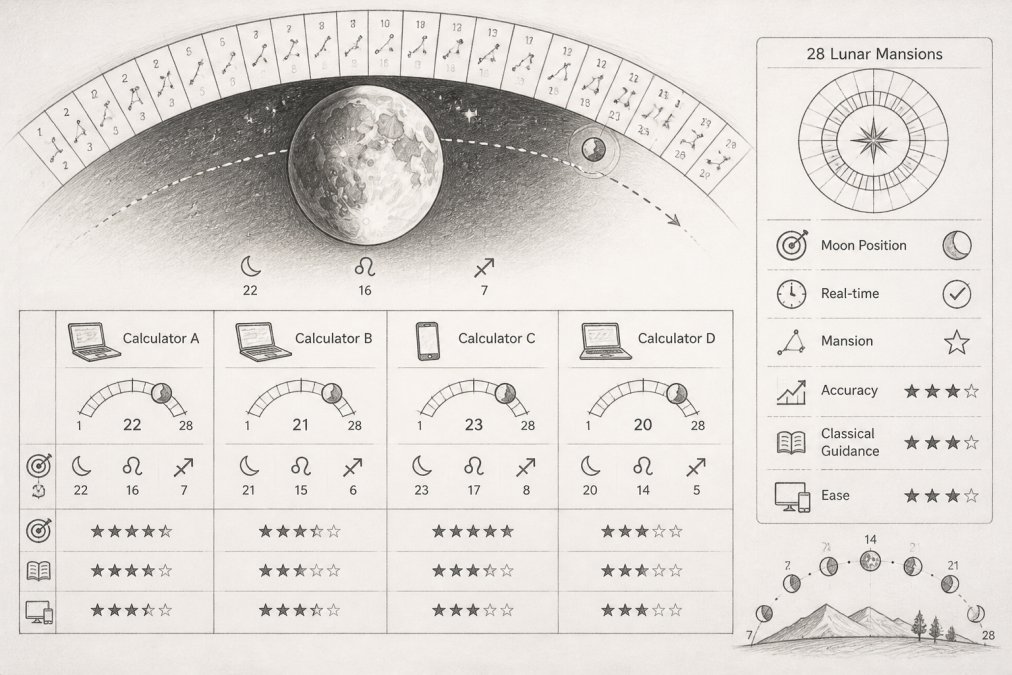
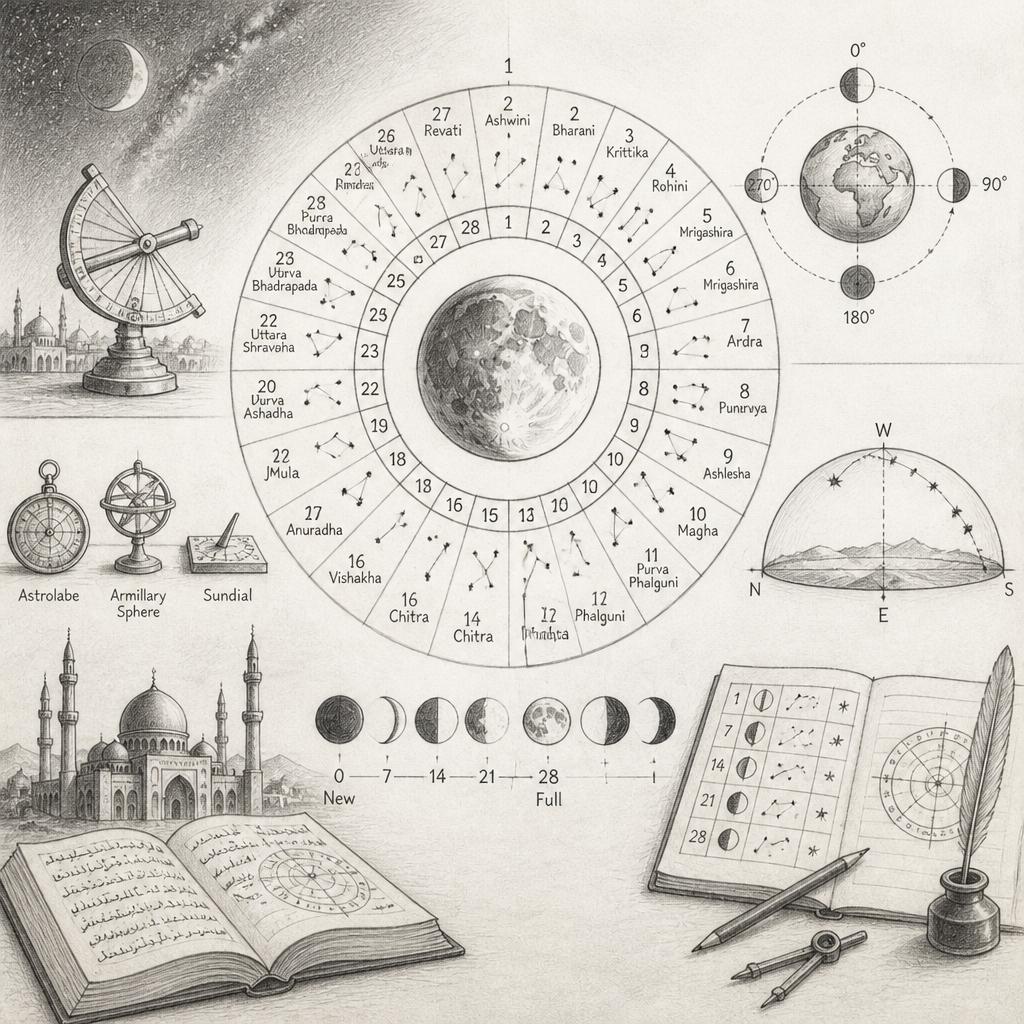
Mansions of the Moon is a free, browser-based calculator that maps the Moon's current position across the 28 lunar mansions of traditional Islamic astronomy. Rather than generating a full natal chart wheel, it specializes in one precise function: showing which mansion the Moon occupies now, at your birth, or when it returns to your natal mansion.
The platform pairs precise astronomical algorithms with classical timing guidance from sources like the Picatrix, making it useful for electional work. Users planning rituals, journeys, or new beginnings can check the Moon's mansion before committing to a time. Moonrise, moonset, phase, and illumination data appear alongside each reading, and each mansion carries unique interactive generative artwork.
Where this tool stands apart is accessibility. No sign-up is required, calculations run entirely in the browser, and the interface explains the historical context without demanding a background in Islamic astronomy.
Astrodienst: The Gold Standard for Free Natal Charts
Astrodienst delivers professional-grade natal chart calculations with an extensive database and many chart types, including transit and synastry. It is widely considered the gold standard for accuracy, and its free tier is genuinely substantial.
The Astro*Intelligence series provides detailed computer-generated interpretations beyond basic planetary descriptions. Users can request charts using different house systems, including Placidus and whole sign houses, and the engine handles retrograde motion and lunar nodes with precision.
The trade-off is the interface. Astrodienst's layout feels dated and can overwhelm beginners, with dense menus and technical options presented without guidance. For users who want accurate calculations and are willing to navigate a learning curve, it remains excellent.
Professional Software Options: Astro Gold and Sirius
For practicing astrologers and researchers, dedicated software offers depth that browser tools cannot match. Two options dominate this space, each with distinct strengths.
Astro Gold: A Professional Tool for Mobile Use
Astro Gold is professional-grade astrology software built for macOS, Windows, iOS, and Android. Its advanced chart calculation engine delivers high precision, and the clean, modern interface works well on mobile devices without requiring virtualization software like Parallels on Mac.
The reporting tools suit practicing astrologers who need customizable chart displays and transit tracking during client sessions. Astro Gold carries a significant one-time purchase cost, positioning it as an investment rather than a casual tool. Casual users will likely find the free browser alternatives sufficient.
Sirius: The Researcher's Choice
Sirius is one of the most comprehensive astrology software packages available, integrating the massive Astrodatabank research database with advanced predictive and research-oriented modules. It supports a wide variety of astrological traditions and techniques, making it an industry standard for advanced study.
The depth here is unmatched for research purposes. Users can analyze large datasets, test techniques across many charts, and customize chart presentation extensively. That power comes with a steep learning curve and a high price point, limiting its appeal to dedicated professionals.
Why Astrology Chart Accuracy Varies Between Tools
Chart accuracy varies between tools primarily because of differences in house systems, ephemeris precision, and how each platform handles birth time and location data. The same birth data can produce different ascendant and midheaven placements depending on which house system the calculator defaults to.
Most online calculators default to Placidus houses, while traditional practitioners often prefer whole sign houses. Neither is objectively correct, but the choice changes interpretation. Planetary positions themselves rarely vary between reputable tools, since they draw on the same astronomical ephemerides. Divergence appears in house cusps, which depend on both the house system and the precision of the calculation engine. authentic crystals.
Birth time rectification adds another layer. A chart calculated with an unknown birth time uses noon as a default, which shifts the ascendant and house placements entirely. Users should always confirm their birth time and location before comparing results across platforms.
The Technical Mechanism Behind Divergent Results
To understand why two calculators disagree, you need to look at three layers of the calculation pipeline:
-
Ephemeris source and version. Most modern tools draw planetary longitudes from the JPL DE431 ephemeris or the older Swiss Ephemeris (jpl.nasa.gov). DE431 covers a wider date range (roughly 13,000 BC to 17,000 AD) and uses a different integration model than the truncated Swiss Ephemeris (jpl.nasa.gov). For dates after 1800 AD, the two agree to within arcseconds. For ancient or rectified charts, the divergence can reach several arcminutes, enough to shift a house cusp in rare cases. Tools that do not disclose their ephemeris source are harder to verify against published astronomical tables.
-
Geocentric vs. topocentric coordinates. Most free calculators compute the chart from the Earth's center (geocentric). A smaller number of professional tools offer topocentric calculation, which adjusts for your actual latitude and longitude on the Earth's surface. The difference is most pronounced for the Moon, which can shift by up to one full degree between the two methods, enough to change a lunar mansion assignment in borderline cases. If you are using a lunar mansion calculator for electional timing, confirm whether it uses geocentric or topocentric coordinates.
-
Timezone and longitude handling. The single most common source of error is not astronomy but geography. Calculators that rely on a built-in timezone database (like the IANA tz database) handle daylight saving time transitions correctly. Older or simpler tools may apply a fixed UTC offset, which produces wrong results for dates before 1970 or for locations that changed timezone laws. A chart cast for a birth in Indiana in 1965, for example, will differ by an hour depending on whether the tool applies the state's pre-1970 timezone rules. Always double-check the calculated local sidereal time against an independent source if your birth date is before 1970 or in a region with complex timezone history.
Why the Moon Is the Hardest Test Case
The Moon moves faster than any other planet through the zodiac, roughly 13 degrees per day, or one lunar mansion every 24 to 28 hours. That speed makes it the most sensitive test of a calculator's precision. A tool that rounds planetary positions to the nearest degree may place the Moon in the correct sign but in the wrong mansion. For lunar mansion work, you need a calculator that reports the Moon's longitude to at least two decimal places of arc.
Mansions of the Moon displays the exact degree and minute of the Moon's longitude alongside the mansion assignment. This level of detail lets users verify the result against any published ephemeris, the same standard professional astrologers apply when auditing a chart.
Which Astrology Calculator Should You Choose?
The right choice depends on what you intend to do with the chart. For natal chart interpretation and transit tracking, Astrodienst offers the best free calculations available. For professional work on mobile devices, Astro Gold justifies its cost. For research involving large datasets, Sirius remains unmatched.
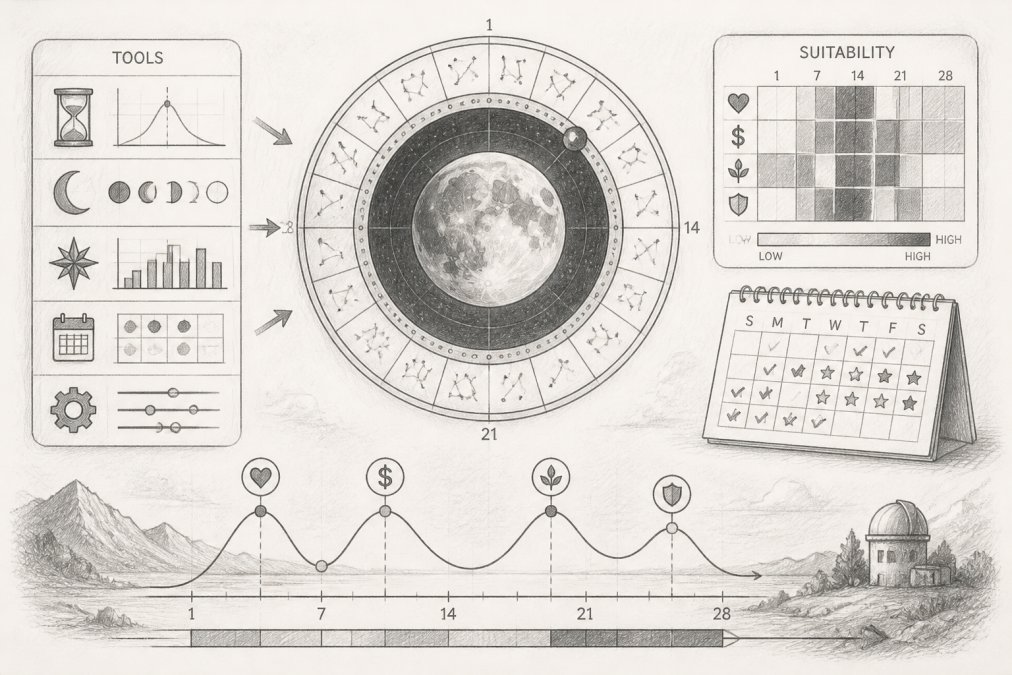
For lunar mansion calculations and electional timing based on the Moon's position, Mansions of the Moon is the top pick. It is the only tool in this comparison dedicated to the 28 lunar mansions, presenting the information clearly enough for beginners while remaining precise enough for practitioners. The free, browser-based format with no sign-up requirement also eliminates the data privacy concerns attached to account-based platforms.
Users wanting to integrate lunar timing into their practice can track the Moon's return to their natal mansion for personalized insights. Those planning rituals or significant beginnings can check the current mansion before choosing a time. The generative artwork paired with each mansion makes the system memorable and helps users build an intuitive connection to each mansion's character.
The Mobile-First Test Most Calculators Fail
Most astrology portals were built for desktop browsers and have never been optimized for mobile. Yet many of the most respected calculators still render as tiny, scroll-heavy pages with tap targets that are too small to hit accurately.
Run this quick test on any calculator you are considering. Open it on your phone, disable desktop mode, and try to cast a chart. If you have to zoom in to tap the birth date field, if the house cusp table runs off the edge of the screen, or if the chart wheel requires constant pinching to read, the tool fails the mobile test. Astrodienst's free charts are accurate and deep, but the interface on a phone is cramped and menu-heavy. Astro Gold works well on mobile because it was rebuilt as a native app, but it carries a significant purchase price. Sirius has no mobile version at all.
Mansions of the Moon was designed mobile-first. The layout collapses to a single column on a phone, the Moon's current mansion appears immediately without scrolling, and the interactive mansion artwork is sized for a touchscreen. There is no app to download and no account to create, the page loads in any browser and runs the calculation locally on your device.
A Decision Framework for Choosing by Use Case
Rather than picking a single "best" calculator, match the tool to the specific question you are asking:
- "What does my natal chart say about my personality?" → Astrodienst's free natal chart with the Astro*Intelligence interpretation is the strongest free option. Expect a dated interface and a learning curve.
- "I need to time an event by the Moon." → Mansions of the Moon gives you the current mansion, the Moon's return to your natal mansion, and the classical timing guidance from the Picatrix tradition in one place.
- "I am a professional astrologer working with clients on my phone." → Astro Gold is the only serious option that runs natively on iOS and Android without a desktop companion.
- "I am researching patterns across thousands of charts." → Sirius, with its Astrodatabank integration, is the industry standard, but budget for both the software and the learning curve.
- "I want to check a chart quickly without creating an account." → Mansions of the Moon and Astrodienst both offer no-sign-up access, but Mansions of the Moon is the only one that runs entirely in your browser without sending your birth data to a server.
The Privacy Angle That Changes the Decision
Data privacy is not a footnote in this comparison, it is a decisive factor. Every time you enter a birth date, time, and location into an account-based platform, that data is stored on a server. Some platforms use it to build marketing profiles; others share it with analytics partners. If you are casting charts for clients or researching sensitive family data, the stakes are higher than a casual horoscope check.
Mansions of the Moon performs all calculations locally in your browser. Your birth data never leaves your device. No cookies, no accounts, no server-side storage. This is the same privacy model used by encrypted note-taking apps, and it is rare among astrology calculators. For users who value both precision and discretion, this combination is the deciding factor.
Frequently Asked Questions
Which astrology chart calculator is considered the most accurate?
Astrodienst is widely regarded as the gold standard for calculation precision in the astrology community. However, accuracy also depends on your birth data and the house system used. Mansions of the Moon uses precise astronomical algorithms for lunar mansion calculations, ensuring the Moon's position is exact. For the most reliable results, always use your exact birth time and location.
What is the difference between a free natal chart calculator and a lunar mansions calculator?
A free natal chart calculator, like Astrodienst, maps all planetary positions at your birth moment to create a full chart wheel. A lunar mansions calculator, like Mansions of the Moon, specifically tracks the Moon's position across the 28 traditional lunar mansions. While a natal chart offers a broad overview, a lunar mansion calculator provides specialized timing guidance based on the Moon's current cycle.
Are free online astrology calculators reliable?
Yes, many free online calculators are reliable if they use accurate ephemeris data and algorithms. Astrodienst offers professional-grade calculations for free. Mansions of the Moon provides precise lunar mansion calculations directly in your browser without requiring sign-up. Always verify your birth time and location, as incorrect input data will affect the output regardless of the calculator's quality.
Can astrology calculators help with electional timing?
Yes, some calculators are designed for electional timing. Mansions of the Moon integrates classical guidance from sources like the Picatrix to help you choose auspicious moments for activities such as starting a journey or beginning a project. By tracking the Moon's position through the 28 mansions, you can align your plans with traditional timing principles.