 ultimate-guide
Islamic Astronomy for Beginners: A 2026 Guide
Last Updated: October 22, 2026
Quick Summary
Islamic astronomy beginners learn through precise calculation of celestial positions, lunar cycles, and their relationship to timekeeping, navigation, and ritual practice, with the 28 lunar mansions forming its foundation as divisions of the Moon's monthly path.
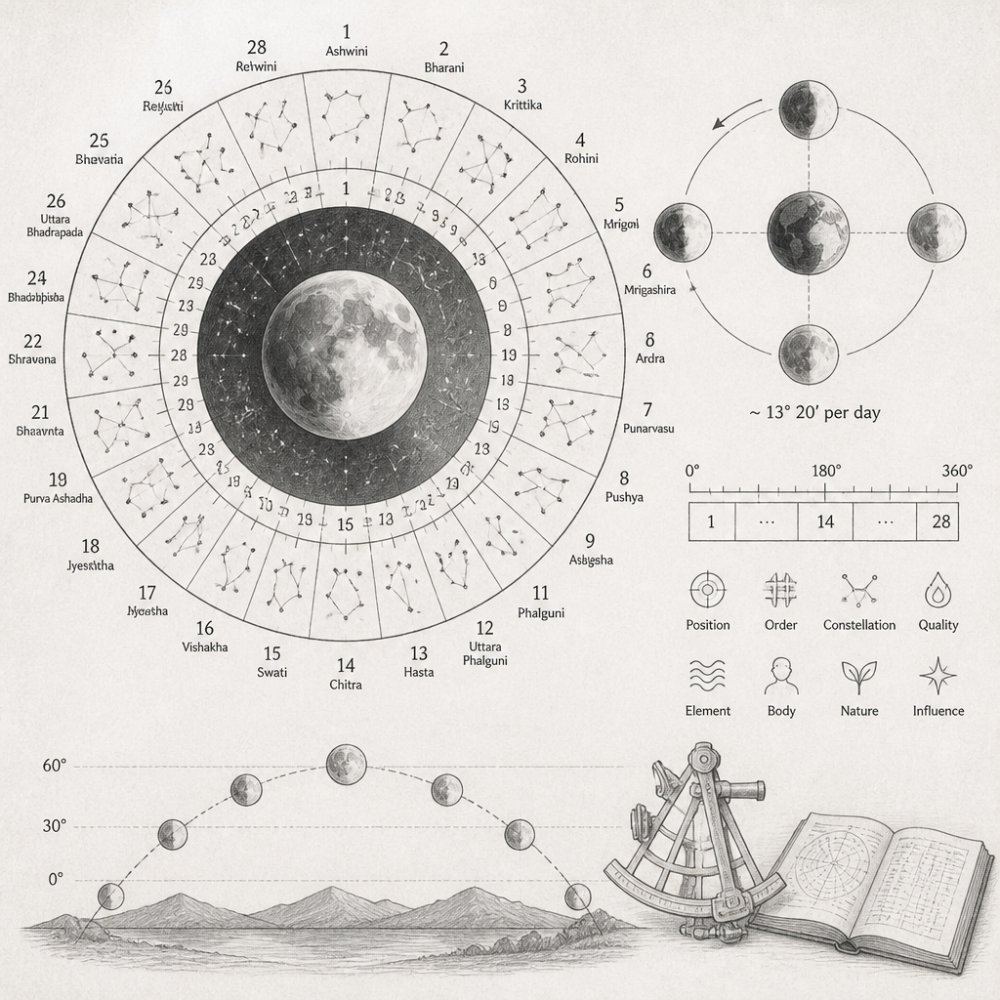
- The 28 lunar mansions divide the Moon's monthly orbit into equal sections, each occupying roughly 12-13 degrees and carrying traditional associations with specific timings.
- Medieval Islamic astronomers developed precision instruments like the astrolabe and quadrant to measure celestial positions and solve astronomical problems.
- Moon Mansion Calculator automatically identifies your natal mansion and current lunar position using precise astronomical algorithms.
- The lunar mansions provide a framework for electional timing, allowing practitioners to align activities with specific mansion associations.
- Islamic astronomy historically served essential functions including determining prayer times, calculating the Islamic calendar, and establishing the qibla direction.
Table of Contents
- What Is Islamic Astronomy and Why It Matters Today
- The Historical Roots: From Greek to Islamic Golden Age
- Understanding the 28 Lunar Mansions
- Islamic Astronomy Instruments and Observational Tools
- How to Track the Moon's Position in Real Time
- Using a Lunar Mansion Calculator for Electional Timing
- Practical Applications: From Prayer Times to Daily Planning
- Common Beginner Questions and Clarifications
- Frequently Asked Questions
What Is Islamic Astronomy and Why It Matters Today
Islamic astronomy is a sophisticated system of celestial observation and mathematical modeling developed during the Islamic Golden Age. The 28 lunar mansions, divisions of the Moon's monthly path, form its foundation.
Moon Mansion Calculator makes this classical knowledge accessible by combining precise astronomical algorithms with timing guidance from sources like the Picatrix, a medieval grimoire connecting lunar positions to practical activity planning.
What makes Islamic astronomy distinct is its emphasis on observation and mathematical rigor.
For modern practitioners, Islamic astronomy provides both historical context and practical tools: the lunar mansions offer a framework for timing activities, and the underlying mathematics ensures accuracy.
The Historical Roots: From Greek to Islamic Golden Age
Islamic astronomy emerged from a synthesis of inherited knowledge and original observation. When scholars encountered Greek astronomical texts, particularly Ptolemy's Almagest, they translated, verified, corrected, and extended the work with their own observations.
The translation movement, centered in Baghdad and Cordoba, preserved Greek, Persian, and Indian astronomical traditions while advancing them. Al-Farghani refined Ptolemy's planetary models, Al-Battani measured the solar year precisely, and Al-Sufi created the medieval world's most detailed star catalog.
The Islamic Golden Age (roughly 8th to 14th centuries) saw sophisticated observatories built at Maragheh and Samarkand.
The 28 lunar mansions, known in Arabic as manāzil al-qamar, have roots in older Indian, Persian, and pre-Islamic Arabian traditions that tracked the Moon's monthly journey. Islamic astronomers standardized these divisions into the framework used today. Each mansion occupies roughly 12-13 degrees of the Moon's path and carries associations with specific timings and applications.
Understanding the 28 Lunar Mansions
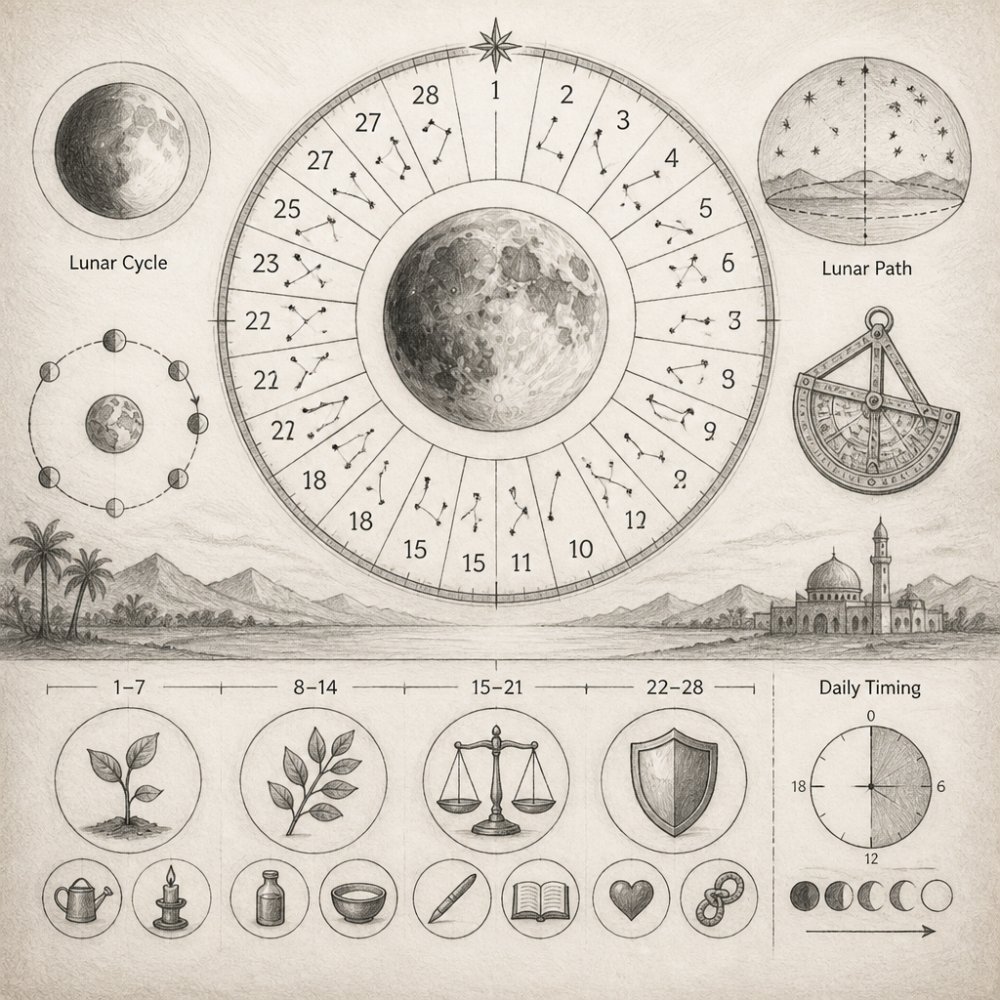
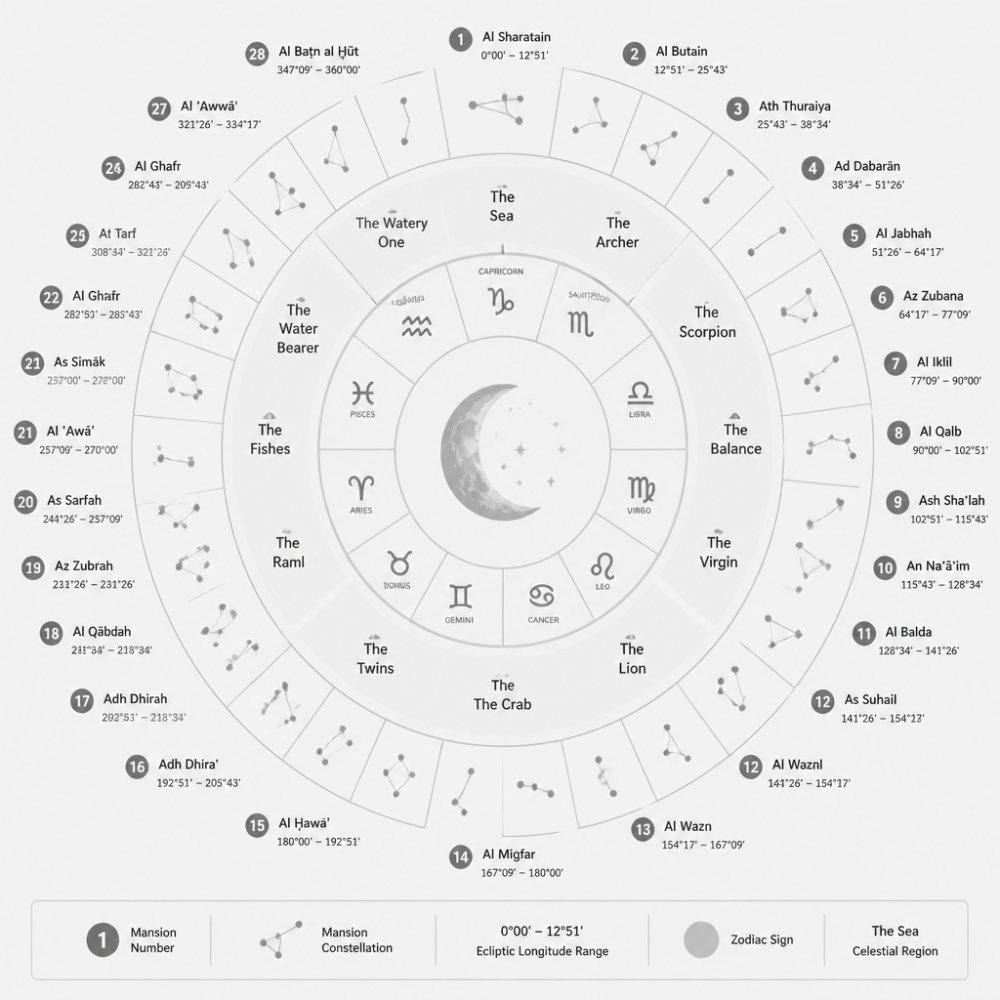
The 28 lunar mansions divide the Moon's monthly orbit into equal sections. As the Moon travels the ecliptic over approximately 27.3 days, it passes through each mansion sequentially, providing a lunar calendar independent of the solar year.
What Each Mansion Represents
Each mansion carries a name, a range of celestial coordinates, and traditional associations. The first, Al-Sharatain, spans the beginning of the zodiac near Aries; the second, Al-Butain, follows immediately after.
Moon Mansion Calculator displays these 28 divisions with precise coordinates and contemporary names. Classical texts like the Picatrix assign each mansion specific influences and recommended activities: some favor beginnings, others completion, some communication, others solitude.
The associations reflect centuries of observation and practice.
How Mansions Connect to Timing and Ritual
The mansions serve as a timing system for electional practice, choosing when to begin significant activities.
This is deliberate timing based on a classical framework: the practitioner makes the choice and takes the action, while the mansion provides a structure for when it occurs. The Picatrix and similar texts offer detailed guidance on which mansions support which activities.
Prayer times connect to solar position, not lunar mansions, but the lunar cycle carries significance in Islamic practice: the Islamic calendar follows lunar months, and certain observances align with lunar phases.
Islamic Astronomy Instruments and Observational Tools
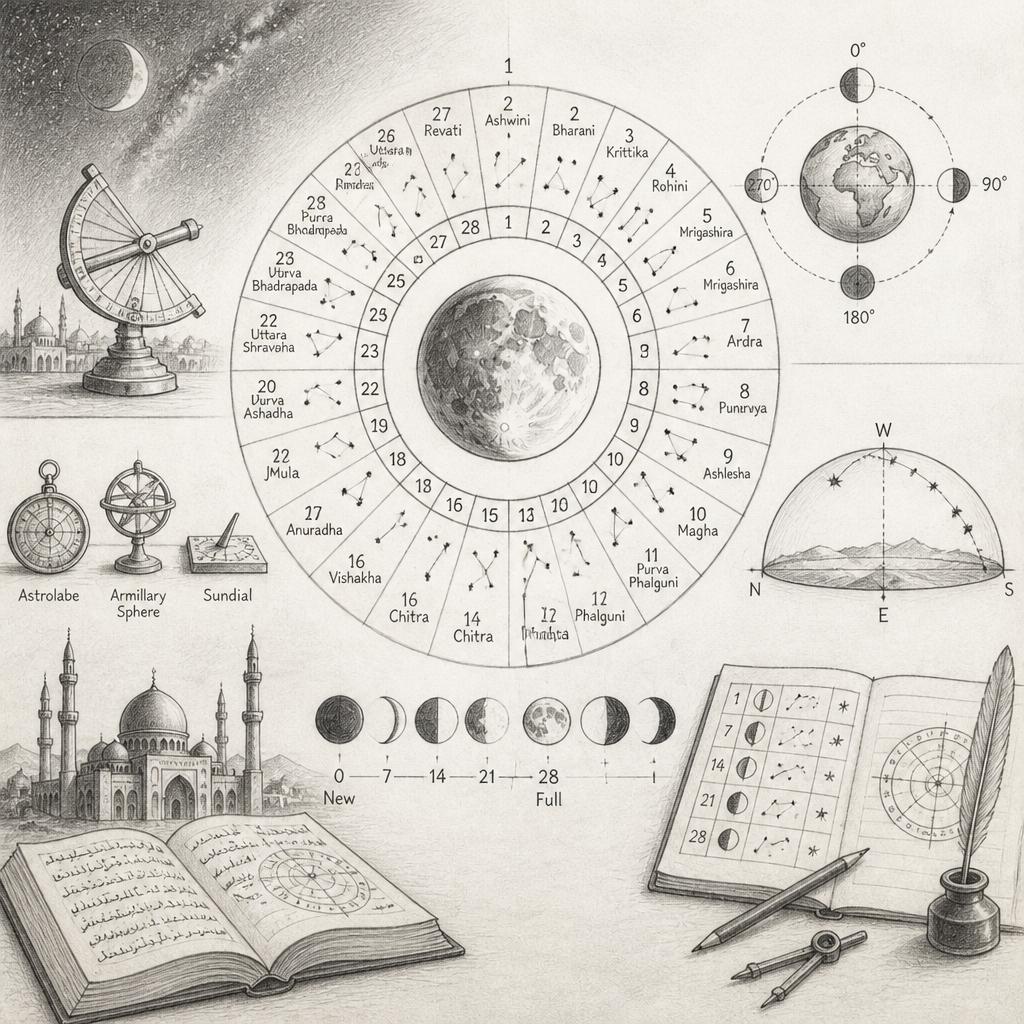
Medieval Islamic astronomers developed specialized instruments to measure celestial positions with unprecedented precision. These were engineered solutions to specific measurement problems, and many remain effective today.
The Astrolabe: Reading the Heavens
The astrolabe is perhaps the most iconic instrument of Islamic astronomy.
An astrolabe projects the celestial sphere onto a flat surface using stereographic projection, which preserves angles while flattening the sphere. The user aligns a rotating pointer (the alidade) with a celestial object, reads the angle, and uses the engraved scales and tables to solve problems.
Medieval astrolabes were precision tools, often engraved with remarkable detail. A single instrument might include multiple plates for different latitudes, and the back often carried trigonometric tables and scales for additional calculations.
Quadrants, Armillary Spheres, and Celestial Measurement
The quadrant, a quarter-circle instrument with a sighting mechanism, let observers measure the altitude of celestial objects above the horizon.
The armillary sphere, a three-dimensional model of the celestial sphere made of interlocking rings, served as both teaching tool and observational instrument.
These instruments required understanding of geometry, trigonometry, and celestial coordinate systems, and using them effectively demanded training. Yet they were precise enough that observations made centuries ago remain valuable for studying long-term changes in celestial positions.
How to Track the Moon's Position in Real Time
Tracking the Moon's current position involves understanding lunar phase, illumination percentage, and which of the 28 mansions the Moon occupies at any given moment.
Reading Lunar Phase and Illumination Data
Lunar phase describes the Moon's position relative to the Sun and Earth. At new moon, the Moon sits between Earth and Sun, invisible.
Illumination percentage quantifies phase: 0% means new moon, 50% quarter phase, 100% full moon. It increases from new moon to full moon, then decreases back over the lunar month.
Find Your Natal Moon Mansion →
Moon Mansion Calculator provides real-time illumination data, showing the exact percentage and phase at any moment. This precision matters for electional timing, where practitioners sometimes distinguish between points within a single mansion based on illumination or phase.
Identifying Your Current Lunar Mansion
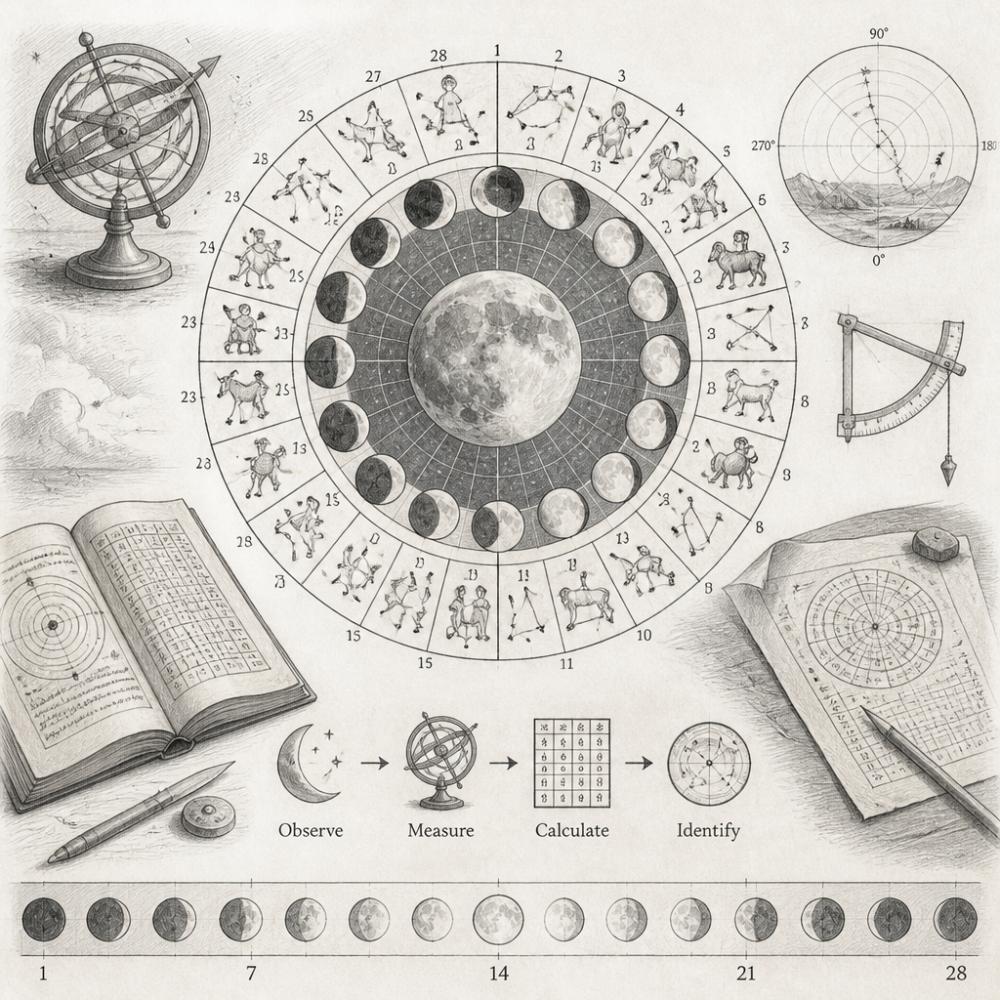
To identify the current lunar mansion, one must know the Moon's ecliptic longitude, its position along the path it traces through the sky.
Moon Mansion Calculator performs this calculation automatically, displaying the current mansion along with its precise degree position. Understanding the calculation reveals how the ancient framework translates into contemporary astronomical data.
The Moon moves through each mansion in approximately one day. Some practitioners check the current mansion daily, while others focus on specific moments: the new moon, full moon, or the Moon's return to their natal mansion.
Using a Lunar Mansion Calculator for Electional Timing
A lunar mansion calculator transforms raw astronomical data into actionable timing information, answering two questions: Where is the Moon now, and where was it when I was born?
Finding Your Natal Mansion and Return Cycles
The natal mansion is the mansion the Moon occupied at birth. Determining it requires the exact birth time, date, and location; with these, a calculator can identify the mansion.
Knowing one's natal mansion provides a reference point for tracking lunar returns, which occur when the Moon returns to the mansion it occupied at birth, approximately once per lunar month (every 27.3 days). Some practitioners mark lunar returns as moments for reflection, renewal, or activities aligned with that mansion's associations.
Moon Mansion Calculator's Natal Deep Report provides this information. Tracking lunar returns over time reveals patterns and cycles.
Planning Activities by Lunar Mansion Influence
Electional timing uses the mansions' traditional associations to choose when to begin activities. If planning a journey, one might wait for the Moon to reach a mansion linked to travel; if launching a creative project, one might time it to a mansion associated with creativity and expression.
This approach requires consulting classical references like the Picatrix to understand each mansion's associations, then monitoring the Moon's current position to identify favorable windows. Some practitioners plan weeks ahead; others adjust their schedule based on the Moon's position.
Moon Mansion Calculator's Activity Timing Advisor matches activities to appropriate mansions.
Practical Applications: From Prayer Times to Daily Planning
Islamic astronomy historically served essential practical functions: determining prayer times, calculating the Islamic calendar, establishing the qibla direction, and organizing the religious calendar. Modern practitioners apply the same system to personal timing and activity planning.
Prayer times depend on solar position, so the 28 mansions don't directly determine salah times.
For contemporary practitioners interested in lunar-based timing, the mansions provide a framework for intentional activity selection.
The generative artwork paired with each mansion in Moon Mansion Calculator serves aesthetic and mnemonic functions, reinforcing the mansion's character and making the system more memorable.
Common Beginner Questions and Clarifications
Do I need to know mathematics to use this system? No. The calculator handles all computations automatically, so a beginner can start immediately.
Can I use this system without believing in astrology? Yes. The lunar mansions represent a real astronomical system with historical significance.
Is this the same as what I might find in other lunar calculators? Different tools use different systems and calculations.
Understanding Islamic astronomy for beginners opens access to a sophisticated system of celestial observation and timing developed over centuries.
Frequently Asked Questions
What exactly are the 28 lunar mansions in Islamic astronomy?
The 28 lunar mansions are divisions of the Moon's monthly path through the sky, each spanning roughly 13 degrees. In Islamic astronomy, these mansions served both practical and spiritual purposes: they marked precise timekeeping for prayers and religious observances, and provided a framework for understanding the Moon's influence on earthly events. Each mansion has a name, associated stars, and traditional meanings that inform electional timing practices.
How can I find my natal lunar mansion?
Your natal lunar mansion is determined by the Moon's position at the moment of your birth. A lunar mansion calculator uses your birth date, time, and location to map where the Moon was positioned among the 28 mansions. This calculation requires precise astronomical algorithms to determine lunar longitude. Once you know your natal mansion, you can track when the Moon returns to that same position each month, creating a personal lunar cycle for planning and reflection.
Can I actually use Islamic astronomy for planning my daily activities?
Yes. Many practitioners use lunar mansion timing to plan activities like starting projects, making important decisions, or scheduling rituals. The Picatrix, a classical medieval text, provides specific guidance on which mansions favor which types of work. For example, certain mansions are traditionally associated with travel, others with healing or communication. By tracking the Moon's current mansion, you can align your intentions with the lunar cycle and choose timing that supports your goals.
How is Islamic astronomy different from other systems I might have heard about?
Islamic astronomy developed from Greek, Persian, and Indian mathematical traditions, but scholars of the Islamic Golden Age refined observational methods, created precise astronomical tables (called zīj), and built dedicated observatories. The system emphasizes mathematical rigor and direct observation over interpretation. Islamic astronomy also integrated with religious practice, calculating prayer times and determining the lunar calendar. This blend of precise calculation, observational astronomy, and practical application makes it distinct from purely interpretive systems.
Do I need any special equipment or knowledge to get started?
No. Modern lunar mansion calculators handle all the complex mathematics. You only need to know your birth date, time, and location. The calculator generates your natal mansion and tracks the Moon's current position across all 28 mansions. Understanding the basic concepts, what each mansion represents and how to read lunar phase data, is enough to begin. As you practice, you can deepen your knowledge by studying classical texts and observational techniques.
How accurate are lunar mansion calculations?
Modern calculators use precise astronomical algorithms based on the same mathematical models developed during the Islamic Golden Age and refined by contemporary astronomy. These algorithms account for the Moon's orbital position, Earth's axial tilt, and your geographic location. Accuracy depends on correct birth data; even small errors in birth time can shift the mansion. Reputable calculators are based on established astronomical standards and produce results consistent with historical tables and contemporary celestial observations.
What's the connection between Islamic astronomy and timing for rituals or electional work?
Islamic astronomical observation directly informed electional timing practices. Scholars documented which lunar positions and mansion influences supported specific intentions, healing, travel, communication, new beginnings. The Picatrix preserved these classical associations. By tracking the Moon's passage through the 28 mansions, practitioners can choose moments when lunar influence aligns with their purpose. This isn't superstition but a structured system based on centuries of observation and documented correlations between lunar cycles and earthly outcomes.