 how-to
How to Use Lunar Mansions for Daily Planning
Table of Contents
- What You'll Need Before You Start
- What Are the 28 Lunar Mansions?
- Step 1: Find Today's Mansion With a Lunar Mansion Calculator
- Step 2: Map Each Mansion to a Type of Activity
- Step 3: Build a Daily Planner Around the Lunar Cycle
- Best Practices for Lunar Mansion Scheduling
- Common Mistakes to Avoid
- Frequently Asked Questions
Last Updated: September 11, 2026
What You'll Need Before You Start
Learning how to use lunar mansions for daily planning takes little preparation. No astronomy background or special equipment is needed, just observation, a calendar, and a willingness to check the sky before committing to a plan.
Mansions of the Moon, a free browser-based calculator, maps the Moon's current position across the 28 lunar mansions of traditional Islamic astronomy, pairing astronomical algorithms with classical timing guidance from sources like the Picatrix.
Here is what to gather before the first session:
- A current lunar mansion calculator (browser-based is fine)
- A notebook or digital planner with space for daily notes
- A list of recurring activities worth timing: meetings, travel, creative work, rest
- Fifteen minutes once a week to review the lunar cycle ahead
That is the entire toolkit. The rest is practice.
What Are the 28 Lunar Mansions?
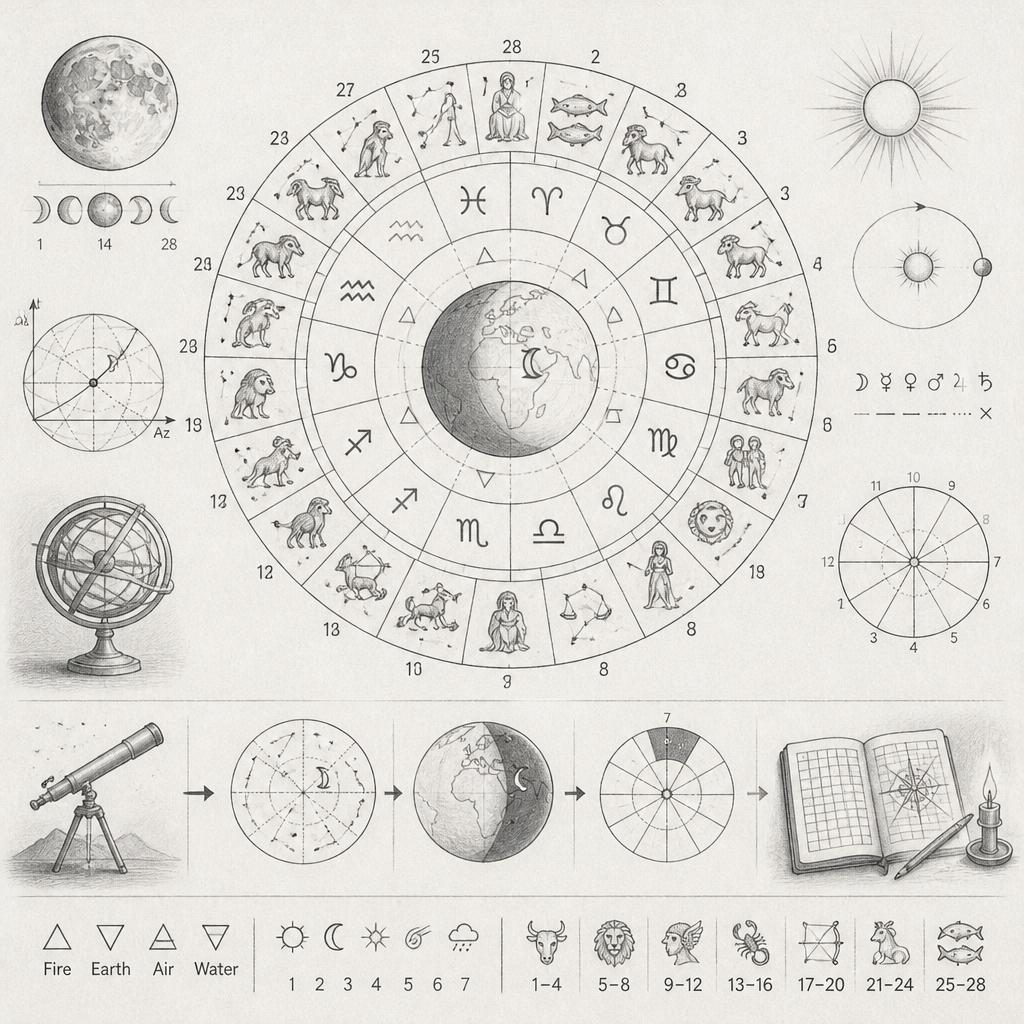
The 28 lunar mansions are unequal segments of the sky that mark the Moon's nightly progress along the ecliptic, forming a lunar station system used for timekeeping and electional timing across medieval Islamic astronomy. Each mansion carries its own character and guidance for which activities suit it.
The system belongs to a lineage of celestial mapping that includes the Arabic astronomical tradition that preserved and refined it. Where a natal chart divides the sky by season, the mansions divide it by the Moon's monthly circuit.
That difference matters for planning. A lunar mansion meaning is tied to a segment of sky the Moon occupies for roughly one day, making the system suited to daily decisions rather than year-long forecasts.
A Quick Tour of the Mansion Names
The mansion names read like a journey across the sky, each with a distinct tone. Al-Sharatain opens the cycle with beginnings and initiative. Al-Butain favors quiet groundwork. Al-Thurayya, the Pleiades station, supports bold moves and visibility. Aldebaran rewards persistence in long projects. Al-Haqa suits careful negotiation and honest dealing.
Further along, Al-Hana favors protection and steady effort, while Al-Dhira supports communication and learning. Al-Nathra opens doors to travel and exploration. Al-Tarf closes out the early mansions with themes of closure and completion.
Most practitioners start by memorizing the handful of mansions that match their most frequent activities, then expand from there.
Step 1: Find Today's Mansion With a Lunar Mansion Calculator
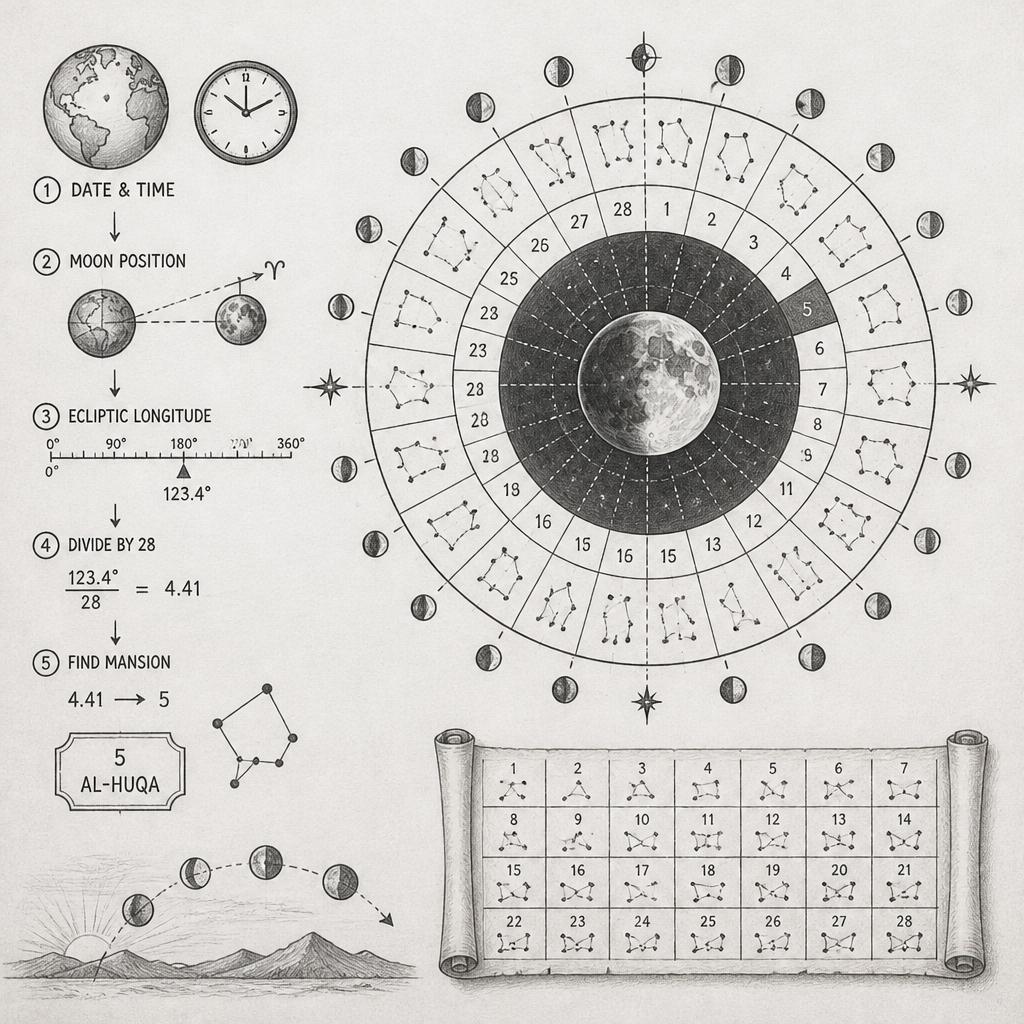
A lunar mansion calculator converts the Moon's current celestial longitude into the mansion it occupies right now. The calculation is astronomical, so the result is the same regardless of who runs it.
Open the calculator and read the current mansion number and name, the Moon's phase and illumination, and the moonrise and moonset times, the foundation of any daily plan built on the system.
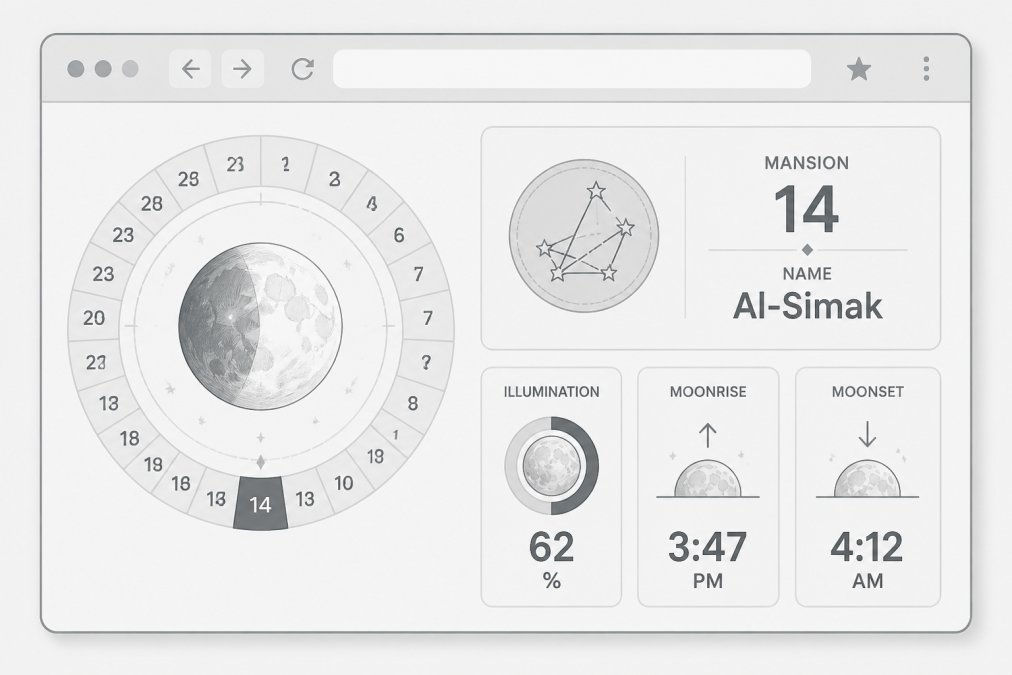
The same tool usually offers a natal mansion calculation: enter a birth date and location, and it identifies the mansion the Moon occupied at that moment. Tracking the Moon's monthly return to that mansion gives a personal rhythm worth noting.
Step 2: Map Each Mansion to a Type of Activity
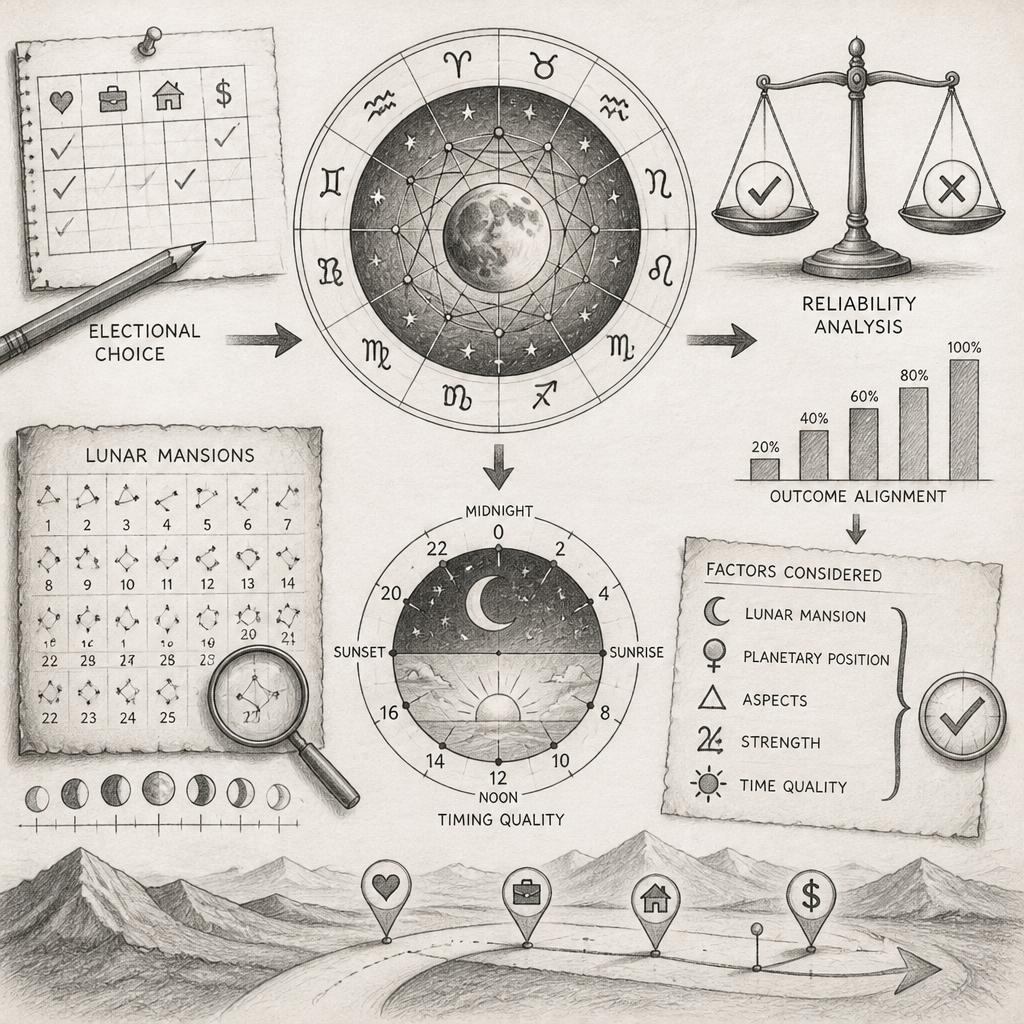
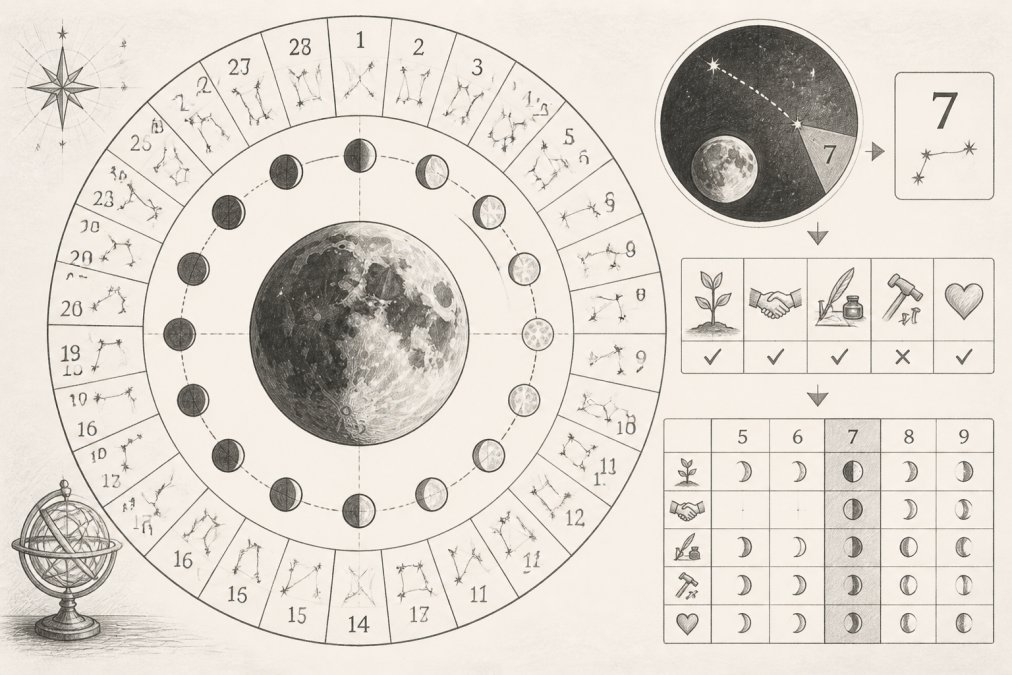
Each of the 28 mansions pairs with a traditional activity category, and daily planning is largely matching today's mansion to today's tasks. The categories fall into six groups: beginnings, travel, negotiations, rest, study, and ritual timing.
start a spiritual ritual.A workable shorthand divides the cycle into six recurring themes:
| Activity Category | Sample Mansions | Best Used For |
|---|---|---|
| Beginnings | Al-Sharatain, Al-Butain | Launching projects, first meetings |
| Travel | Al-Nathra, Al-Jabhah | Journeys, relocation, new routes |
| Negotiations | Aldebaran, Al-Haqa | Contracts, pricing talks, agreements |
| Study | Al-Dhira, Al-Nithra | Learning, research, writing |
| Rest | Al-Sarfah, Al-Awwa | Recovery, reflection, low-stakes admin |
| Ritual timing | Al-Ghafr, Al-Zubrah | Ceremony, meditation, intention setting |
The categories overlap: a travel mansion can also support a difficult conversation held far from home. The mansion sets the tone; the practitioner decides the task.
Step 3: Build a Daily Planner Around the Lunar Cycle
Building a planner around the lunar cycle means letting the mansion, not the weekday, decide what gets scheduled first. The lunar month runs roughly 29.5 days from new moon to new moon, and the Moon spends about one day in each mansion, a natural daily rhythm that maps onto a weekly planner (nasa.gov).
Review the week ahead, note which mansions fall on which days, then place high-stakes activities on mansions that support beginnings or negotiations. Move routine admin to rest mansions and reserve study mansions for deep work.
A ritual timing entry belongs in the planner too. When a mansion associated with ceremony arrives, mark thirty minutes for intention setting or meditation. That single habit turns the system from reference material into practice.
A Worked Example: One Week, Seven Mansions
Here is how a real week can be laid out once you know the mansion sequence, following the standard order used by Mansions of the Moon.
| Day | Mansion | Activity Category | What Gets Scheduled |
|---|---|---|---|
| Monday | Al-Sharatain | Beginnings | Kick off the new client project; send the first outreach email |
| Tuesday | Al-Butain | Groundwork | Gather research, draft the outline, no external commitments |
| Wednesday | Al-Thurayya | Visibility | Publish the post, pitch the podcast, take the meeting that needs an audience |
| Thursday | Aldebaran | Persistence | Push the long project forward; handle the tedious follow-ups |
| Friday | Al-Haqa | Negotiation | Contract review, pricing conversation, any honest-dealing talk |
| Saturday | Al-Dhira | Study | Deep reading, course module, writing that needs sustained focus |
| Sunday | Al-Sarfah | Rest | Recovery, low-stakes admin, weekly review |
Notice that the week does not follow a Monday-first logic. The mansion sequence sets the order, and the planner bends around it.
A Simple Daily Planning Template
- Check today's mansion number and name in the calculator
- Note the Moon's phase, illumination, and moonrise time
- List the three most important tasks for the day
- Match each task to the mansion's activity category
- Reschedule anything that clashes with the mansion's tone
- Add one ritual timing block if the mansion supports it
- Record the outcome in the evening for pattern tracking
Fifteen minutes in the morning is enough, and the pattern tracking pays off within a month.
Putting the Planner in Your Calendar App
Most people already live inside a calendar app, so the fastest way to make the system stick is to bring the mansion into that tool.
- Create a recurring daily event called "Mansion check" at the same time each morning. Fifteen minutes is enough.
- In the event description, paste the mansion name and its activity category for that day.
- Use a color label for each of the six activity categories, beginnings, travel, negotiations, study, rest, ritual timing, so the week's shape is visible at a glance.
- For any high-stakes task, add the mansion name to the task title itself, so the timing decision travels with the task.
- At the end of each lunar month, export the month's events and scan for patterns: which mansion-task pairings felt natural, which felt forced.
A simple spreadsheet works just as well: three columns, date, mansion, outcome, reveal which stations consistently deliver for you.
Mansion-Specific Do's and Don'ts
Beginners often ask for a simple rule for each mansion. The full list of 28 is worth learning slowly, but this starter set covers the mansions most people encounter first.
| Mansion | Do | Don't |
|---|---|---|
| Al-Sharatain | Start something new; make the first move | Expect quick results; rush the launch |
| Al-Butain | Gather resources; lay quiet groundwork | Force a public announcement |
| Al-Thurayya | Seek visibility; pitch; publish | Hide the work; delay the reveal |
| Aldebaran | Persist on long projects; finish what you started | Abandon a project mid-stream |
| Al-Haqa | Negotiate honestly; review contracts | Sign under pressure; bluff |
| Al-Dhira | Study; write; learn a new skill | Schedule back-to-back meetings |
| Al-Sarfah | Rest; recover; do light admin | Launch anything high-stakes |
| Al-Awwa | Reflect; journal; review the month | Make irreversible decisions |
The pattern is consistent: each mansion has a tone, and the do's and don'ts describe what fits it. Once you internalize a handful, the rest of the sequence becomes easier to read.
Best Practices for Lunar Mansion Scheduling
Best practices for lunar mansion scheduling come down to consistency, restraint, and a plan for when the mansion and the calendar disagree.
Check the mansion daily rather than weekly, because the Moon shifts stations roughly every 24 hours and a weekly review misses the transitions. Keep the plan light: flag the two or three decisions that genuinely benefit from timing and let the rest of the day run normally.
Track outcomes for at least one full lunar cycle before drawing conclusions, noting which mansion-task pairings felt natural and which felt forced.
When the Mansion Clashes With a Fixed Commitment
Most people cannot move a board meeting because the mansion favors rest, the system is a timing aid, not a veto. Separate tasks into three tiers:
- Movable high-stakes tasks, launches, pitches, negotiations, first meetings. These are the ones worth rescheduling to a supportive mansion.
- Fixed commitments, recurring meetings, deadlines set by others, travel already booked. These stay where they are; the mansion informs how you approach them, not whether they happen.
- Filler tasks, admin, email, routine follow-ups. These can absorb whatever mansion the day happens to land on.
When a fixed commitment falls on an unsuited mansion, adjust the framing rather than the date. A negotiation on a rest mansion can still go well if you listen more than you talk; a launch on a groundwork mansion can succeed as a soft opening.
Reconciling Mansion Timing With a Weekday Schedule
The mansion sequence does not align with the seven-day week, so most weeks contain at least one mansion that does not match the day's usual workload. Two habits help:
- Plan the week on the new moon. The lunar month begins there, and a single planning session at the start of the cycle lets you see which mansions fall on which weekdays before the week begins.
- Keep a rolling two-week view. Because the Moon moves through all 28 mansions in roughly 28 days, a two-week window shows you every mansion you will encounter before the next planning session (nasa.gov).
A common pattern is to front-load high-stakes work into the first half of the lunar month, when the mansions tend to favor beginnings and visibility, and reserve the later mansions for consolidation, rest, and review.
A Fallback When the Calculator Is Unavailable
The calculator is the fastest way to identify the current mansion, but two low-tech fallbacks work in a pinch:
- Track from a known anchor. If you know the mansion on a given date, you can count forward one mansion per day. The Moon spends roughly one day in each mansion, so the sequence is predictable over short spans.
- Note the moonrise time. The Moon rises roughly 50 minutes later each day, and the mansion shifts with it (timeanddate.com). A quick glance at a moonrise table gives you a rough sense of where in the cycle you are.
Neither fallback is as precise as the calculator, but both keep a daily practice going when you are away from a screen.
Common Mistakes to Avoid
The most common mistake is treating the mansion system as a rigid rulebook rather than a timing aid. The mansions describe favorable conditions, not guarantees. A negotiation held on a supportive mansion can still fail if the preparation was poor.
A second error is skipping the calculator and relying on memory. The Moon's position shifts constantly, and guessing leads to plans built on the wrong day; running the calculation takes seconds.
Conflicting information across sources is a third pitfall: some references list mansion names differently or assign different activity categories. Sticking to one consistent source, such as the 28 Lunar Mansions reference at Mansions of the Moon, keeps the system coherent.
Finally, beginners often try to learn all 28 mansions at once, which overwhelms. Mastering five mansions that match frequent activities delivers more in the first month than memorizing the full list.
Frequently Asked Questions
What are the 28 lunar mansions?
The 28 lunar mansions are segments of the sky that the Moon passes through over roughly 27.3 days, each covering about 12.8 degrees of the Moon's path. They come from classical Islamic and medieval astronomy, and sources like the Picatrix assign each mansion its own timing guidance for rituals, journeys, and beginnings. Mansions of the Moon maps all 28 with a free browser calculator, so you can see which one the Moon occupies right now.
How do I use a lunar mansion calculator for scheduling?
Open the calculator, note the current mansion, then check its traditional guidance before you commit to a task. If the mansion favors beginnings, schedule launches or first meetings. If it favors rest or reflection, move heavy negotiations to a different day. A lunar mansion calculator removes the manual math, so you can plan a week at a glance instead of checking the sky each morning.
Can lunar mansions help with productivity and time management?
They work as a timing layer on top of your existing system. Instead of forcing every task into the same schedule, you match demanding work to mansions that support it and save quieter tasks for mansions tied to reflection. The gain is not more hours; it is fewer mis-timed efforts, like pitching a client during a mansion traditionally linked to delays.
What is the difference between lunar phases and lunar mansions?
Lunar phases track how much of the Moon is lit, from new to full and back. Lunar mansions track where the Moon sits along the ecliptic, dividing its path into 28 stations. A full moon can fall in any mansion, so the two systems answer different questions: phases tell you the Moon's illumination, mansions tell you its position and the traditional timing attached to that station.
Daily planning works best when the tool behind it stays simple and reliable. Mansions of the Moon offers a free browser-based calculator with precise astronomical calculations, classical timing guidance from the Picatrix tradition, and generative artwork for each of the 28 mansions. There is no sign-up, no paywall, and no data collection. Get started with Mansions of the Moon and align your schedule with the lunar cycle.