 how-to
Is Electional Astrology Reliable for Daily Use?
Table of Contents
- What Is Electional Astrology and How Does It Work?
- Electional Astrology for Beginners: Core Principles
- Reading Your Electional Astrology Chart
- Using a Lunar Mansion Calculator for Daily Timing
- Finding the Best Time to Start a Project Astrologically
- Reliability, Evidence, and Realistic Expectations
- When Not to Wait for the Perfect Chart
- Frequently Asked Questions
Last Updated: October 15, 2026
What Is Electional Astrology and How Does It Work?
Electional astrology is the practice of selecting auspicious dates and times to begin important activities, and whether electional astrology reliable for daily decisions depends on what you expect from it.
The core principle is straightforward: timing matters. A project launched under certain celestial configurations may face more obstacles than one begun under different alignments.
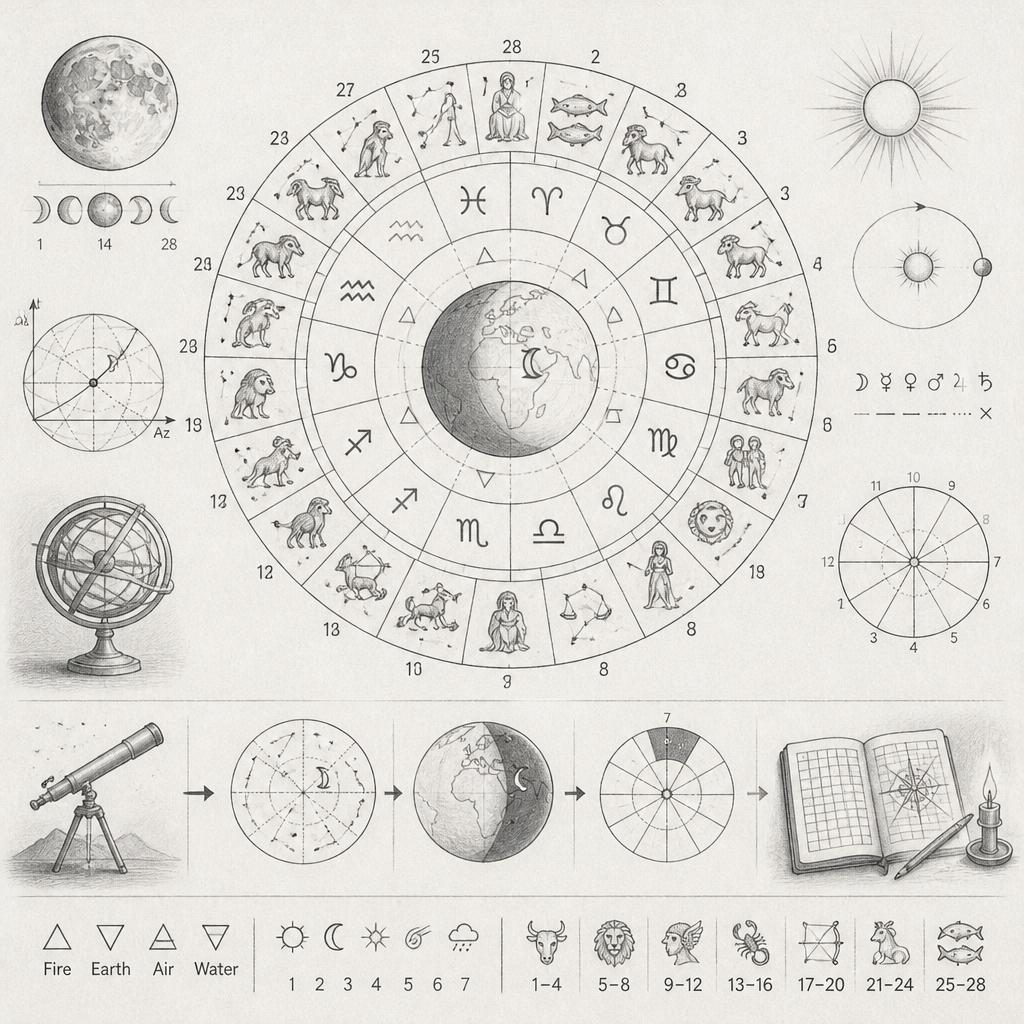
This system draws from classical Islamic astronomy and sources like the Picatrix, a medieval text pairing specific lunar positions with activities. Each of the 28 lunar mansions carries traditional associations: some support beginnings, others favor completion, travel, or spiritual work.
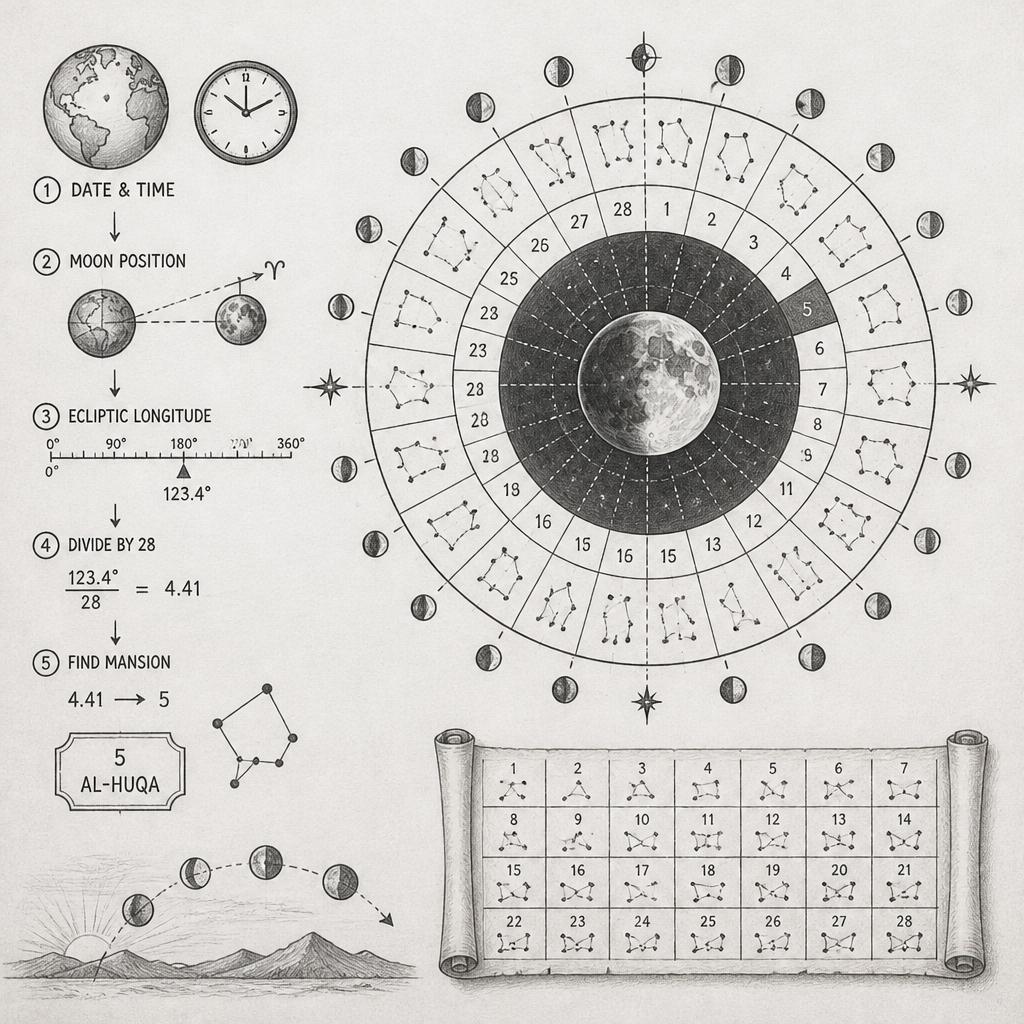
Moon Mansion Calculator brings this system into the modern era, mapping the Moon's current position across the 28 lunar mansions using precise astronomical calculations so users can plan activities accordingly.
Electional Astrology for Beginners: Core Principles
Learning electional astrology starts with the lunar mansion system, a division of the Moon's 28-day cycle into 28 positions, each with traditional meanings.
The Moon moves through one mansion roughly every day, and its influence shifts. Some mansions support launches; others favor rest or completion. Practitioners check the current mansion before starting anything significant.
Key principles include:
- Lunar phase matters. A waxing Moon (growing toward fullness) supports activities that build momentum. A waning Moon (fading toward darkness) suits completion and release.
- Planetary aspects count. Planets form angles to one another. Certain angles (called aspects) are considered harmonious, others challenging.
- The Moon's speed and strength vary. A Moon in certain positions acts more powerfully than in others.
- Intention shapes selection. The same moment may be excellent for one activity and poor for another. A time that supports launching a business may not suit a personal ritual.
Beginners often start by tracking the Moon's mansion and phase, the foundation of daily electional work.
Reading Your Electional Astrology Chart
An electional chart is a snapshot of the sky at a chosen moment.
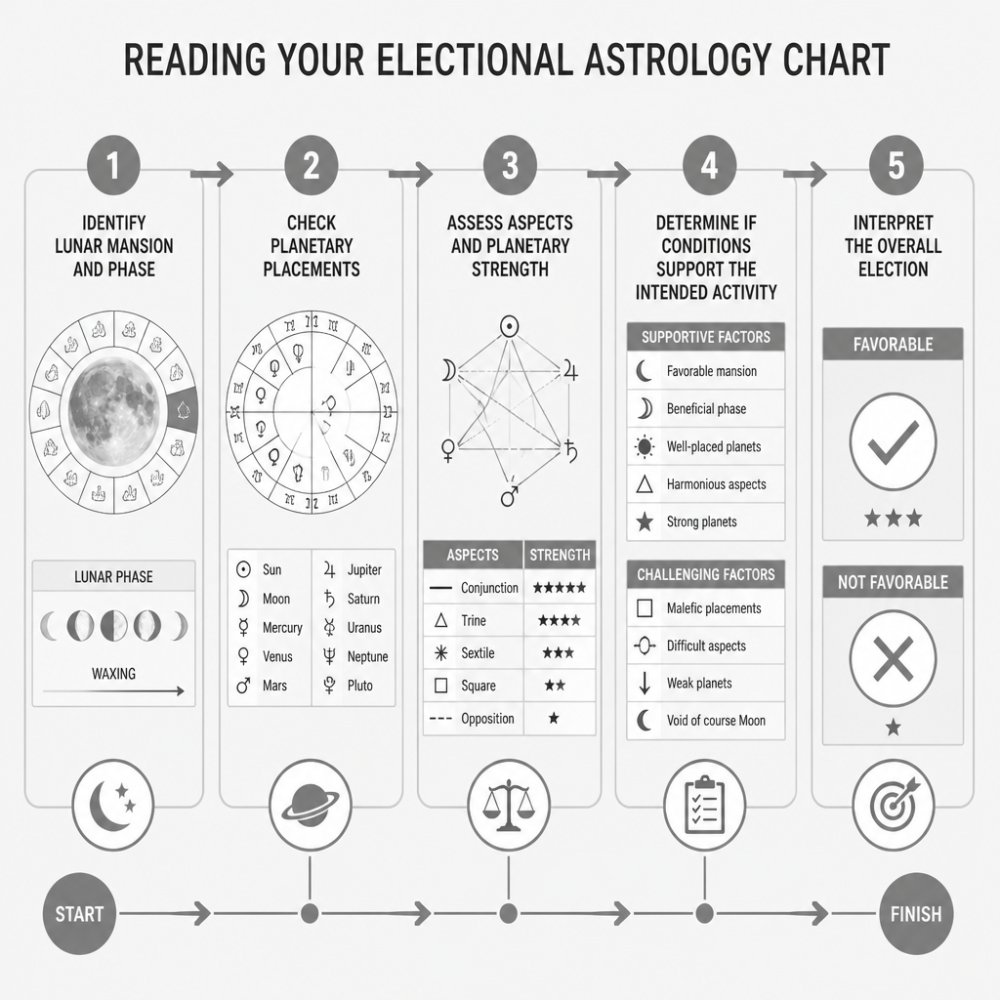
First, locate the Moon: which mansion and phase?
Next, examine planetary placements. Are the major planets in signs and houses that traditionally support the activity? A planet in a strong position reinforces the chart's favorability.
Then assess aspects, the angles planets form to one another. Harmonious aspects (trine, sextile) suggest ease; challenging aspects (square, opposition) indicate obstacles.
Finally, synthesize.
Using a Lunar Mansion Calculator for Daily Timing
A lunar mansion calculator removes guesswork from daily electional work, showing the Moon's current position and traditional meaning without tables or memorization.
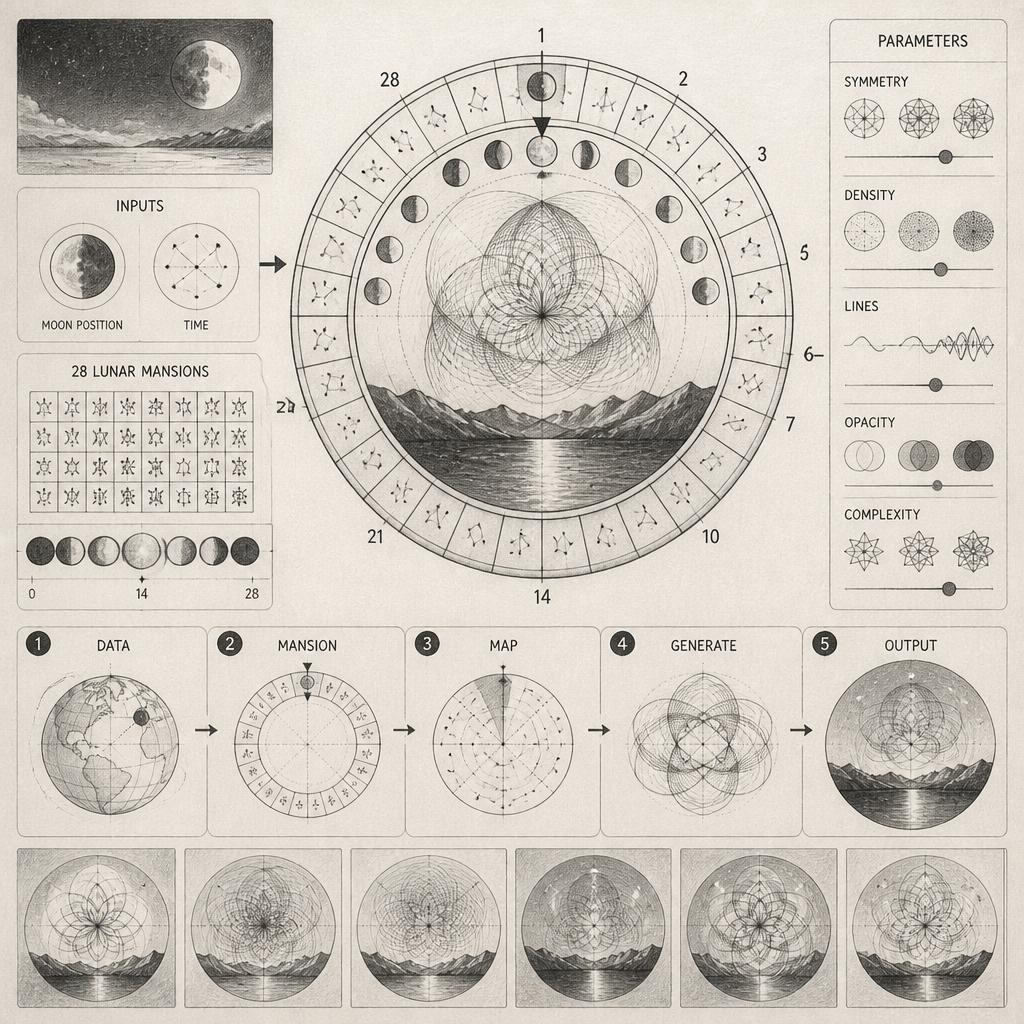
Moon Mansion Calculator shows which of the 28 mansions the Moon occupies, plus moonrise, moonset, phase, and illumination data. Each mansion pairs with unique generative artwork.
But a calculator only helps with a repeatable routine. The method below takes under two minutes and produces a clear yes, no, or adjust answer.
A Two-Minute Daily Check
- Read the current mansion and its traditional association. Before opening your calendar, note which mansion the Moon occupies and whether its classical meaning leans toward beginnings, steady work, completion, rest, or travel. This is the single most important daily signal.
- Note the phase and illumination. A waxing Moon supports building momentum; a waning Moon supports finishing, releasing, and clearing. Illumination percentage tells you how far into that arc you are.
- Check the Moon's speed and condition. The Moon moves roughly 13 degrees per day, but that rate varies. A faster Moon tends to move things along; a slower Moon tends to stall them. If the calculator shows the Moon near a sign change, treat the window as unstable.
- Match the mansion to the activity type. A mansion of beginnings rarely suits a closing task, and a mansion of completion rarely suits a launch. Mismatch is the most common reason a day feels "off" even when the phase looks right.
- Decide: proceed, adjust, or defer. If the mansion, phase, and activity align, proceed. If one factor is off, adjust the scope (start smaller, send the email instead of signing the contract). If two or more are off, defer if the task can wait.
What This Method Is Good For, and What It Isn't
This routine suits low-stakes actions: sending a proposal, scheduling a first call, starting a draft, or setting a weekly intention, actions where a small timing adjustment costs nothing and a mismatch is easy to correct tomorrow.
It is not a substitute for individualized election work on high-stakes ventures. Launching a business, signing a multi-year lease, or filing a legal claim involves many chart factors beyond the Moon's mansion.
A Worked Example
Suppose you want to send a pitch email. The calculator shows the Moon in a mansion of beginnings, waxing at roughly 40% illumination, moving at a normal rate. That is a clean yes, send it today.
Now suppose the Moon is in a mansion of completion, waning, and near a sign change. Both mansion and phase point away from fresh outreach, and the sign change adds instability.
Common Daily Mistakes
- Treating every day as equally important. Most days are fine for most routine actions. Save the careful analysis for actions that actually matter.
- Ignoring the phase because the mansion looks good. A supportive mansion paired with a waning Moon can still undercut a launch-style action.
- Checking once and forgetting. The Moon changes mansion roughly every day, so a check done Monday does not carry into Wednesday.
- Letting the check become a delay tactic. If the action is urgent or the cost of waiting is high, proceed and note the conditions rather than stalling.
The calculator runs entirely in the browser with no sign-up required, so checking the Moon's position takes seconds before a timing decision.
Integrating these mechanical lunar observations into a broader framework of spiritual guidance for everyday life ensures that your daily rhythm remains aligned with the deeper currents of the cosmos.Finding the Best Time to Start a Project Astrologically
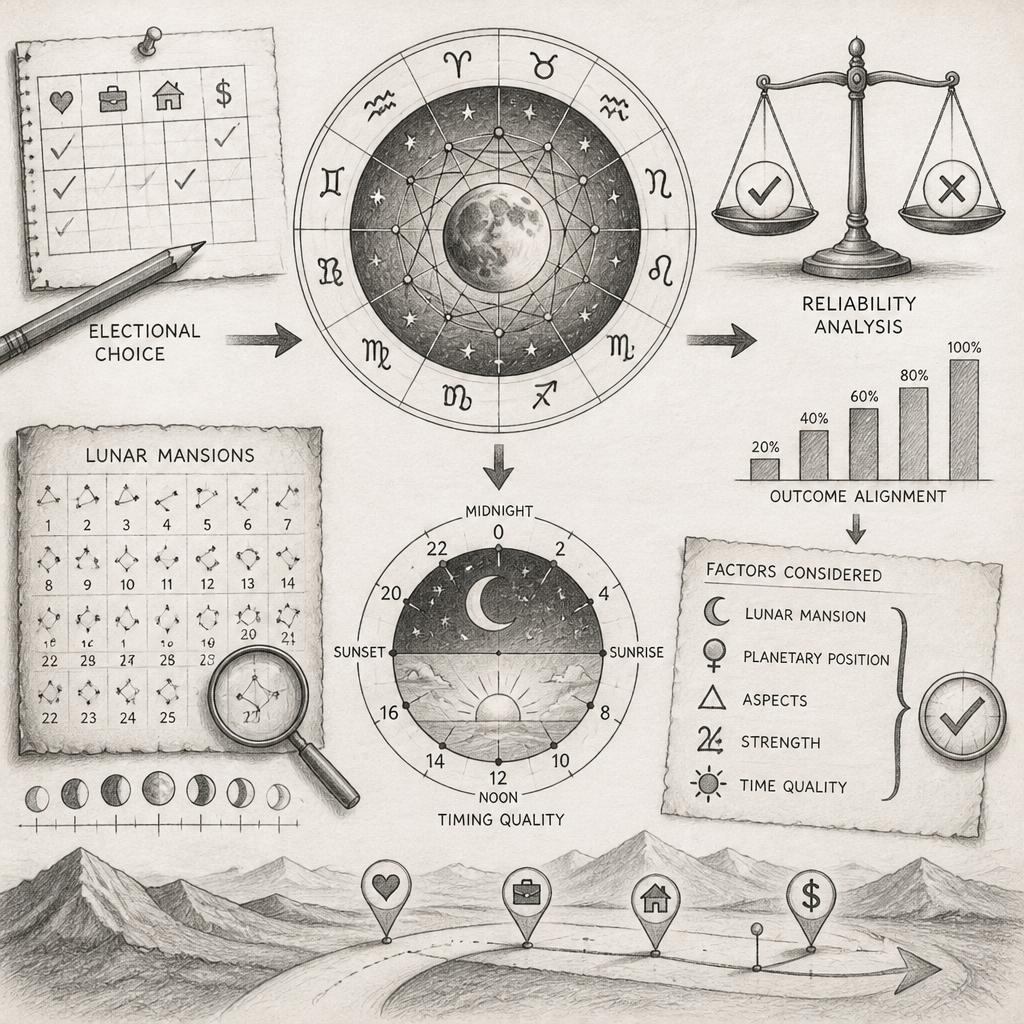
Selecting the best time to start a project involves more than the Moon's mansion, a complete electional approach considers multiple factors together.
Begin by clarifying the project's nature.
Next, scan the lunar calendar for days with the Moon in mansions favorable to the project type and supportive planetary aspects.
Find Your Natal Moon Mansion →
Then pull the electional chart for each candidate start time and study the planetary positions, aspects, and lunar phase.
Finally, trust practical judgment.
Reliability, Evidence, and Realistic Expectations
Whether electional astrology reliable for daily decisions deserves a direct answer: it is not established by scientific evidence as a predictor of outcomes, and no responsible practitioner should claim otherwise. What it offers is a structured, tradition-based framework for timing decisions, and whether that framework is "reliable" depends on what you expect from it.
What the Evidence Does and Doesn't Show
Electional timing has not been validated in controlled studies as a causal mechanism for real-world outcomes. Anyone who says a chart guarantees a result is overstating what the practice can support.
What the evidence also doesn't show is that timing frameworks are useless. Research on decision-making finds that structured routines, pausing, checking conditions, committing deliberately, improve follow-through and reduce impulsive action.
Three Ways to Read "Reliable"
Most disagreements about reliability come from people using the word differently:
- Predictive reliability, Does the chart forecast what will happen? On this standard, the answer is no. There is no scientific basis for claiming it does.
- Consistency reliability, Does the same input produce the same reading across practitioners? Partially. Classical sources agree on many mansion associations and phase rules, but interpretations of planetary condition and aspects vary between practitioners.
- Practical reliability, Does using the framework help you make more deliberate timing decisions? For many users, yes, in the same way any structured planning ritual does.
When someone says electional astrology "works for them," they usually mean the third meaning, not the first, a legitimate but different claim than the one skeptics reject.
A Personal Reliability Test
You can assess the practice yourself with a simple 30-day log:
- Record the mansion, phase, and your intended action before you act.
- Note whether you proceeded, adjusted, or deferred, and why.
- One week later, rate how the action went on a simple scale.
- Look for patterns, not proof, but patterns.
This won't establish causation. It will show whether the framework changes your behavior in useful ways, the only reliability question most daily users need answered.
Where the Practice Genuinely Helps
Even setting aside metaphysical claims, electional timing offers practical benefits:
- It forces a pause. Checking conditions before acting interrupts autopilot decisions.
- It creates intentionality. Choosing a moment for an action makes the action feel deliberate.
- It provides a shared vocabulary. Practitioners can discuss timing with a common set of references.
- It supports reflection. Reviewing why a past action felt right or wrong builds self-awareness.
None require the chart to be predictive, they are benefits of the practice, not evidence for it.
Where It Cannot Help
Electional astrology cannot guarantee success. A well-timed launch still requires planning, market fit, and execution; a project begun under favorable conditions may still face obstacles; and no timing choice substitutes for medical care, legal advice, financial planning, or safety judgment.
The most honest assessment: electional astrology provides a framework for timing decisions. It may influence outcomes at the margins through the behavior it encourages. Whether that influence is celestial, psychological, or both remains open, and a well-informed user can hold that question without dismissing the practice or overclaiming for it.
When Not to Wait for the Perfect Chart
A common pitfall is delaying necessary action while waiting for ideal conditions, which can paralyze decision-making.
Sometimes a project can wait.
Other situations demand action regardless of the chart.
In these cases, electional astrology shifts role: rather than selecting timing, it becomes a tool for understanding the conditions present.
The key is discernment. Ask: can this wait? If yes, use electional methods to find better timing.
Electional astrology offers a structured way to align timing with intention.
Frequently Asked Questions
Is electional astrology reliable for daily decisions?
Electional astrology offers a framework for timing decisions based on planetary and lunar placements, but reliability depends on how you define it. It works best as a guide that increases your awareness of timing rather than a guarantee of success. Many practitioners report improved outcomes when they align actions with favorable electional conditions, though external factors, effort, preparation, and circumstance, remain critical. Treat electional timing as one tool among many, not a substitute for practical planning.
How do you use a lunar mansion calculator for daily timing?
A lunar mansion calculator shows which of the 28 mansions the Moon currently occupies and their traditional associations. To use it daily, check the current mansion and its properties relevant to your intended activity. If you're starting a project, look for mansions associated with beginnings and growth. If you're planning communication, seek mansions linked to clarity and expression. The calculator removes guesswork by providing precise astronomical data, allowing you to plan based on classical timing principles without requiring deep technical knowledge.
How far ahead should you plan an electional chart?
For major undertakings, business launches, significant commitments, or ritual work, plan 2-4 weeks ahead when possible. This window allows flexibility to choose an optimal date and time without rushing. For daily activities and minor decisions, you can work within 1-3 days, checking the current or upcoming lunar mansion. However, life rarely permits perfect timing for everything. When circumstances demand immediate action, proceed without delay rather than missing an opportunity waiting for ideal conditions.
What's the difference between electional astrology and other astrological approaches?
Electional astrology focuses on selecting the best moment to begin an action, while natal astrology interprets your birth chart and horary astrology answers specific questions about current situations. Electional timing works forward, choosing when to act, whereas natal astrology looks at who you are and horary answers what is happening now. Each serves a distinct purpose. Electional astrology pairs well with lunar mansion systems, which provide classical timing guidance rooted in Islamic astronomical tradition.