 how-to
How to Calculate Lunar Mansions Accurately in 2026
Table of Contents
- What You Need to Calculate a Lunar Mansion
- Understanding the 28 Lunar Mansions and Their Structure
- Using a Lunar Mansion Calculator for Instant Results
- Lunar Mansion Calculation by Degree: A Step-by-Step Method
- How Long the Moon Stays in a Lunar Mansion
- Lunar Mansion Dates and Times for Accurate Planning
- Handling Time Zones, Daylight Saving, and Birth Time Uncertainty
- Verifying Your Calculations Against Ephemerides
- Frequently Asked Questions
Last Updated: October 13, 2026
What You Need to Calculate a Lunar Mansion
To calculate a lunar mansion accurately, you need three essential pieces of information: the Moon's exact position in the sky, the date and time of your observation, and your geographic coordinates. The precision of your result depends entirely on how accurate these inputs are.
Start by gathering your birth data if you're calculating a natal lunar mansion. You'll need your birth date, exact birth time (ideally to the minute), and birth location.
Moon position data comes from astronomical ephemerides, tables that track celestial bodies over time. The Moon moves roughly 12-13 degrees per day through the zodiac, which means its position changes constantly.
Geographic coordinates matter because different observers on Earth see the Moon at slightly different positions in the sky. This is called parallax. For most practical purposes, coordinates to the nearest degree work fine, but for high-precision calculations, include minutes and seconds of latitude and longitude.
Understanding the 28 Lunar Mansions and Their Structure
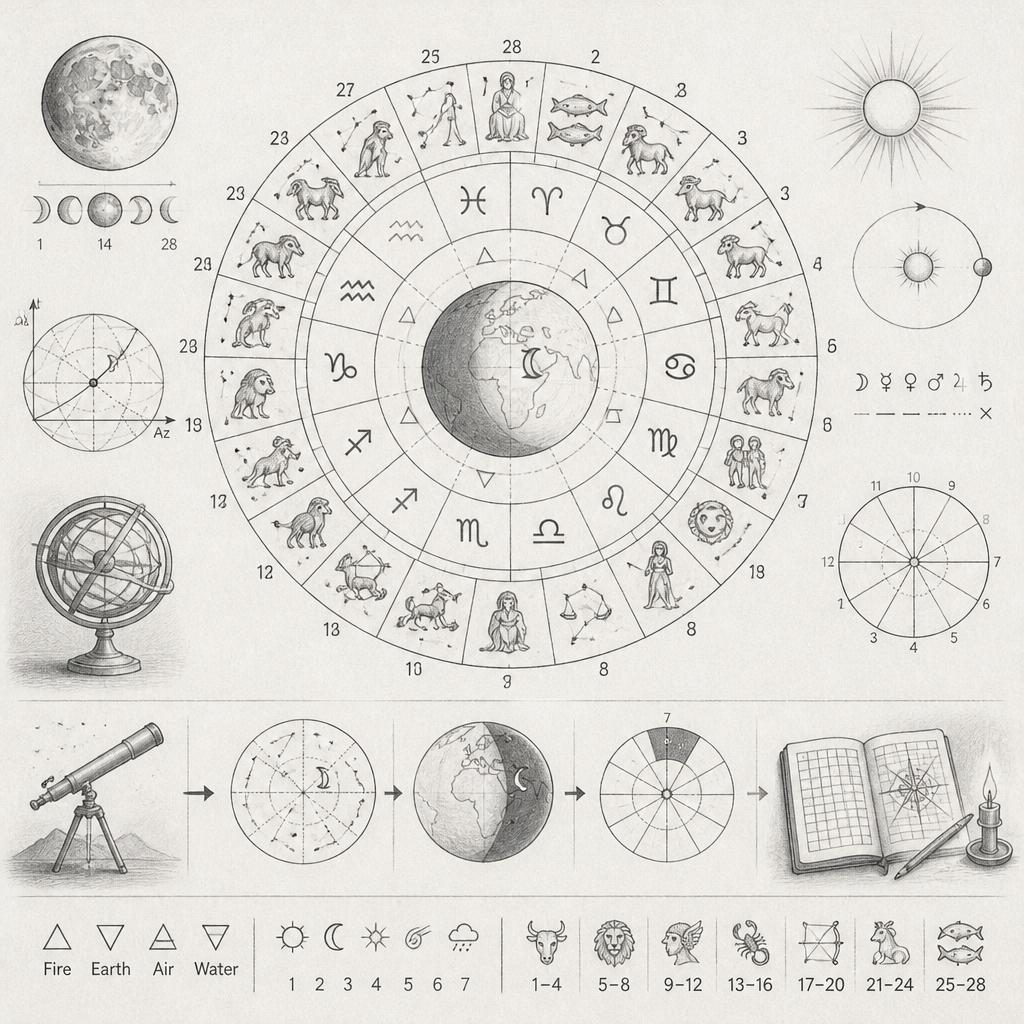
The 28 lunar mansions divide the Moon's monthly path through the zodiac into 28 equal sections. Each mansion spans roughly 12.86 degrees of the zodiac circle (360 degrees ÷ 28 = 12.86 degrees per mansion). This system comes from classical Islamic astronomy and appears in texts like the Picatrix, which describe each mansion's astrological significance and timing applications.
The mansions are numbered sequentially starting from 0 degrees Aries. Mansion 1 begins at 0° and extends to 12.86°. Mansion 2 runs from 12.86° to 25.72°, and so on. This consistent structure makes calculation straightforward once you know the Moon's exact degree position.
The naming convention uses the system from the Moon Mansion Calculator, which draws from classical sources. Each mansion carries its own character and traditional associations. Understanding the structure helps you recognize why precision matters, being off by one degree can place the Moon in a different mansion entirely.
Using a Lunar Mansion Calculator for Instant Results
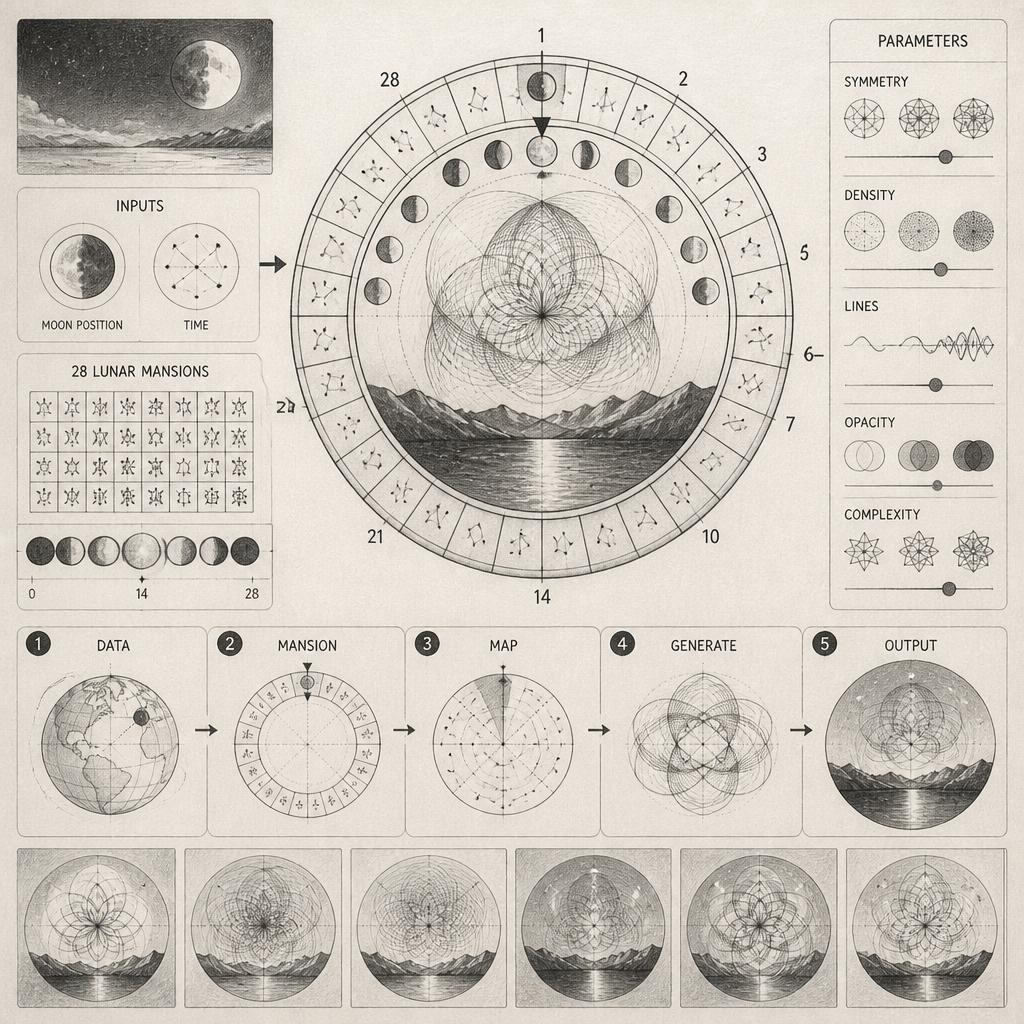
The fastest way to find a lunar mansion is to use a dedicated calculator. Moon Mansion Calculator provides a free, browser-based tool that maps the Moon's current position across the 28 mansions using precise astronomical algorithms.
The calculator handles all the complex conversions behind the scenes. It accounts for time zones, daylight saving time, and geographic coordinates automatically. This eliminates the most common sources of error in manual calculation. For someone unfamiliar with astronomical algorithms, a calculator saves hours of work and removes the risk of computational mistakes.
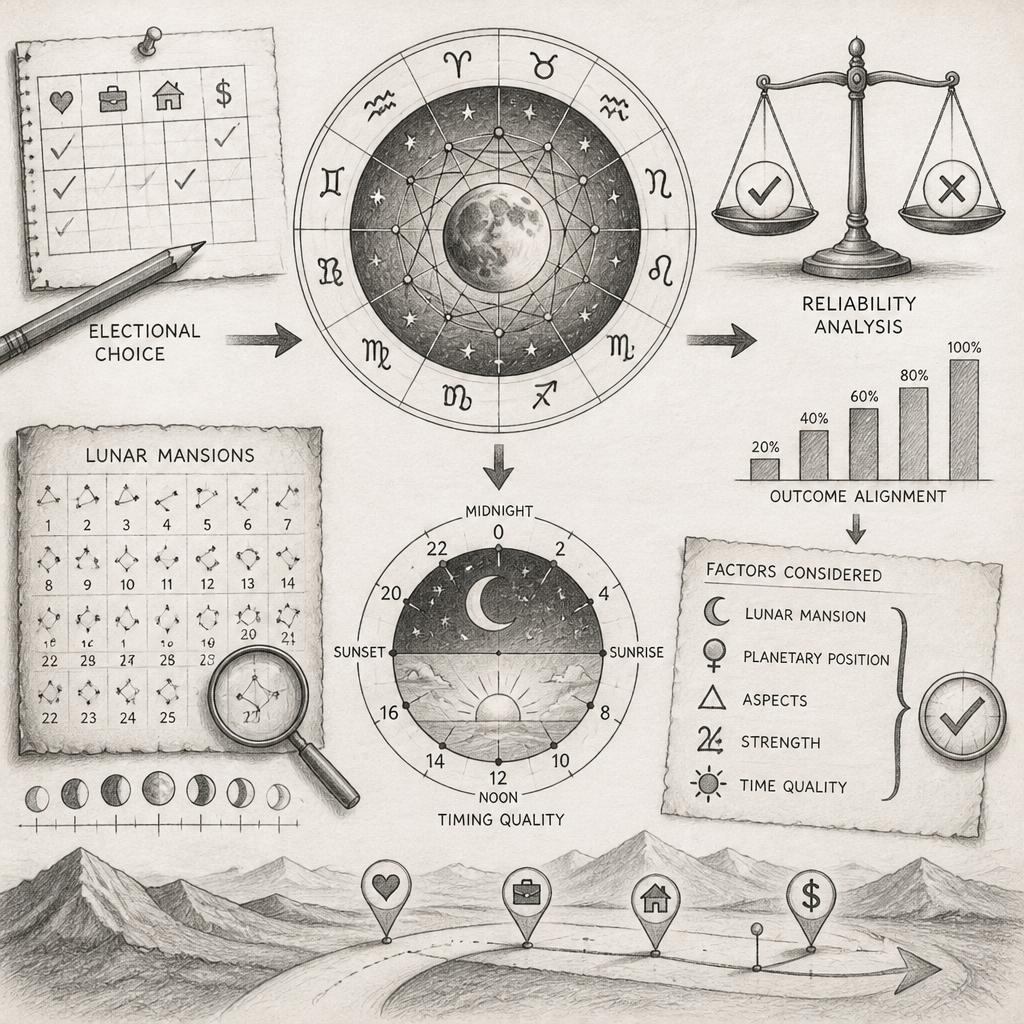
Beyond finding your natal mansion, you can use the calculator to track the Moon's current position throughout each month. This supports planning activities according to lunar electional timing principles from classical sources.
No sign-up is required. The calculations run entirely in your browser, so your data stays private. This approach makes lunar mansion calculation accessible to everyone, from complete beginners to experienced practitioners seeking a verification tool.
Lunar Mansion Calculation by Degree: A Step-by-Step Method
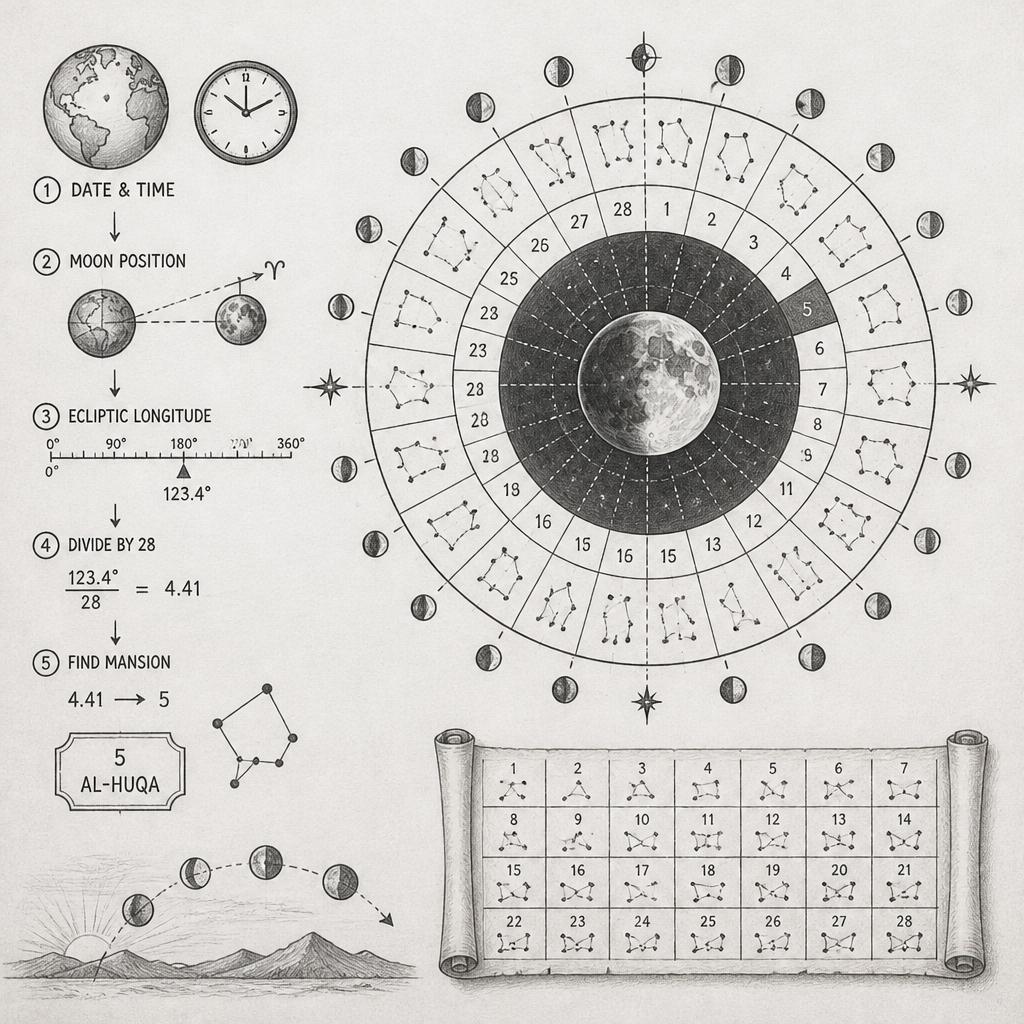
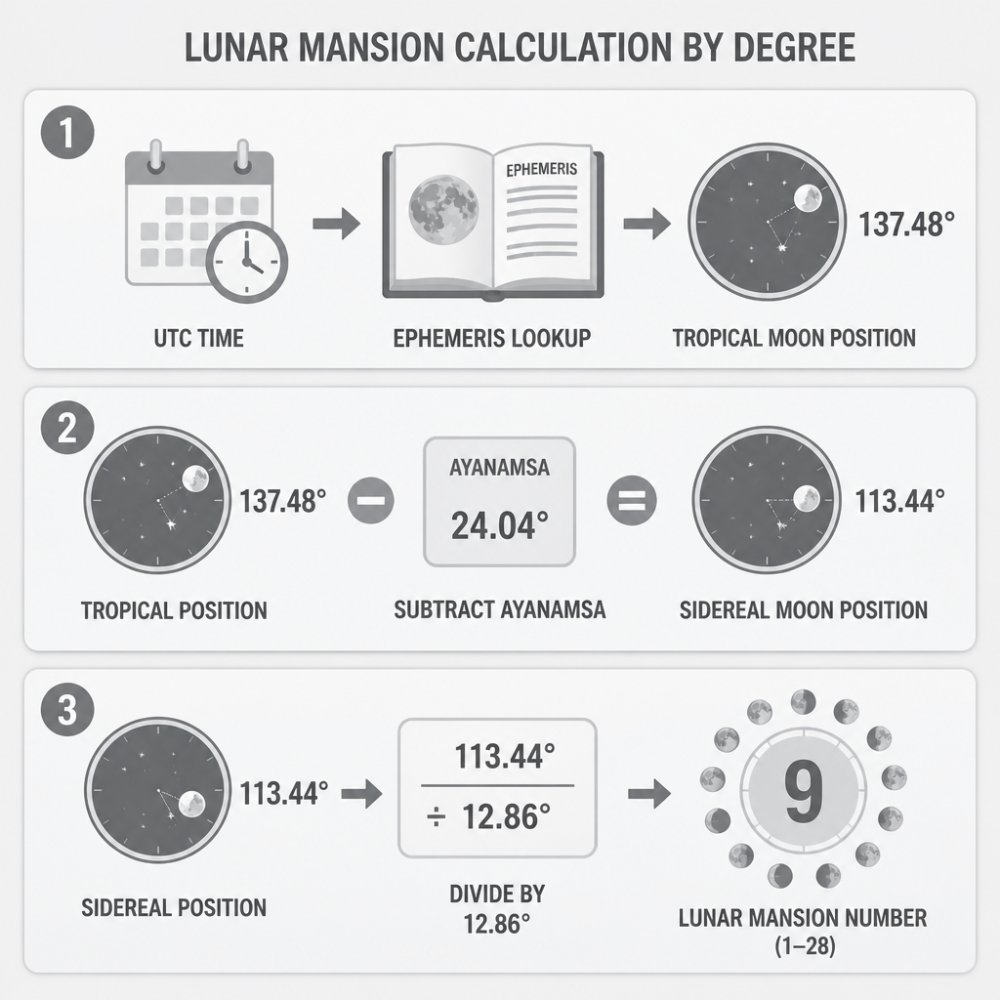
Manual calculation teaches you exactly how the system works and builds confidence in the results. The process has three core steps: determine the Moon's exact position in degrees, convert that position to sidereal coordinates, and identify which mansion contains that degree.
Step 1: Determine the Moon's Exact Position
The Moon's position changes constantly. To find it at a specific moment, you need an ephemeris, a table of celestial positions. Astronomical ephemerides list the Moon's position for each day, usually at noon or midnight UTC (Coordinated Universal Time).
Start by converting your birth time to UTC. If your birth time was 3:45 PM Eastern Standard Time, that equals 8:45 PM UTC (add 5 hours). Write this down clearly.
Next, find the Moon's position in an ephemeris for your birth date at the nearest listed time. Most ephemerides show positions at 0:00 UTC (midnight) and sometimes at 12:00 UTC (noon).
The Moon moves roughly 12-13 degrees per day. To find its hourly motion, divide the daily movement by 24 hours. If the Moon moved 12.5 degrees in one day, it moved roughly 0.52 degrees per hour. Multiply this hourly rate by the number of hours between the ephemeris time and your birth time to find the adjustment.
Step 2: Convert to Sidereal Coordinates
The Moon's position in an ephemeris is often given in tropical coordinates, which measure from the spring equinox point as it appears from Earth. Lunar mansion calculations use sidereal coordinates, which measure from a fixed point in space. The difference between these systems is called the ayanamsa.
The ayanamsa changes slowly over centuries. For 2026, the ayanamsa is approximately 24.04 degrees. To convert tropical to sidereal coordinates, subtract the ayanamsa from the tropical position.
Example: If an ephemeris shows the Moon at 15.3 degrees Aries (tropical), subtract 24.04 degrees. This gives -8.74 degrees, which is equivalent to 351.26 degrees (360 - 8.74 = 351.26). The Moon is actually in late Pisces in sidereal coordinates.
Keep track of whether your result is positive or negative. Negative results mean the position falls in the previous sign. Add 360 degrees to negative results to convert them to the standard 0-360 degree range.
Step 3: Identify the Mansion and Pada
Once you have the sidereal position, divide it by 12.86 to find the mansion number. The quotient tells you which mansion; the remainder tells you the degree within that mansion.
Example: The Moon is at 351.26 degrees sidereal. Divide by 12.86: 351.26 ÷ 12.86 = 27.31. This means the Moon is in mansion 27, at position 0.31 within that mansion (the decimal part).
Find Your Natal Moon Mansion →
Write your result clearly: "Moon in Mansion 27."
How Long the Moon Stays in a Lunar Mansion
The Moon spends approximately 2.14 days in each lunar mansion. This figure comes from dividing the lunar month (29.53 days) by the 28 mansions: 29.53 ÷ 28 = 1.05 days per mansion.
In practical terms, expect the Moon to spend between 1.5 and 2.5 days in any given mansion. This variation means the Moon doesn't enter each mansion at precisely the same time each month. Tracking the exact entry times requires consulting an ephemeris or using a lunar mansion calculator.
Understanding mansion duration helps with planning. If you want to align an activity with a specific mansion's energy, knowing when the Moon enters and exits that mansion lets you work within a predictable window. Most practitioners plan activities during the first or second day of a mansion's transit, when the Moon's presence is strongest.
Lunar Mansion Dates and Times for Accurate Planning
To plan activities aligned with specific lunar mansions, you need to know when the Moon enters each mansion in 2026. These dates and times shift throughout the year because the lunar month doesn't align perfectly with the calendar month.
The Moon enters a new mansion roughly every 2.14 days, but the exact timing depends on the Moon's orbital speed and your geographic location.
For precise dates and times, use an ephemeris or the Moon Mansion Calculator. Enter your location and the date range you're planning for, and the tool returns exact entry times for each mansion. This removes guesswork and ensures your planning aligns with actual astronomical positions.
Many practitioners create a monthly lunar mansion calendar. They list each mansion, its entry date and time, and any activities they plan to perform during that transit. This simple system keeps lunar timing front and center in daily life without requiring constant calculator checks.
Handling Time Zones, Daylight Saving, and Birth Time Uncertainty
Time zone conversions are a major source of error in lunar mansion calculations. All astronomical calculations require UTC, so you must convert your local time to UTC before looking up the Moon's position.
Eastern Standard Time is UTC-5. Pacific Standard Time is UTC-8. Mountain Standard Time is UTC-7. Central Standard Time is UTC-6. To convert to UTC, add the offset. A 3:45 PM EST time becomes 8:45 PM UTC (15:45 + 5 hours = 20:45 in 24-hour format).
Daylight saving time shifts these offsets. During daylight saving, Eastern Daylight Time is UTC-4 instead of UTC-5. Always verify whether daylight saving was in effect on your birth date. In the United States, daylight saving runs from the second Sunday in March through the first Sunday in November.
Uncertain birth times create ambiguity. If you know only the approximate time (morning, afternoon, evening), the Moon could be in any of several mansions depending on which hour within that window you were actually born.
Verifying Your Calculations Against Ephemerides
After calculating a lunar mansion, verify your result using an independent source. Cross-checking against an ephemeris or a second calculator builds confidence in your methodology and catches errors early.
Use a detailed ephemeris that lists the Moon's position for multiple times each day. Calculate the Moon's position at your birth time using your manual method, then compare it to the ephemeris value. They should match to within 0.5 degrees.
A second calculator serves the same purpose. Moon Mansion Calculator provides a verification tool. Enter your birth data and compare the result to your manual calculation. Agreement confirms your method is sound. Disagreement signals where to look for mistakes.
Keep detailed notes of your calculations. Write down each intermediate step: the ephemeris position, the UTC conversion, the ayanamsa subtraction, the division by 12.86. This trail makes it easy to spot where an error crept in if verification reveals a discrepancy.
| Verification Step | What to Check | Acceptable Tolerance |
|---|---|---|
| Ephemeris lookup | Moon position at UTC time | ±0.5° |
| UTC conversion | Time zone offset applied correctly | Exact match |
| Ayanamsa subtraction | Tropical to sidereal conversion | ±0.1° |
| Mansion calculation | Division by 12.86 and remainder | ±0.2° |
Calculating lunar mansions accurately opens a direct connection to classical timing systems.
Frequently Asked Questions
What information do I need to calculate my natal lunar mansion accurately?
You need three pieces of data: your exact birth date, your precise birth time (ideally to the minute), and your birth location (city and state). The birth time is most critical, even a 15-minute difference can place the Moon in a different mansion. If your exact time is unknown, some calculators allow you to enter a range and show all possible mansions. Location determines your time zone and geographic coordinates, which affect how the Moon's position translates to your local time.
How many degrees does each of the 28 lunar mansions cover?
Each lunar mansion covers approximately 12.86 degrees of the zodiac (360 degrees divided by 28 mansions). This means the Moon moves through one mansion roughly every 2.57 days as it orbits Earth over its 27.3-day cycle.
Why do lunar mansion calculators sometimes show different results?
Differences arise from three main sources: the ayanamsa (the offset between tropical and sidereal zodiac systems), boundary conventions (where exactly one mansion ends and the next begins), and time-zone handling. Some calculators use different astronomical algorithms or rounding methods. To verify accuracy, compare results against an ephemeris (astronomical almanac) or multiple independent calculators to identify which system aligns with your preferred classical source, such as the Picatrix.
How can I use lunar mansion timing in my daily life?
Track the Moon's current mansion using a lunar mansion calculator and plan activities aligned with each mansion's traditional significance. For example, certain mansions are considered auspicious for beginnings, travel, or relationship work, while others support introspection or completion. Check the current mansion before starting a project, journey, or ritual. Many practitioners also calculate their natal mansion and track when the Moon returns to it each month for personal insight and timing guidance based on classical sources like the Picatrix.