 how-to
Islamic Astrology for Beginners: Too Technical?
Table of Contents
- Why Islamic Astrology Feels Technical at First
- The Real Barriers Beginners Face
- What Makes It Simpler Than It Looks
- Understanding the 28 Mansions of the Moon
- Lunar Mansions for Beginners: A Practical Starting Point
- Observational vs. Predictive: What Beginners Actually Need to Know
- How to Use Moon Phase for Personal Growth
- Common Mistakes Beginners Make with Islamic Astrology
- Tools and Resources That Lower the Learning Curve
- Conclusion
- Frequently Asked Questions
Last Updated: September 13, 2026
Why Islamic Astrology Feels Technical at First
Islamic astrology is the study of how the Moon and planets move through the sky, read through classical Islamic astronomy and its 28 lunar mansions. This guide from Mansions of the Moon answers a question beginners ask constantly: is Islamic astrology too technical for someone starting out? No, provided you separate two things that get tangled together.
The first is observation: where the Moon sits tonight, which mansion it occupies, and how much light it throws. That part is astronomy, and it is straightforward. The second is interpretation: what classical sources say a given mansion favors, and how practitioners apply that to timing decisions.
Beginners stumble because they try to learn both at once, from texts written for people who already knew the sky. Start with the sky.
The Real Barriers Beginners Face
The biggest barrier is vocabulary, not mathematics. Terms like ghayb (the unseen), ijma (scholarly consensus), and Ilm al-Nujum (the science of the stars) appear in nearly every classical text without explanation. A reader who does not know that Ilm al-Nujum covers both observation and prediction will assume the whole field is beyond them.
A second barrier is the source material. The Picatrix, a medieval compendium of timing guidance, assumes fluency in astronomical tables most modern readers have never seen. Reading it cold feels like opening a manual for a language you do not speak.
The third barrier is genuine: predictive astrology and observational astronomy use overlapping vocabulary for different purposes. Mixing them up makes the subject feel twice as hard as it is.
What Makes It Simpler Than It Looks
The reputation for difficulty comes from the interpretive layer, not the observational one. Once you separate them, the technical load drops sharply. Here is the arithmetic a beginner actually works with.
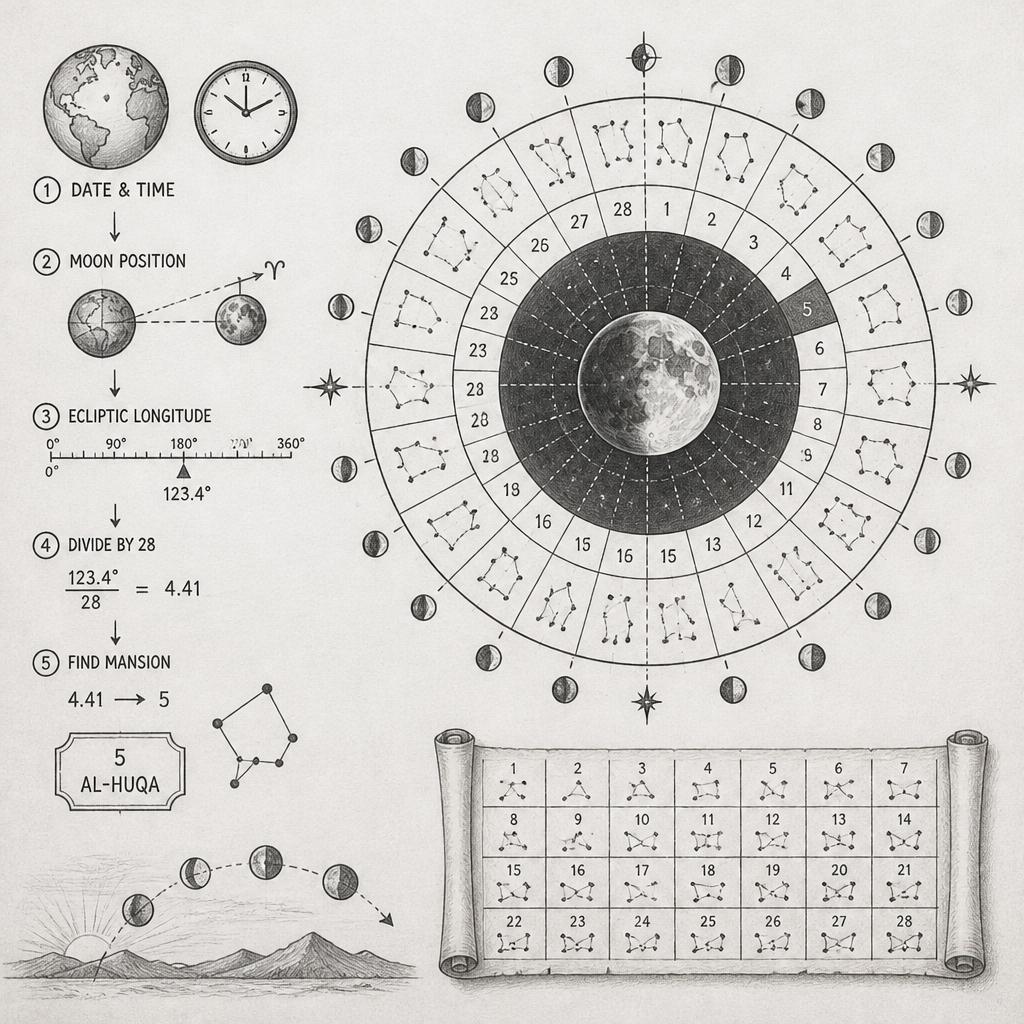
The Moon completes a full circuit against the fixed stars in about 27.3 days. Divide that into 28 unequal segments and the Moon spends roughly 23 to 24 hours in each. That is the whole clock. You are not calculating ephemerides by hand or memorizing hundreds of rules, you answer one question, which segment the Moon is in right now, then read one line of commentary about it.
Compare that to what a beginner actually fears. The fear is usually that the subject requires:
- Spherical trigonometry. It does not. Mansion boundaries were historically derived from star positions, but a calculator or reference table does that work for you.
- Arabic fluency. It does not. Transliterated mansion names and English-language references are enough to start.
- Chart construction. Not for the observational half. Casting a full chart is a separate skill, not required to identify the current mansion.
- Years of memorization. Not for a working baseline. Most beginners can name the current mansion and its character within a week of daily checking.
The sources feel dense because they were written for readers who already had the sky memorized. A medieval author could assume his reader knew which stars rose at dusk in a given season. You cannot, so you start with a tool that gives the position directly and work backward into the text.
A useful mental model: the 28 mansions are a ruler, and the Moon is a moving mark along it. The ruler does not change. Only the mark moves. Once you can read the mark, the commentary attached to each position becomes a lookup rather than a puzzle.
The system is also self-contained. You do not need planetary tables, house systems, or aspect calculations to use the mansion cycle for timing, those belong to other layers. The mansion cycle stands on its own, which is why it is the most common entry point for people starting from zero.
Understanding the 28 Mansions of the Moon
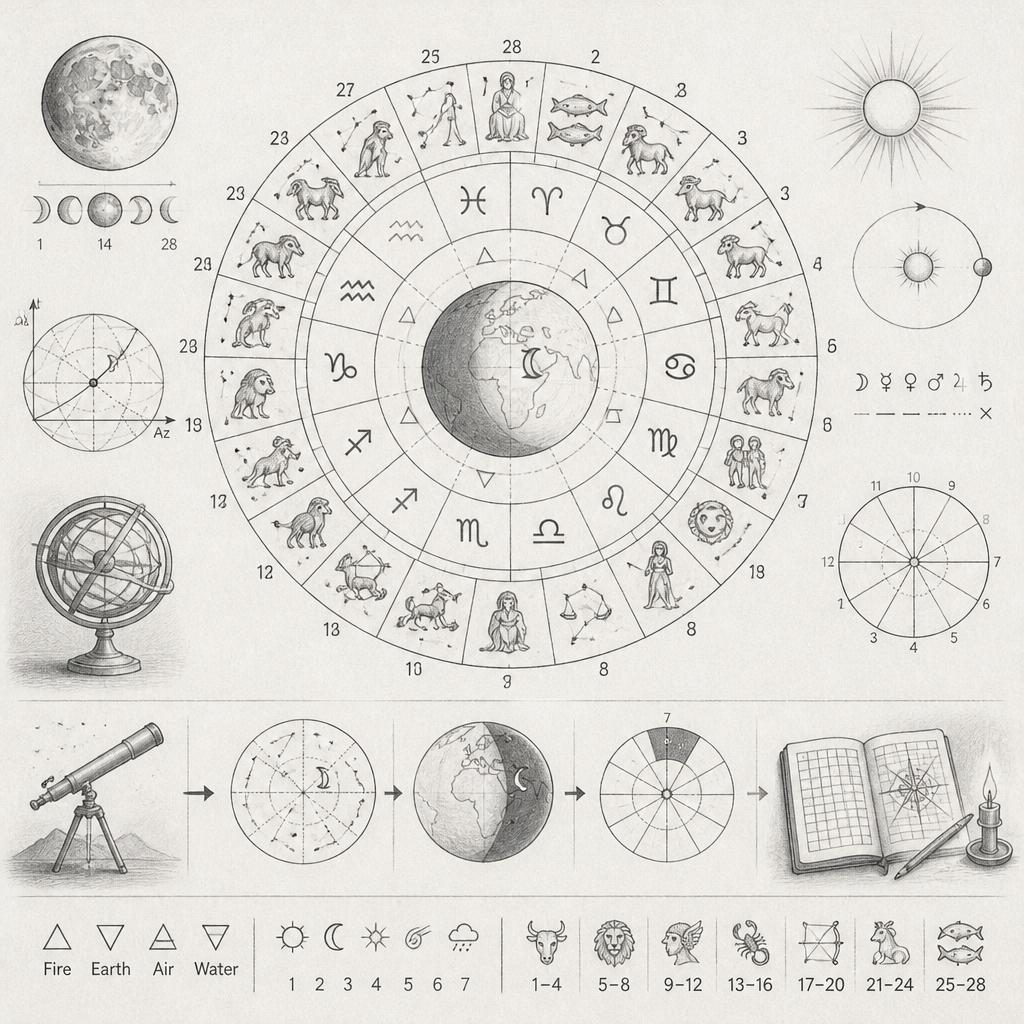
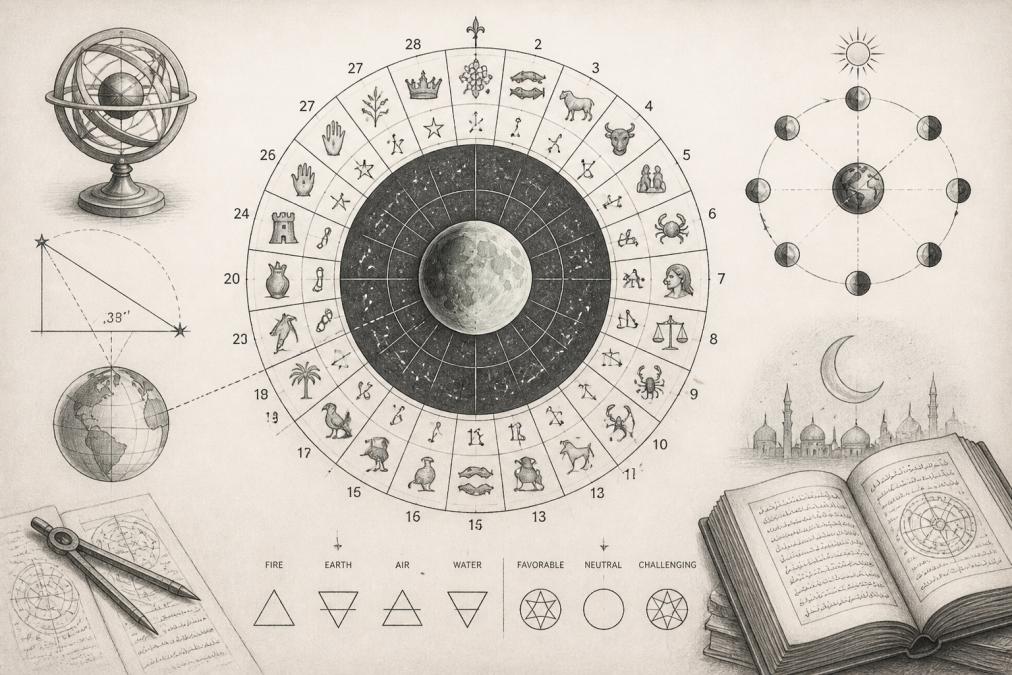
The 28 lunar mansions are segments of the sky that mark the Moon's nightly position, each traditionally associated with specific activities and timing guidance. The system predates Islam and was absorbed into Islamic astronomy as a practical tool for scheduling journeys, beginnings, and rituals.
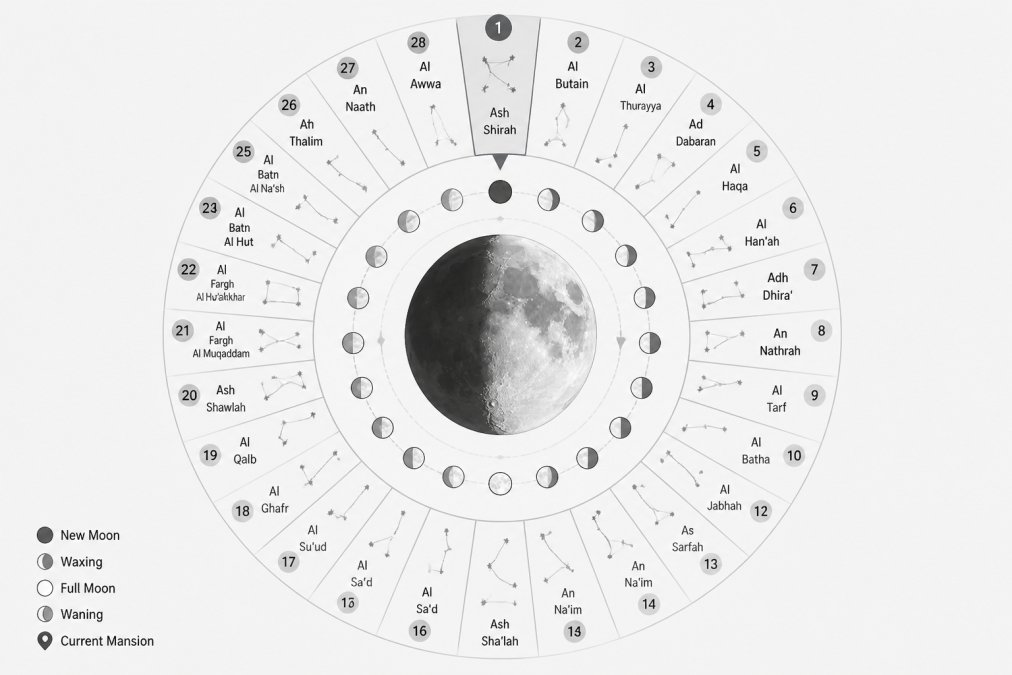
Each mansion carries a distinct character in classical sources: some favor travel, others planting, others retreat and reflection. The names matter less than the pattern, the Moon's position tells you which mansion is active, and the mansion tells you what the tradition associates with that window.
The Encyclopaedia Britannica entry on lunar mansions notes that the 28-mansion system appears across multiple cultures, with regional variations in naming and interpretation. The Islamic version, preserved through Arabic astronomical texts, is the lineage most modern practitioners work from.
Lunar Mansions for Beginners: A Practical Starting Point
For beginners, the practical entry point is a single question: which mansion is the Moon in right now? Everything else follows.
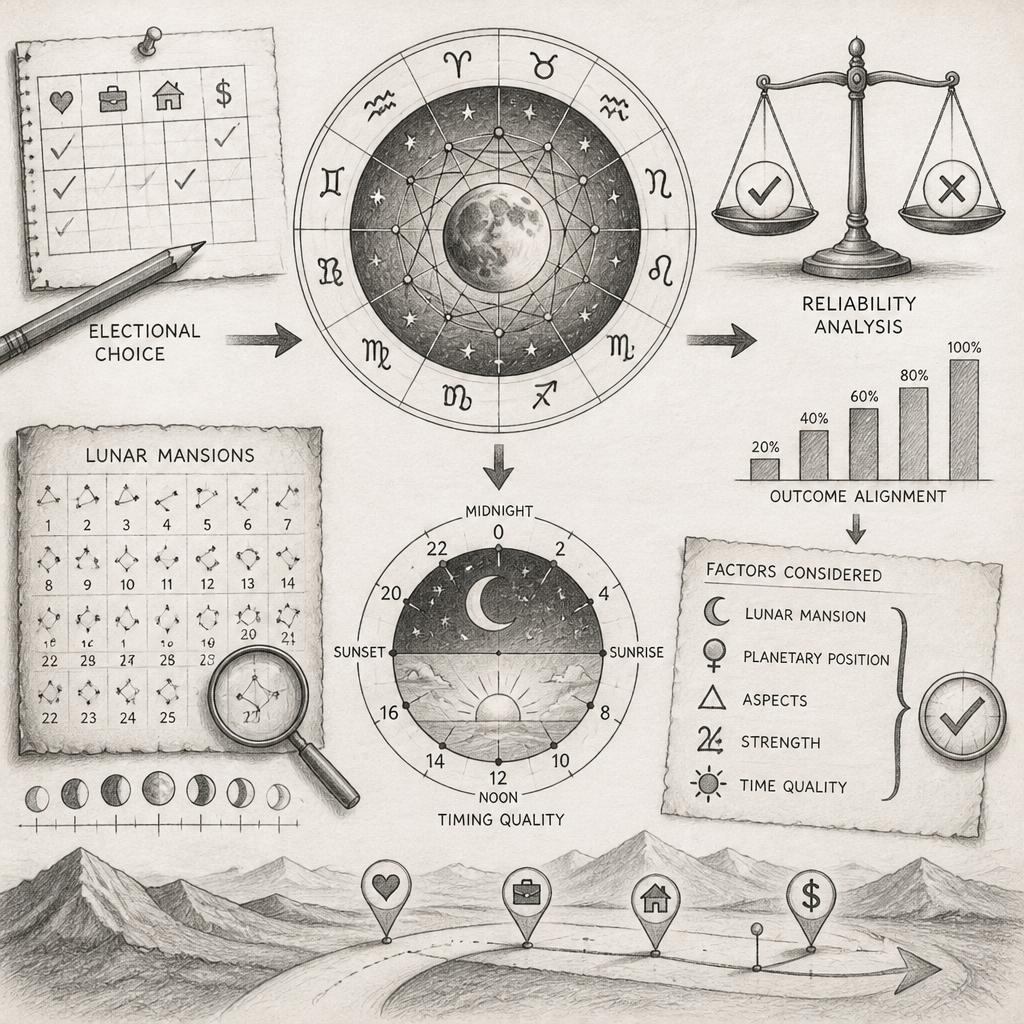
A workable starting sequence looks like this:
- Identify the Moon's current mansion using a calculator or reference table
- Note the mansion's traditional character in a single sentence
- Compare that character against what you were already planning to do
- Record the outcome over several cycles to build your own reference
That fourth step is where most beginners quit, and where the system becomes genuinely useful. A month of notes teaches more than a year of reading.
NASA's moon phase and libration data provides the underlying astronomical information, which is worth checking against any calculator you use. If the moon phase and position data match an independent source, the tool is doing its job.
Observational vs. Predictive: What Beginners Actually Need to Know
This distinction decides whether the subject feels manageable or overwhelming, and most beginner guides skip the mechanics. Here is the difference in plain terms.
Observational work answers a positional question: where is the Moon, and what is it doing? The inputs are date, time, and location; the outputs are the Moon's mansion, phase, illumination percentage, and rise and set times. Every output is verifiable against an independent source. If two calculators disagree, one is wrong, and you can find out which.
Predictive work answers an interpretive question: given that position, what does the tradition associate with it? The inputs are the mansion and your context; the output is a recommendation or characterization, not a measurement. It cannot be checked against an ephemeris because it is not a claim about where anything is. This interpretive framework relies on qualitative associations rather than physical mechanics, much like the symbolic resonance explored in crystal healing basics.
The two share vocabulary, which causes most beginner confusion. The word for a mansion's "influence" in a classical text can describe either a physical property of the sky or an interpretive association, and the surrounding sentences are often the only clue which one is meant.
For a beginner, the practical rule is this: master the observational layer completely before touching the interpretive layer. The observational layer has a fixed, learnable scope. The interpretive layer is open-ended and grows with the tradition you study.
A concrete way to tell which layer you are working in:
| Question you are asking | Layer | Can it be verified independently? |
|---|---|---|
| Which mansion is the Moon in tonight? | Observational | Yes, against any ephemeris |
| What time does the Moon rise? | Observational | Yes |
| What phase is the Moon in? | Observational | Yes |
| What does this mansion favor? | Interpretive | No, it is a tradition-specific association |
| Should I start a project now? | Interpretive | No |
If you are stuck on a question in the bottom half of that table before you are comfortable with the top half, you have skipped a step. Go back to the position data.
This matters for the "too technical" question because the observational layer is genuinely easy, a few minutes a day, while the interpretive layer is where the years go. Beginners who conflate them assume the whole subject carries the interpretive layer's difficulty. It does not. The entry point is the easy half, and the easy half is enough to get real use out of the system.
How to Use Moon Phase for Personal Growth
Using the moon phase for personal growth means aligning your planning with the lunar cycle rather than fighting it. The waxing phase, as the Moon's light increases, is traditionally associated with beginnings and outward activity. The waning phase suits completion, release, and reflection.
A simple practice: pick one recurring task, such as starting a project or reviewing your week, and schedule it by phase rather than calendar date. Track whether the timing changes how the task feels or goes.
Pew Research Center's survey data on alternative spiritual practices shows that personal-growth practices tied to natural cycles have grown steadily among adults who describe themselves as spiritual but not religious. The lunar cycle fits that pattern well because it is observable, regular, and requires no institutional framework.
Common Mistakes Beginners Make with Islamic Astrology
The first mistake is treating the tradition as fortune-telling. Classical Islamic astronomy distinguished between observing celestial bodies and claiming to know the ghayb, the unseen. Beginners who expect predictions of specific events will be disappointed and will misread the sources.
The second mistake is skipping the observation step. Reading about mansion meanings without ever checking the actual Moon position turns a practical system into abstract trivia.
The third mistake is source-hopping. Pulling one mansion name from one translation, a meaning from another, and a timing rule from a third produces contradictions that make the system look unreliable. Pick one lineage and stay with it long enough to understand its internal logic.
Tools and Resources That Lower the Learning Curve
The right tool removes most of the technical friction. A lunar mansion calculator showing the current mansion, moonrise and moonset, phase, and illumination turns the observational half of the practice into a single glance.
Mansions of the Moon offers a free browser-based calculator that maps the Moon's current position across the 28 lunar mansions, with no sign-up required. It pairs each mansion with original generative artwork, giving beginners a visual anchor for an otherwise abstract system, and provides traditional timing guidance drawn from classical sources, so you see both the position and the associated recommendation in one place.
For those who want to go further, a Natal Deep Report maps the mansion the Moon occupied at birth, and a Compatibility Report compares natal mansions between two people. Both build on the same observational foundation rather than requiring new technical knowledge.
| Beginner Need | What Helps | Why It Matters |
|---|---|---|
| Identify the current mansion | A live calculator | Removes the need to read astronomical tables |
| Understand mansion character | One consistent reference source | Prevents contradictory interpretations |
| Track personal patterns | A simple written log | Builds familiarity through observation |
| Go deeper over time | Natal or compatibility reports | Extends the same system to personal timing |
Conclusion
The technical reputation of Islamic astrology comes from its texts, not its practice. A beginner who learns to identify the Moon's current mansion and observes the cycle for a few months will understand more than someone who reads the Picatrix cover to cover without ever looking up.
Mansions of the Moon was built for exactly that entry point: a free browser-based calculator showing the current mansion, moonrise, moonset, phase, and illumination data, with no sign-up and no background in Islamic astronomy required. Each of the 28 mansions comes with its own generative artwork, and the classical timing guidance sits alongside the calculation rather than behind it. Get started with Mansions of the Moon and let the first month of observation teach you what the sources mean.
Frequently Asked Questions
Is it haram to study Islamic astrology?
Islamic jurisprudence distinguishes between observational astronomy and predictive practices. Studying celestial bodies to understand timekeeping and lunar phases is generally accepted. However, using celestial positions to predict future events or claim knowledge of the unseen (ghayb) is considered by many to be outside the scope of traditional Islamic scholarship. Learning lunar mansion timing for practical planning falls into the observational category.
Can beginners learn lunar mansion timing without a math background?
Yes. Modern digital tools handle all the astronomical calculations for you. You do not need to compute planetary positions or memorize complex formulas. What matters is understanding what each mansion represents and how to apply that timing to your daily activities. Start by tracking the moon's current mansion for a few weeks and noting how it aligns with your plans.
What is the difference between observational and predictive Islamic astrology?
Observational astronomy focuses on tracking celestial bodies for timekeeping, navigation, and calendar purposes. Interpretive practices attempt to provide guidance for activities based on celestial positions. The first is a scientific heritage studied throughout the Islamicate world. The second involves interpretation of traditional sources and faces more theological debate. Beginners interested in lunar mansions are engaging with the observational tradition.
How do I start using lunar mansions for personal growth?
Begin by identifying the moon's current mansion each morning using a reliable calculator. Note the traditional guidance associated with that mansion, such as whether it favors beginnings, travel, or reflection. Over time, track how your activities align with these periods. Many practitioners also calculate their natal mansion to understand their personal lunar return cycle, which adds a layer of self-awareness to the practice.