 how-to
Using Moon Phase for Personal Growth: A 2026 Guide
Table of Contents
- Why the Lunar Cycle Works as a Growth Framework
- Mapping Your Personal Growth to the 8 Moon Phases
- How to Track Lunar Cycles for Productivity
- Simple Moon Phase Manifestation Rituals That Stick
- Using a Lunar Mansion Calculator for Deeper Timing
- Troubleshooting Stagnation: When the Cycle Feels Stuck
- Your First Lunar Month: A Step-by-Step Plan
- Conclusion: Let the Moon Set the Rhythm
- Frequently Asked Questions
Last Updated: September 6, 2026
Using moon phase for personal growth is a method of aligning your intentions, actions, and reflections with the natural rhythm of the lunar cycle. Rather than treating each month as a blank slate, this framework gives you a built-in schedule for when to start projects, push forward, and step back. Below, we show you exactly how to use each phase without needing a background in astronomy or astrology.
Why the Lunar Cycle Works as a Growth Framework
The lunar cycle works as a growth framework because it mirrors the natural arc of any project: beginning, building, peaking, and releasing. Most goal-setting systems ask you to maintain the same energy level for 30 days, which is unrealistic. The Moon gives you permission to vary your intensity.
Psychologically, this aligns with the body's own rhythms (peer-reviewed research). Many practitioners find their energy levels naturally ebb and flow over a roughly 29.5-day period, a pattern observed across cultures for millennia. The key insight is that you are not fighting your natural state; you are working with it. This is a framework for time management and self-awareness, not a belief system.
Mapping Your Personal Growth to the 8 Moon Phases
To use the lunar cycle effectively, understand that the 8 phases divide into two clear halves: an expansive arc and a contractive one. The first half is for planting and building; the second half is for reviewing and releasing. Most guides stop at the New and Full Moon, but the intermediate phases are where the real work happens.

New Moon to First Quarter: Planting Seeds
The New Moon is the dark sky of the month, a time for intention setting and defining what you want to grow. This is when you write down your goals and commit to a single focus. In the days that follow, the Waxing Crescent asks for small, consistent actions.
As the Moon grows toward the First Quarter, you will hit your first obstacle, the moment of friction where many people quit. The First Quarter Moon is a call to make a decision and push through resistance. This is where you build momentum through discipline rather than motivation.
Full Moon to Last Quarter: Harvesting and Releasing
The Full Moon is the culmination of your efforts, a time for gratitude and acknowledging how far you have come. This is not the moment to start new things; it is the moment to shine a light on what is working and what is not. Clarity is the gift of this phase.
As the Moon wanes, the focus shifts to releasing patterns that no longer serve you. The Waning Moon is ideal for introspection, decluttering, and letting go of habits that created friction in the first half of the month. The Last Quarter is a period of forgiveness and tying up loose ends before the cycle resets. This rhythm of action and release prevents burnout.
How to Track Lunar Cycles for Productivity
Most advice on tracking lunar cycles stops at "check a calendar." That is not a system; it is a reminder. To actually use moon phases for personal growth, you need to integrate the cycle into the tools you already use for work and life. This section takes a productivity-first approach that treats the lunar cycle as a time-management framework, not a spiritual overlay.
The Core Shift: From Date-Based to Phase-Based Planning
The fundamental change is moving your planning questions from "What day is it?" to "What phase is the Moon in?" This reframes your week. Instead of a flat to-do list, you get a natural arc: ideate, build, launch, review.
The 4-Bucket Productivity System
Divide your tasks into four buckets, each aligned with a lunar quarter. This is about matching task type to cognitive demand.
- New Moon (Ideation & Strategy): Schedule brainstorming, mind-mapping, and long-term planning. This is low-output, high-thought work. Block 90 minutes on your calendar for "Strategic Thinking", no meetings, no email.
- Waxing Moon (Execution & Deep Work): This is your sprint window. Protect 3-4 hours daily for deep work on your top 1-2 priorities. Use a time-blocking method (e.g., Pomodoro or 90-minute focus sessions) to build momentum.
- Full Moon (Communication & Launch): Shift to external-facing tasks. Schedule presentations, client calls, and launches. Your energy is at its peak for social interaction and persuasion. Move your weekly team meeting to this day if possible.
- Waning Moon (Review & Maintenance): This is for editing, decluttering your inbox, updating your CRM, and administrative tasks. It is also the best time for performance reviews and personal reflection. The cognitive load is lower, so match it with lower-stakes work.
Tools to Make It Stick
A calendar is the only tool you need, but you must set it up correctly. Here is how to do it without buying new software.
- Google Calendar or Outlook: Create a recurring monthly event for "New Moon" and "Full Moon." Set a 24-hour reminder. Then, create a separate calendar called "Lunar Focus" and manually block out the 4 phases for the next 3 months. This takes 15 minutes once a quarter.
- Notion Template: If you use Notion for project management, create a database with a "Phase" property (New, Waxing, Full, Waning). Tag each task with its phase. Filter your view by the current phase to see what you should be working on today.
- Bullet Journal: In your monthly log, draw a small circle for the New Moon and a filled circle for the Full Moon. Use a simple tracker to note your energy level (1-5) each day. After 2-3 months, you will see a pattern that validates the cycle for your own body.
The 15-Minute Weekly Lunar Review
To make this a growth tool, not just a scheduling trick, add a weekly review. Every Sunday, spend 15 minutes doing this:
- Check the phase: What phase is the Moon in right now? (Use a free lunar calendar or the Mansions of the Moon calculator.)
- Review last week: Did you align your tasks with the phase? Where did you force output during a waning period?
- Plan next week: Based on the upcoming phase, what is the one priority task? Block time for it now.
The Trade-Off: Rigidity vs. Responsiveness
The weakness of phase-based planning is that it can feel rigid. Life does not care if the Moon is New when your boss demands a report. The solution is to use the phases as a default schedule, not an absolute rule. If you miss a New Moon intention-setting window, do it the next day. The system is forgiving if you are consistent over the long term, not perfect in any single cycle. understanding your soul journey.
Simple Moon Phase Manifestation Rituals That Stick
Most lunar rituals fail because they are vague ("set an intention") or require too much time. This section uses behavioral psychology to design rituals that actually stick, turning manifestation into a habit-formation tool.
Why Most Rituals Fail: The Habit Loop Problem
A ritual is just a habit with symbolic meaning. If it does not follow the standard habit loop, cue, routine, reward, it will not survive. Most lunar rituals have a cue (the New Moon) and a routine (writing an intention), but they lack a reward. You write the intention, feel a brief spark, then forget about it for two weeks.
The 3-Part Ritual Framework (Cue, Action, Reward)
To make a ritual stick, you must engineer all three parts. Here is a framework that takes less than 5 minutes per phase.
Part 1: The Cue (New Moon, 2 minutes)
Do not just "write an intention." Use a specific prompt that forces clarity. Write one sentence in this format:
"This cycle, I will [specific action] by [specific date], because it will move me closer to [long-term outcome]."
Example: "This cycle, I will send 10 networking emails by the Full Moon, because it will move me closer to finding a new role."
Part 2: The Action (Waxing Moon, 1 minute every 3 days)
This is the missing piece in most rituals. Schedule a 60-second check-in every 3 days during the Waxing phase. Open your journal or notes app and answer one question: "What is the smallest next step I can take today?" This turns a passive intention into an active feedback loop.
Part 3: The Reward (Full Moon, 2 minutes)
At the Full Moon, do not just "express gratitude." That is too abstract. Instead, do a progress audit. Write down two things:
- What progress did I make? (Be specific, even "sent 3 emails" counts.)
- What did I learn that I will apply next cycle?
The reward is the feeling of visible progress. This is what makes the ritual self-reinforcing. You will want to repeat it because it produces a tangible outcome, not just a warm feeling.
The Release Ritual: A Behavioral Psychology Approach
The Waning Moon release is often framed as "burning a paper to let go." That is symbolic but weak. A stronger approach uses implementation intentions, a technique from psychology research (apa.org). Instead of just "releasing," you pre-plan a replacement behavior.
- Identify the habit to release. Be specific: "I check my phone first thing in the morning."
- Write an if-then plan: "If I wake up, then I will leave my phone in the other room and drink a glass of water first."
- Schedule the release: During the Waning Moon, physically write this if-then plan on a sticky note and place it where you will see it. This is not about burning; it is about reprogramming your environment.
The 5-Minute Monthly Ritual Template
Here is the complete, time-boxed ritual you can start tonight:
| Phase | Time | Action |
|---|---|---|
| New Moon | 5 min | Write your one-sentence intention using the format above. |
| Waxing (every 3 days) | 1 min | Answer: "What is the smallest next step?" |
| Full Moon | 5 min | Do the progress audit (2 bullet points). |
| Waning Moon | 5 min | Write one if-then plan for a habit to release. |
This is not about the Moon having power over you. It is about using a recurring external cue to build a self-reflection habit, a reliable, monthly reminder to check in with yourself. That consistency is what drives growth.
Using a Lunar Mansion Calculator for Deeper Timing
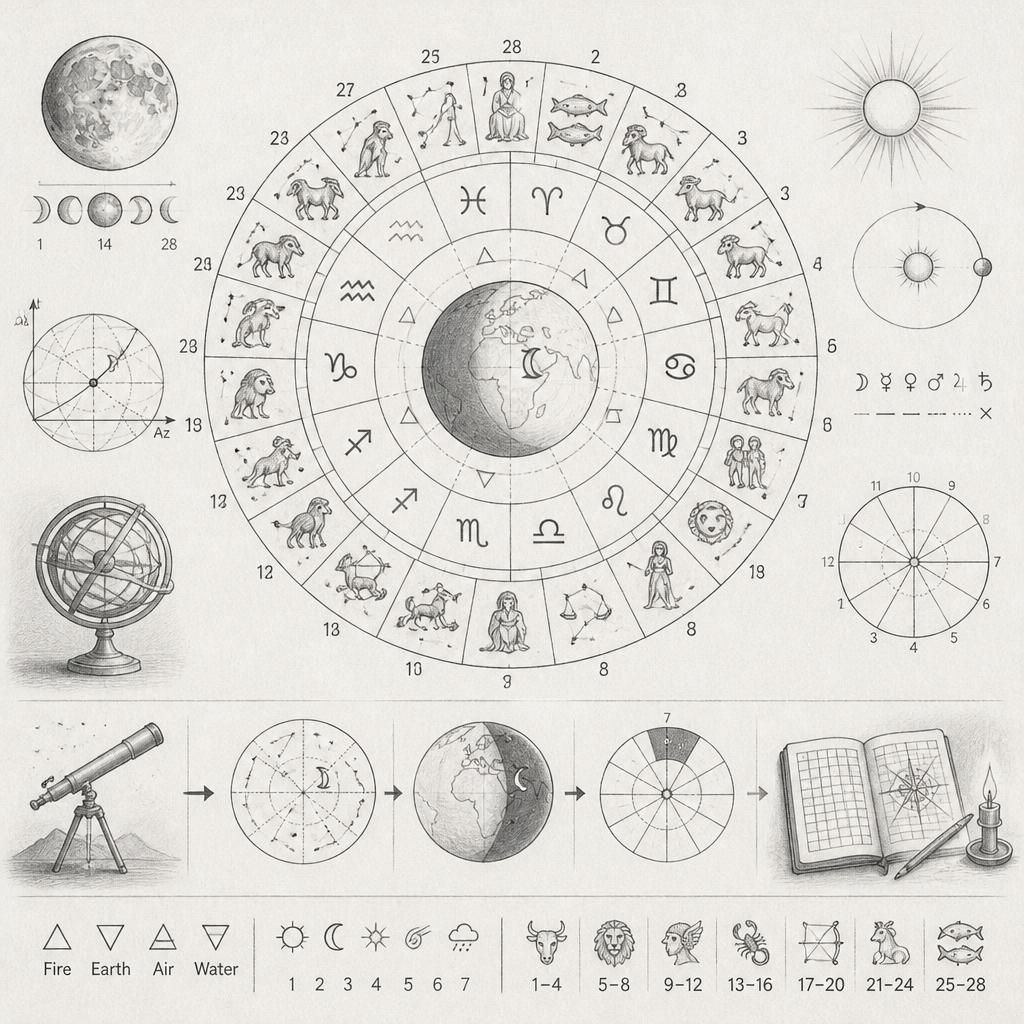
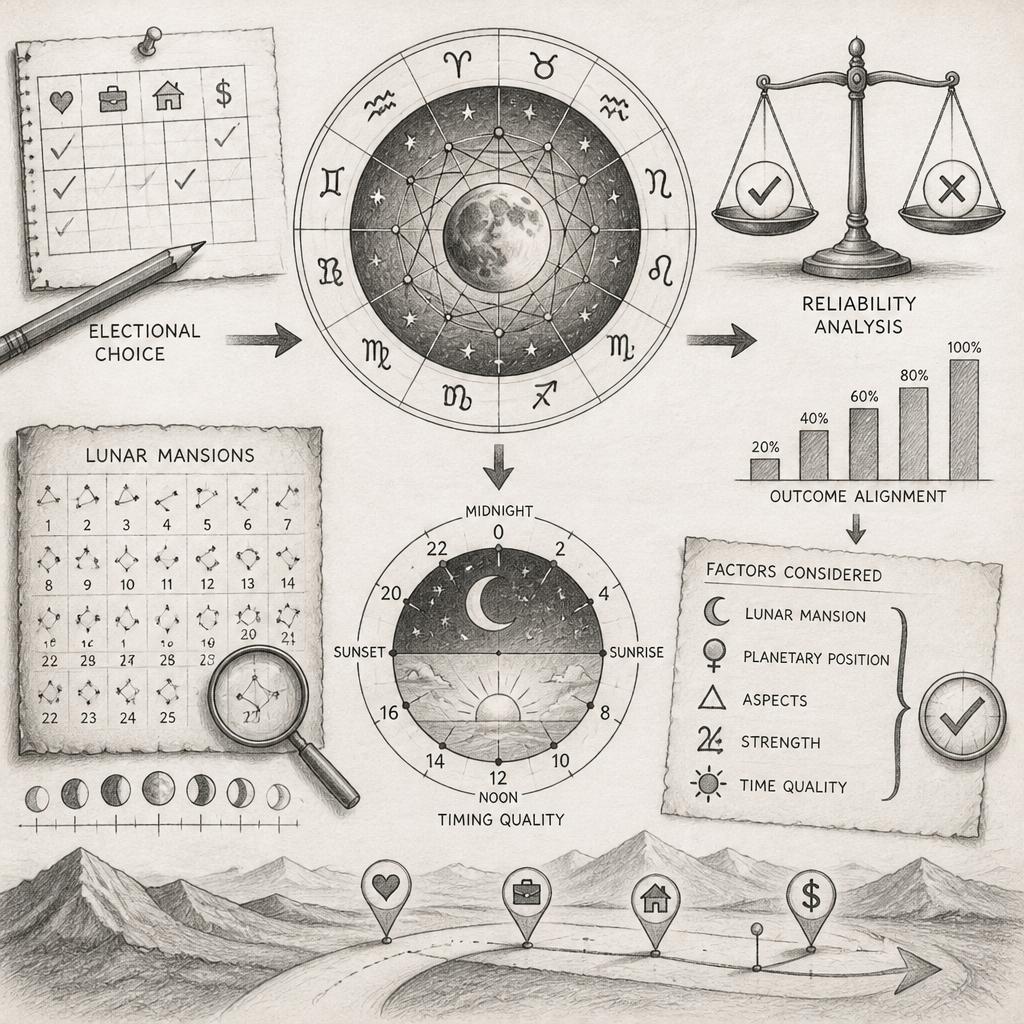
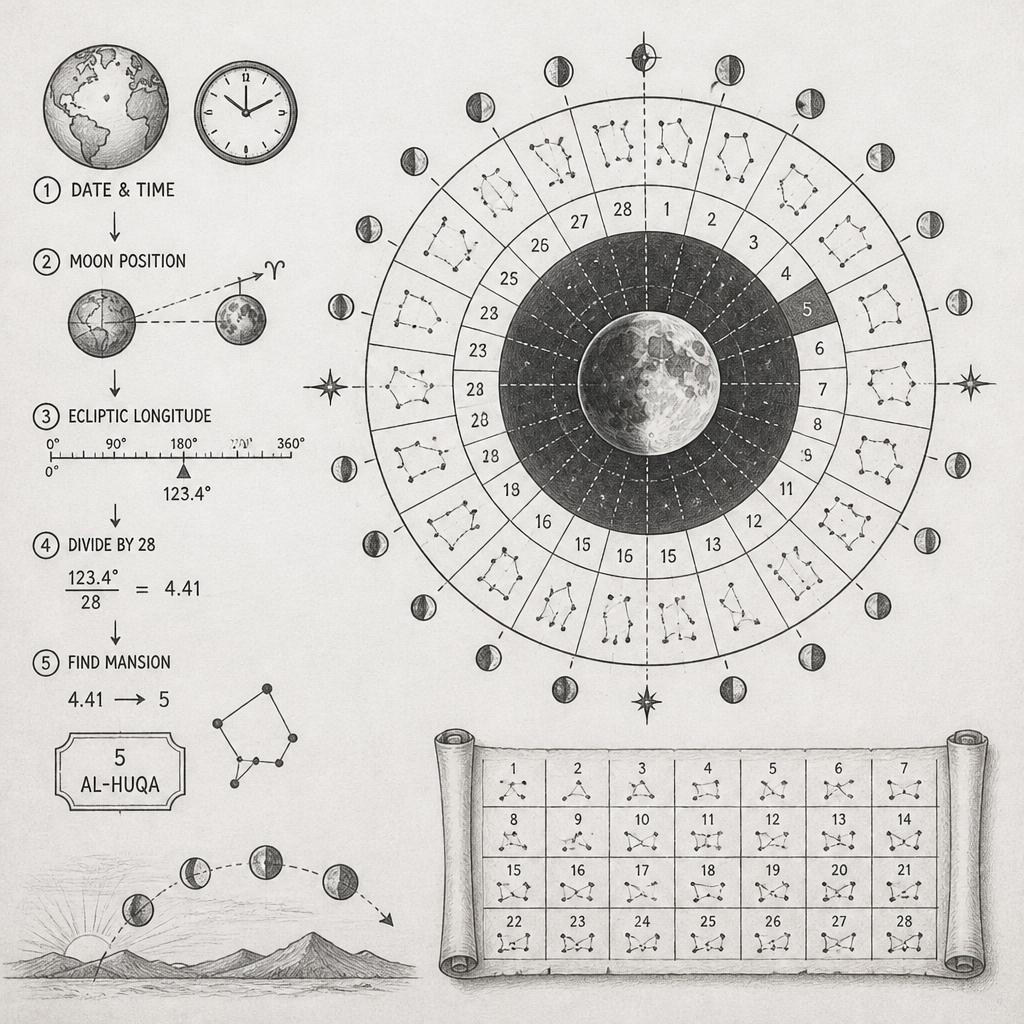
A lunar mansion calculator is a tool that maps the Moon's position against the 28 mansions of traditional Islamic astronomy (britannica.com). While the 8 phases give you a broad rhythm, the mansions give you specific daily guidance.
For example, if you have a difficult conversation scheduled, you might check the mansion to see if the timing supports communication or if it is better suited for solitary work. Mansions of the Moon offers a free, browser-based calculator that runs precise astronomical calculations directly in your browser. It pairs each mansion with unique generative artwork, making the system visual and easy to remember.
Troubleshooting Stagnation: When the Cycle Feels Stuck
Stagnation happens when you expect linear progress from a cyclical system. If you feel stuck, the issue is usually that you are trying to harvest during the New Moon or plant seeds during the Waning Moon.
If you feel stuck for more than two weeks, try this reset:
- Stop forcing output. If you are in a Waning phase, rest is the productive action.
- Revisit your intention. The goal you set last New Moon may no longer be relevant. It is okay to change it.
- Check the mansion timing. Sometimes the Moon is in a mansion that is traditionally considered challenging for new beginnings. Use that day for maintenance tasks instead.
By acknowledging that some days are for action and others are for integration, you stop judging yourself for low energy and start planning for it.
Your First Lunar Month: A Step-by-Step Plan
Starting a lunar practice is easier than you think: mark the phases on your calendar and commit to two check-ins.
Total Time: 30 minutes per week Difficulty: Beginner
What You'll Need:
- A calendar or planner
- A journal or note-taking app
- Access to a lunar phase calendar or calculator
Step 1: Identify the Next New Moon [Time: 5 minutes] Find the date of the next New Moon. This is your starting line. Mark it clearly in your calendar.
Step 2: Set One Intention [Time: 10 minutes] On the New Moon, write down a single goal. Make it something you can control, like "Meditate for 5 minutes daily" rather than "Get a promotion."
Step 3: Schedule Action Days [Time: 10 minutes] Look at the week following the New Moon. Block out three days for focused work on your intention.
Step 4: Schedule a Review [Time: 5 minutes] Set a reminder for the Full Moon. On that day, review your progress and adjust your approach.
Step 5: Plan Your Release [Time: 5 minutes] During the Last Quarter, decide what you will stop doing. This is as important as the goal itself.
Expected Result: By the next New Moon, you will have a clear record of what worked and what did not, giving you the data to set a smarter intention for the next cycle.
Conclusion: Let the Moon Set the Rhythm
The challenge with using moon phase for personal growth is not understanding the phases; it is remembering to check in with them. Mansions of the Moon solves this by providing a free calculator that shows your current mansion, the phase, and the illumination data instantly, with no sign-up required. By combining the simplicity of the phase cycle with the precision of the 28 mansions, you get a practical system for timing your efforts throughout the month.
Frequently Asked Questions
What is the best moon phase to start a new project?
The new moon is the traditional starting point for new projects. Its energy supports intention setting and planting seeds for what you want to grow over the next 29.5 days. The waxing crescent phase that follows is also good for taking the first concrete actions. For more precise timing, a lunar mansion calculator can identify specific days within that window that align with your project's purpose.
How does the lunar cycle influence personal development?
The lunar cycle offers a natural rhythm for personal development: waxing phases support building momentum and taking action, while waning phases favor release and reflection. Using the moon phase for personal growth gives you a built-in review system. Instead of forcing constant forward motion, you alternate between action and introspection, which prevents burnout and supports sustainable progress toward your goals.
What is the difference between moon phases and lunar mansions?
Moon phases describe the Moon's illumination relative to the Sun, dividing the month into eight parts. Lunar mansions are a more precise system: the Moon's daily path is divided into 28 distinct stations, each with its own traditional qualities. While phases give you a general week-by-week rhythm, a lunar mansion calculator shows you the specific energetic flavor of each individual day for finer-tuned planning.
How can I track moon phases for daily goal setting?
Start by noting the current phase and setting one intention for the next seven days that matches its energy: action-oriented goals during waxing phases, review and gratitude during waning phases. Use a lunar mansion calculator or moon phase app to see the exact phase change dates. Review your progress weekly at the phase shift and adjust your next goal based on what worked.