 ultimate-guide
What Are the 28 Lunar Mansions? Meaning + Guide
Table of Contents
- The 28 Lunar Mansions: A Cross-Cultural Map of the Night Sky
- One Moon, Three Systems: Chinese, Indian, and Arabic Variations
- The Meaning of the 28 Lunar Mansions in Classical Astrology
- How to Use Lunar Mansions for Timing Your Activities
- Finding Your Mansion with a Lunar Mansion Calculator
- Visualizing the Mansions: The Four Palaces and Their Guardians
- Start Your Practice with the Moon's Current Mansion
- Frequently Asked Questions
Last Updated: September 5, 2026
The 28 Lunar Mansions: A Cross-Cultural Map of the Night Sky
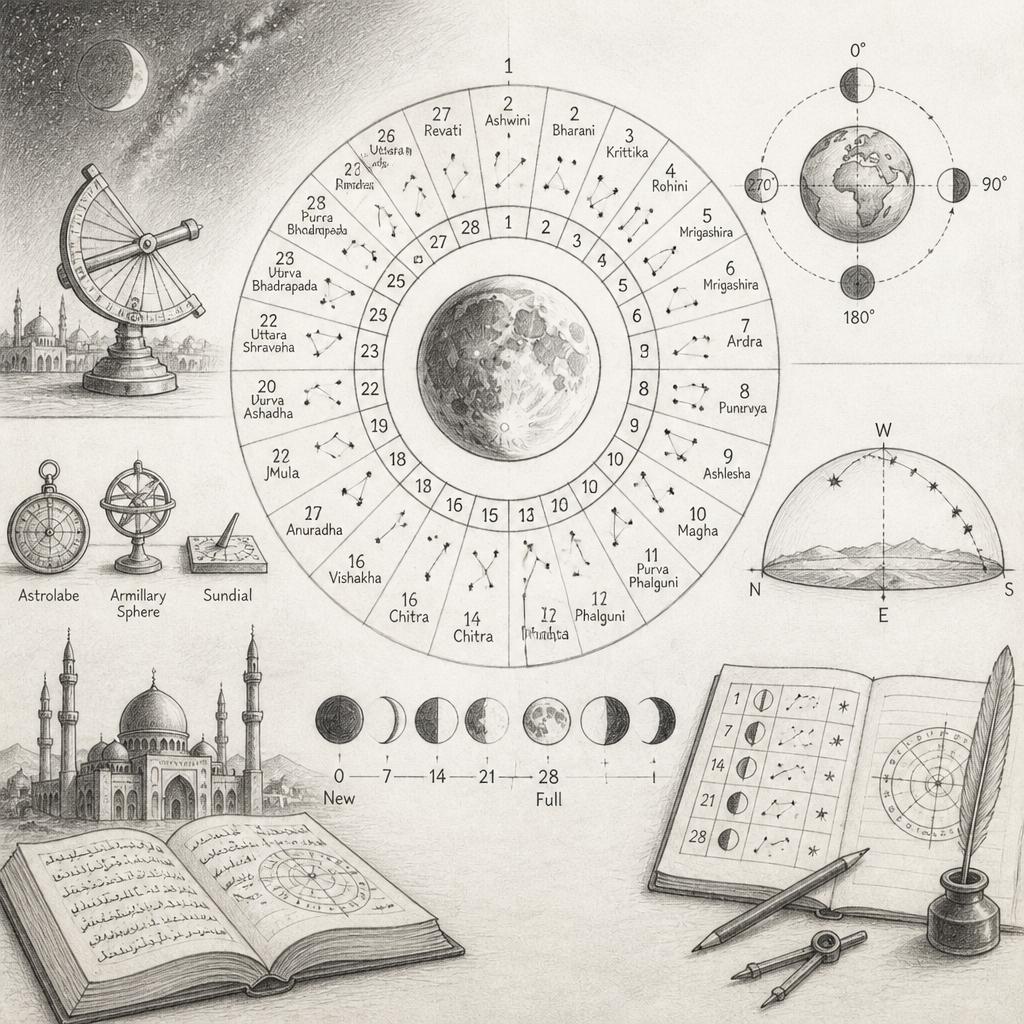
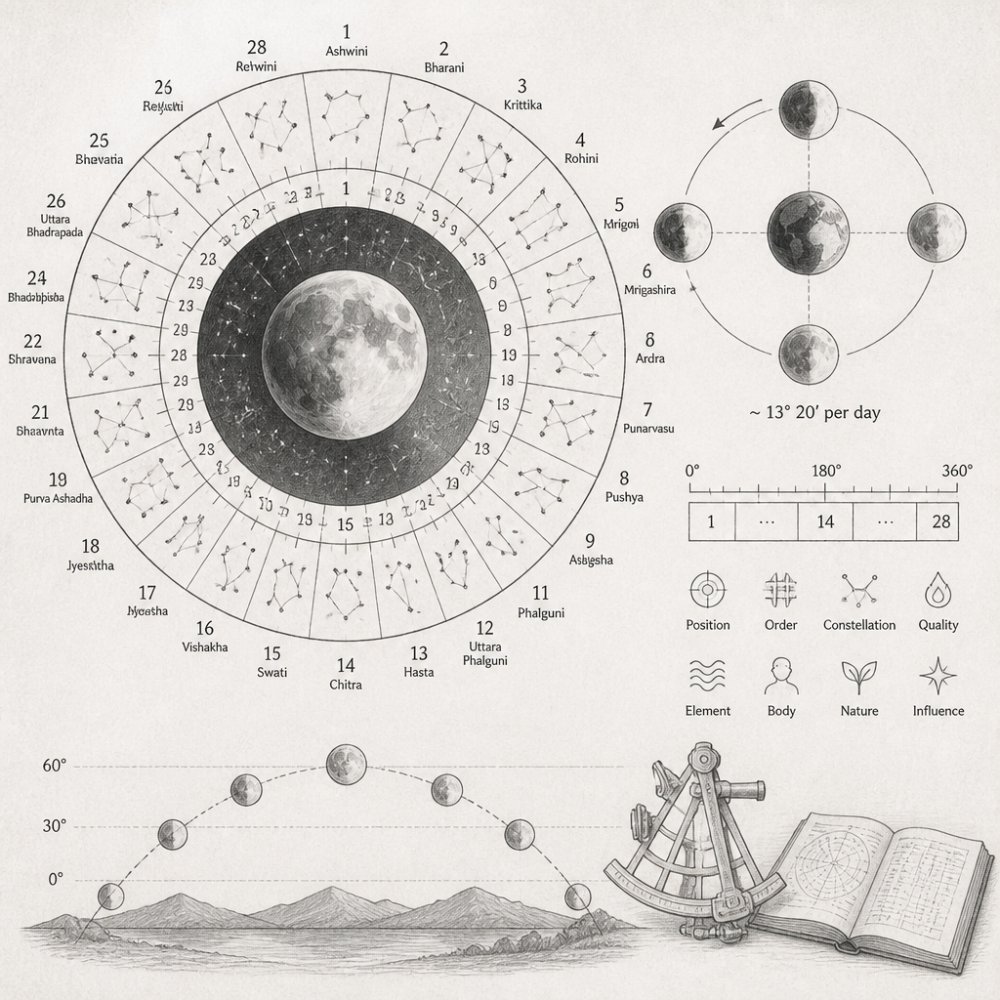
The 28 lunar mansions are a system of 28 distinct segments along the Moon's nightly path, used for thousands of years to track time and guide decision-making. Unlike the 12 zodiac signs that mark the Sun's yearly journey, these asterisms chart the Moon's roughly 27.3-day orbit around Earth, dividing the celestial sphere into 28 stations the Moon visits each night. At Mansions of the Moon, we've built our platform around making this ancient system accessible, and this guide breaks down what these mansions are, where they came from, and how you can actually use them today.
Here's the part most guides miss: the mansions aren't just one tradition. They appear across Chinese, Indian, and Arabic astronomy with different names, meanings, and applications. The concept is simple, though. Each night, the Moon rises approximately 13 degrees further east along the ecliptic, the apparent path of the Sun and planets. Over about a month, it passes through all 28 mansions in sequence.
The Encyclopedia Britannica's overview of the lunar zodiac notes that this practice of dividing the Moon's path predates the zodiac itself, representing some of humanity's earliest attempts at celestial mapping. For anyone interested in the history of astronomy or astrology, the mansions offer a direct link to how our ancestors understood the night sky.
One Moon, Three Systems: Chinese, Indian, and Arabic Variations
The 28 lunar mansions appear in three major cultural systems, each with its own structure and symbolism. The Chinese system, known as the xiu, organizes the mansions into four groups of seven, each associated with a cardinal direction and a mythological guardian. The Indian system, called the nakshatras, actually uses 27 primary mansions (with a 28th sometimes included), and forms the backbone of Vedic astrology, where each mansion rules specific personality traits and life events.
The Arabic system, known as the manzil, holds particular significance for Islamic astronomy and is the foundation used by Mansions of the Moon. These 28 mansions were used for navigation, weather prediction, and electional timing, choosing favorable moments for activities like travel, marriage, or beginning a new venture.
What's fascinating is how each tradition assigns different meanings to the same celestial markers. A mansion associated with prosperity in the Chinese system might carry themes of caution in the Arabic tradition. The stars themselves are the same, but the cultural lens changes how they're interpreted.
| System | Name | Number of Mansions | Primary Use |
|---|---|---|---|
| Chinese | Xiu | 28 (4 groups of 7) | Calendrical, mythological |
| Indian | Nakshatra | 27-28 | Vedic astrology, personality |
| Arabic | Manzil | 28 | Navigation, electional timing |
The Meaning of the 28 Lunar Mansions in Classical Astrology
In classical astrology, the meaning of the 28 lunar mansions centers on their role as celestial stations that condition the Moon's influence as it transits through each one. Each mansion carries specific qualities, planetary affinities, and auspicious or inauspicious associations, making them essential tools for electional work. But to understand the system, you need to see it in action, not just as an abstract concept.
The Arabic tradition, particularly as codified in the Picatrix, a 13th-century grimoire on astrological magic, assigns each mansion specific purposes. Consider the first mansion, Al-Nath (the Butting Horn), which includes the star Hamal in Aries. The Picatrix associates it with destroying, binding, and sowing discord, a stark contrast to the second mansion, Al-Botayn (the Little Belly), which is favorable for agriculture, building, and secure travel. This pattern of alternating or nuanced meanings continues throughout the sequence.
For instance, the 14th mansion, Al-Azubra (the Den), is traditionally good for love and marriage, while the 18th, Al-Kalb (the Heart), is considered favorable for rituals of protection and for warding off enemies. The 24th mansion, Al-Sa'd al-Akhbiyah (the Fortunate of the Tents), is associated with healing, reconciliation, and the success of new ventures. Conversely, the 26th, Al-Fargh al-Mu'hir (the First Spout), is often cited for destruction and separation, a warning against initiating important matters.
These aren't arbitrary assignments. They derive from the fixed stars within each mansion and the mythological narratives attached to those stars. The 10th mansion, Al-Dhira (the Forearm), contains the bright stars Castor and Pollux, the mythological twins. In classical astrology, this mansion is associated with travel, brotherhood, and the pursuit of knowledge, themes directly drawn from the Gemini mythos.
The Library of Congress's digitized collection on medieval astrology houses several manuscripts detailing these mansion-based practices, showing how seriously medieval scholars took this system. The Picatrix itself, translated into Latin in 1256, remains the most comprehensive surviving text on the subject, and its detailed lists of mansions, their talismans, and their uses offer a practical window into how astrologers once worked.
Understanding the meaning of the 28 lunar mansions requires recognizing that each one represents a different flavor of lunar energy, and knowing which flavor is active on a given day allows for more intentional living. The mansions are not a monolithic system of good or bad omens; they are a nuanced toolkit where context, intention, and the specific qualities of each station determine the most appropriate course of action. This granularity is what separates the mansions from the broader zodiac signs and makes them a uniquely powerful timing system.
How to Use Lunar Mansions for Timing Your Activities
The practical application of lunar mansions is simpler than it might seem. To use lunar mansions for timing your activities, you first identify which mansion the Moon currently occupies, then consult its traditional meanings to determine what types of activities are supported.
A common approach is to keep a simple list of the mansions and their general qualities. For example, if the Moon is in a mansion traditionally associated with travel and expansion, that might be an ideal window for booking a trip or launching a project that needs momentum. Conversely, if the Moon sits in a mansion known for rest and retreat, you might schedule introspection or recovery rather than pushing forward on negotiations.
The key is consistency. Many practitioners find that tracking the Moon's mansion for just one full lunar cycle reveals patterns they had previously missed. You might notice that certain mansions consistently coincide with productive workdays or difficult conversations. That awareness alone transforms the system from abstract history into a practical tool.
Finding Your Mansion with a Lunar Mansion Calculator
A lunar mansion calculator removes all the guesswork from this practice by instantly computing the Moon's current position within the 28-mansion cycle. Instead of manually consulting an ephemeris or doing complex astronomical math, you enter your location and time, and the calculator tells you exactly which mansion the Moon occupies.
This is where Mansions of the Moon excels. Our free, browser-based calculator runs precise astronomical algorithms entirely on your device, so there's no sign-up required. You get the current mansion, along with moonrise, moonset, phase, and illumination data, all in one clean interface. We also provide traditional timing guidance drawn from classical sources like the Picatrix, giving you both the astronomical position and its historical interpretation side by side.
The calculations are based on the sidereal zodiac, which anchors the mansions to fixed stars rather than the tropical zodiac used in Western sun-sign astrology. NASA's Moon fact sheet confirms the Moon's mean synodic period of 29.53 days and sidereal period of 27.32 days, which is why the 28-mansion system works so cleanly: the Moon returns to roughly the same mansion after 27 to 28 nights.
Visualizing the Mansions: The Four Palaces and Their Guardians
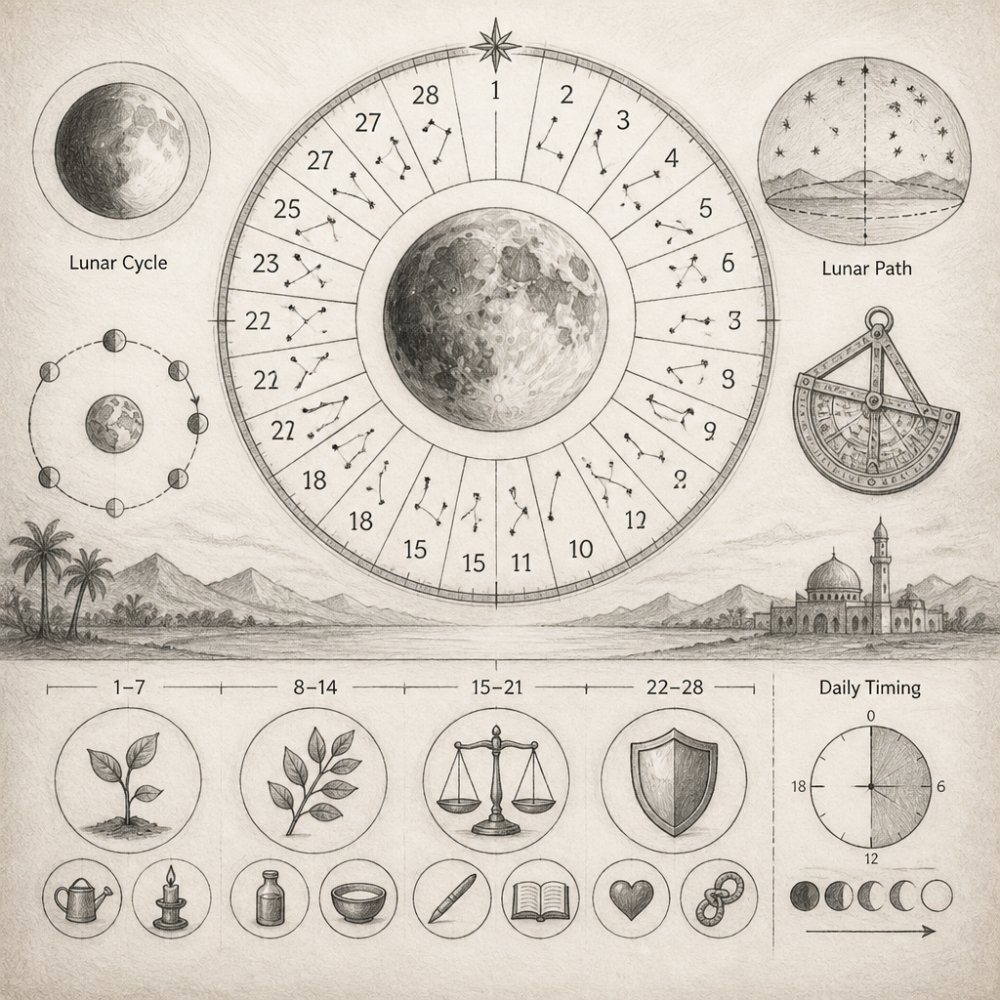
One of the most beautiful ways to understand the mansions is through the Chinese system's visual mapping, which organizes all 28 xiu into four palaces, each guarded by a celestial animal. The Azure Dragon of the East presides over seven mansions in the spring sky, the Vermilion Bird of the South rules the summer, the White Tiger of the West commands autumn, and the Black Tortoise of the North governs winter.
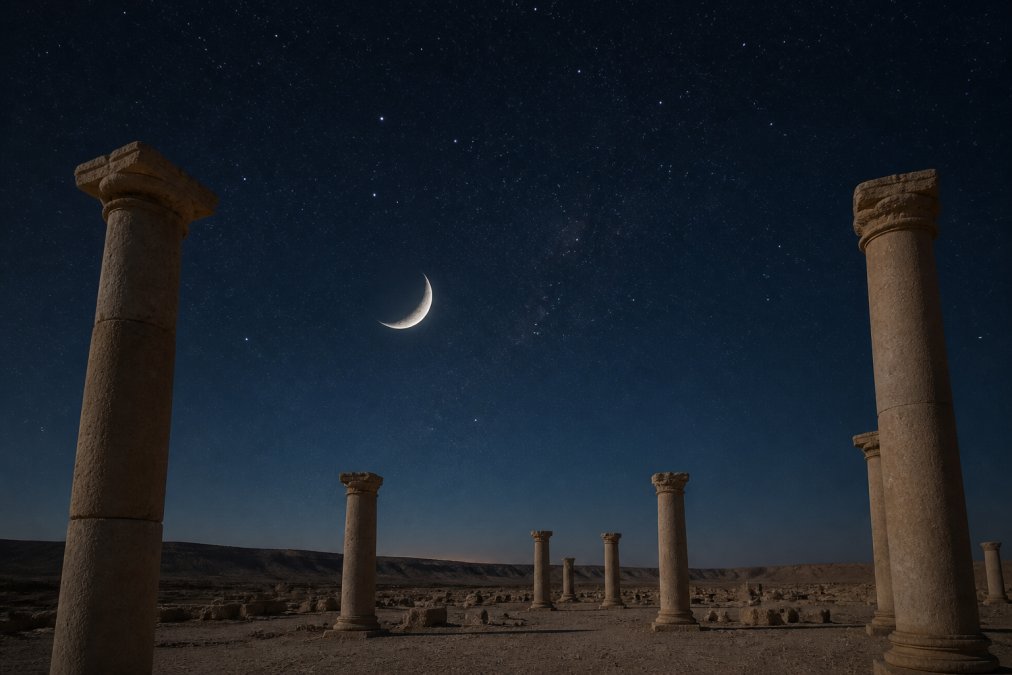
Each palace corresponds not only to a season but also to a set of asterisms that rise and set with the Moon throughout that part of the year. The equinoxes and solstices mark the boundaries between these palaces, tying the lunar cycle to the broader solar year. This integration of lunar and solar astronomy is one of the most sophisticated achievements of archaic astronomy, and it's why the mansions remained central to Chinese calendrical practice for millennia.
The four palaces are not just symbolic; they map directly onto the ecliptic. The Azure Dragon of the East covers the segment from about 0° to 90° of ecliptic longitude, roughly corresponding to the constellations Aries through Cancer. The Vermilion Bird of the South spans 90° to 180°, covering Cancer through Libra. The White Tiger of the West runs from 180° to 270°, through Libra to Capricorn, and the Black Tortoise of the North completes the circle from 270° to 360°, through Capricorn back to Aries.
For the modern practitioner, visualizing the mansions this way creates a mental map that makes the system far easier to internalize. Instead of 28 abstract points, you get four seasonal quadrants, each with seven distinct stations. The guardians serve as mnemonic devices, anchoring each palace's character and the types of activities traditionally associated with its mansions.
To further clarify how these systems map onto each other, consider this consolidated comparison of the three major traditions. While the Chinese and Arabic systems both use 28 mansions, the Indian nakshatra system typically uses 27, each spanning 13°20' of the ecliptic. The Chinese xiu are uneven in width, reflecting the actual asterisms they contain, while the Arabic manzil are more evenly distributed. The table below shows the first five mansions of each system and their approximate ecliptic positions, demonstrating how different cultures carved up the same celestial road.
| Ecliptic Longitude (approx.) | Chinese Xiu | Indian Nakshatra | Arabic Manzil |
|---|---|---|---|
| 0° - 13° | Jiǎo (Horn) | Ashwini | Al-Nath |
| 13° - 26° | Kàng (Neck) | Bharani | Al-Botayn |
| 26° - 39° | Dī (Root) | Krittika | Al-Thurayya |
| 39° - 52° | Fáng (Room) | Rohini | Al-Dabaran |
| 52° - 65° | Xīn (Heart) | Mrigashira | Al-Haq'a |
This side-by-side view reveals a crucial insight: the mansions are not a single, monolithic system but a shared astronomical foundation adapted by each culture to its own needs. The Chinese system emphasizes calendrical and state rituals, the Indian system is deeply woven into personal astrology, and the Arabic system focuses on practical timing and navigation. Seeing them together transforms the mansions from a historical curiosity into a living, comparative map of human celestial navigation.
Start Your Practice with the Moon's Current Mansion
The best way to learn the 28 lunar mansions is to begin tracking the Moon's current mansion today. You don't need a background in astronomy or a deep knowledge of medieval texts. You need a reliable tool and the willingness to observe patterns over a few weeks.
Start by checking the Moon's mansion each morning, perhaps alongside your usual astrological or calendar review. Note the mansion's name, its traditional associations, and how your day actually unfolds. Within a single lunar cycle, you'll have enough personal data to start seeing correlations. The mansions are a system of timing, and like any timing system, they reveal their value through use, not just study.
The Mansions of the Moon platform was built for exactly this purpose. Our free calculator gives you the Moon's current mansion, its phase and illumination, and the traditional guidance associated with that station, all wrapped in unique generative artwork that makes each mansion visually distinct. There's no sign-up required for use, no paywall, and no data collection. Just a precise, beautiful tool for connecting your daily life to the rhythm of the Moon. Follow @moonmansionscal on X for daily mansion updates and join a growing community of practitioners rediscovering this ancient system.
The 28 lunar mansions offer a rich, cross-cultural framework for aligning your activities with the Moon's nightly progression, one that predates the zodiac and remains remarkably practical today. Whether you're drawn to the historical astronomy, the classical timing guidance of the Picatrix, or the simple beauty of tracking the Moon's journey, the mansions reward consistent practice. Mansions of the Moon makes that practice effortless with precise browser-based calculations, integrated classical guidance, and generative artwork for each mansion, all free and requiring no account. Get started with Mansions of the Moon and see which mansion the Moon occupies tonight.
Frequently Asked Questions
What is the difference between the 27 and 28 lunar mansion systems?
The 28 lunar mansions divide the Moon's monthly path into 28 segments, primarily used in Chinese and Arabic astrology. The 27 nakshatras are the Indian equivalent, which divides the same path into 27 segments. This difference arises from averaging the Moon's sidereal day against its synodic month. While both systems track the Moon's nightly progression against fixed stars, the 28-mansion system often includes the star Al Risha as a boundary marker, whereas the 27-nakshatra system does not.
How can I find out which lunar mansion the Moon is in today?
The most accurate way is to use a lunar mansion calculator that references the Moon's current ecliptic longitude. These tools compute the Moon's position against the 28 mansions in real time. You will need your current date and time, as the Moon moves through roughly one mansion each day. A reliable calculator will also show you the mansion's ruling planet and its associated traditional timing guidance, giving you a practical starting point for planning.
Do the 28 lunar mansions correspond to zodiac signs?
Yes, they do, but not in a one-to-one fashion. Each lunar mansion occupies a specific segment of the ecliptic, the same path the Sun travels through the zodiac. Therefore, a mansion will fall entirely within a single zodiac sign. For example, the first mansion, Al Sharatan, is located in Aries. However, lunar mansions are measured from the sidereal zodiac, not the tropical one, so the boundaries will differ from the signs you see in most Western horoscopes.
How are lunar mansions used in electional astrology?
In electional astrology, you choose a time to start an activity based on the qualities of the lunar mansion that will be active. Each of the 28 lunar mansions has traditional associations, such as good for travel, building, or starting a business, while others are considered unfavorable for certain actions. By consulting a source like the Picatrix, you can align your new venture with a mansion believed to bring success, thereby using the Moon's position as a cosmic timing tool.