 ultimate-guide
Beginner Guide to Islamic Lunar Mansions
Table of Contents
- What Are the 28 Lunar Mansions?
- From Islamic Astronomy to the Picatrix: A Short History
- How to Calculate Your Lunar Mansion
- Lunar Mansion Cycle Duration and the Moon's Path
- Electional Timing with Lunar Mansions: A Beginner's Framework
- How to Start Tracking the Moon: A Step-by-Step Practice
- Common Mistakes Beginners Make with Lunar Mansions
- Frequently Asked Questions
Last Updated: October 1, 2026
What Are the 28 Lunar Mansions?
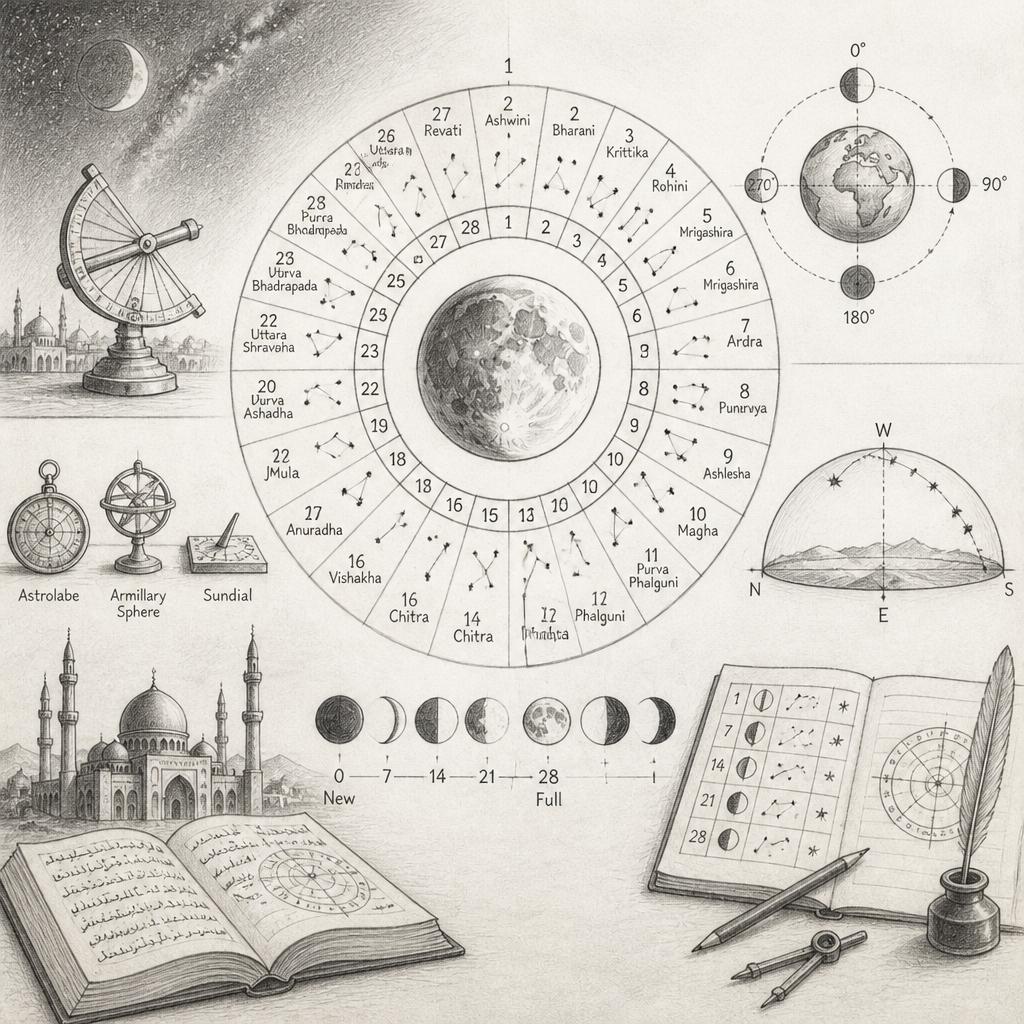
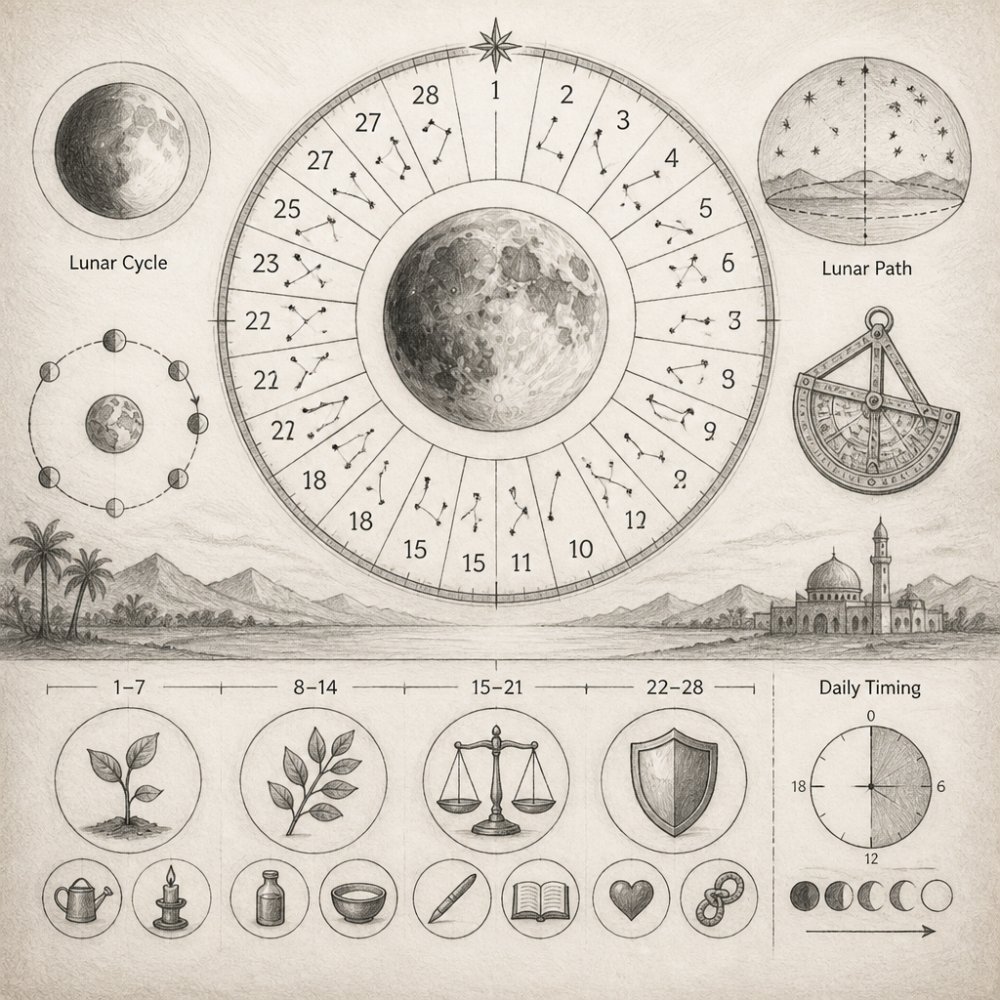
The 28 lunar mansions divide the Moon's path across the sky into 28 stations, each marking roughly one day of its monthly journey. This guide explains where the system came from, how to calculate your mansion, and how to use it daily.
In Arabic they are called Manāzil al-Qamar, "stations of the Moon." Each mansion spans a segment of celestial longitude along the ecliptic, the path the Sun and Moon trace against the stars. The system served as a practical tool for timekeeping, navigation, and timing decisions.
This guide from Moon Mansion Calculator covers the full system, from the Arabic alphabet correspondence to electional timing drawn from classical sources like the Picatrix. Each station carries a distinct character that shapes what activities suit it.
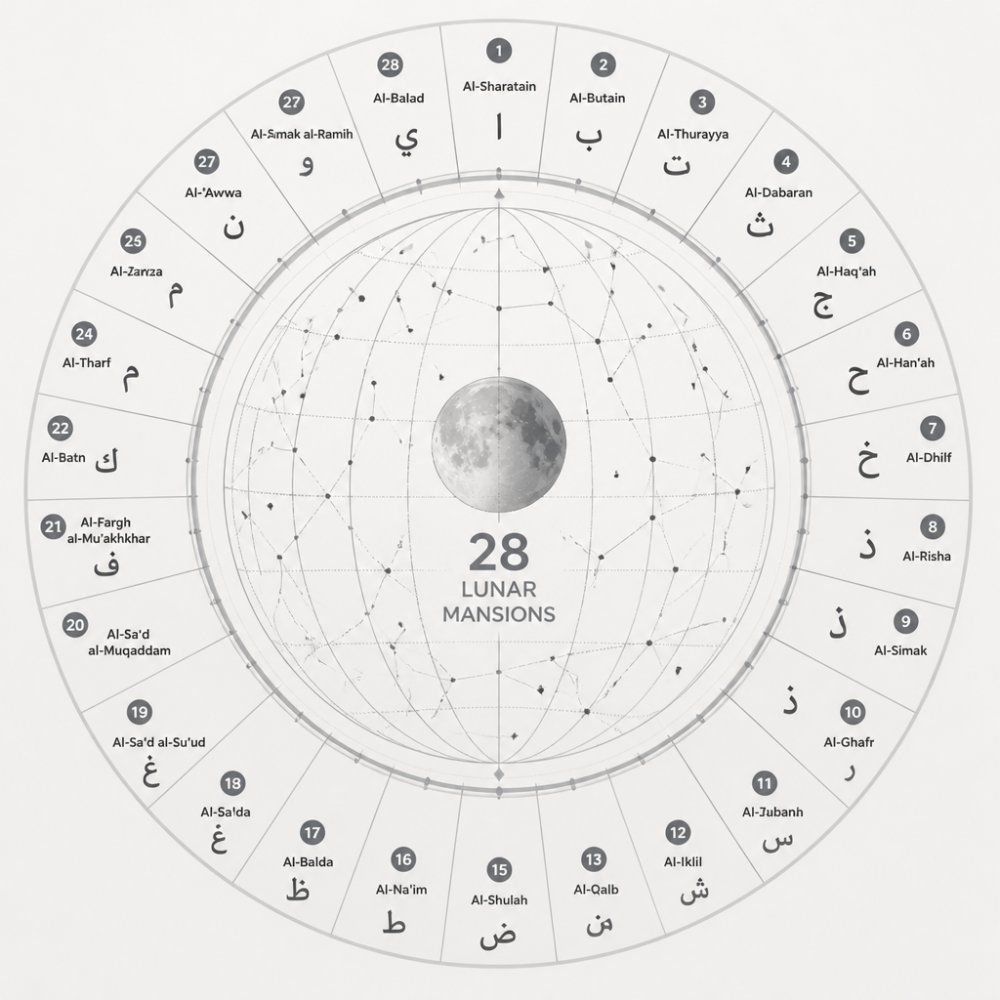
Manazil, Lunar Stations, and the Arabic Alphabet Correspondence
Manāzil is the plural of manzil, a stopping point or dwelling. Caravans stopped at fixed desert waypoints; the Moon does the same across the sky. Each mansion corresponds to a lunar day, and the 28 stations complete one full circuit of the Moon's orbit.
Classical scholars linked each mansion to a letter of the Arabic alphabet.
From Islamic Astronomy to the Picatrix: A Short History
Islamic astronomers inherited lunar stations partly from pre-Islamic Arabian star lore and partly from Hellenistic and Indian astronomy. By the ninth century, Baghdad astronomers had formalized the 28 stations with precise sidereal positions tied to fixed stars. These celestial markers eventually became deeply woven into the broader tapestry of Islamic literature resources, providing a foundational framework for scholars seeking to bridge ancient observational science with the evolving spiritual traditions of the faith.
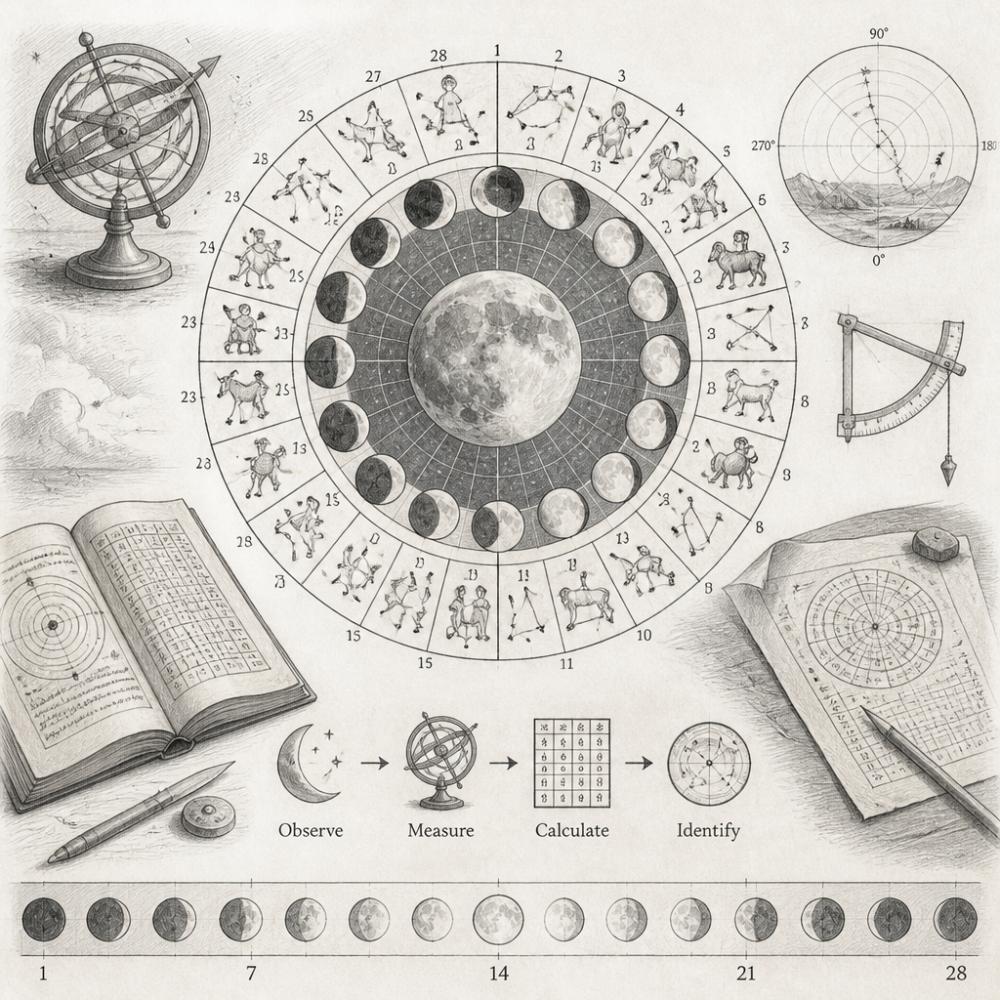
How to Calculate Your Lunar Mansion
The formula is straightforward:
Mansion number = floor(Moon's ecliptic longitude ÷ 12.857) + 1
Manual Calculation vs. a Lunar Mansion Calculator
Manual calculation works if you already have an ephemeris table and understand how to read ecliptic coordinates. The U.S. Naval Observatory's astronomical data services publish positional data that practitioners can cross-reference.
| Method | What You Need | Best For |
|---|---|---|
| Manual ephemeris | Ecliptic longitude tables, calculator | Students verifying the math |
| Lunar mansion calculator | Browser, date and time | Daily tracking and ritual planning |
| Natal chart software | Birth date, time, location | One-time natal mansion lookup |
Lunar Mansion Cycle Duration and the Moon's Path
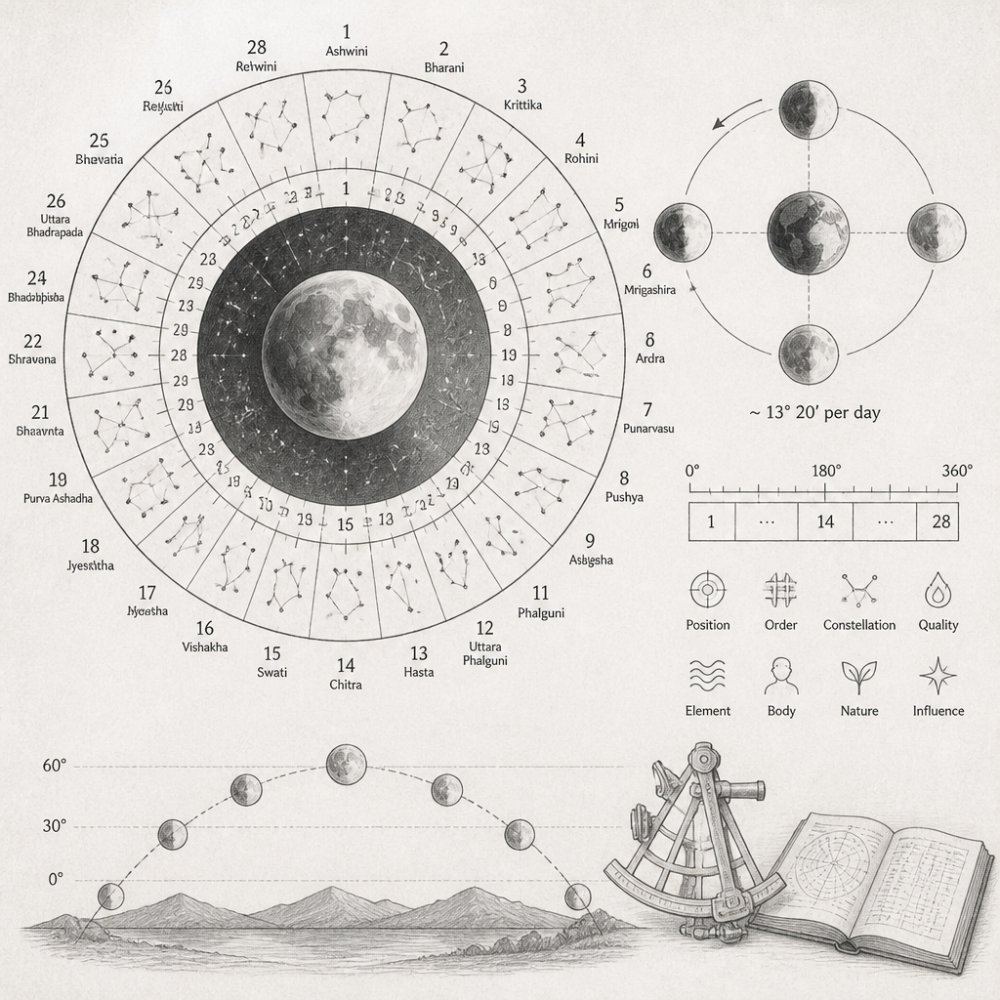
One pass through all 28 lunar stations takes about 27.3 days, the Moon's sidereal orbital period. Each mansion lasts roughly 23 hours and 20 minutes, though the exact duration shifts because the Moon's speed varies along its elliptical orbit.
Electional Timing with Lunar Mansions: A Beginner's Framework
Electional timing with lunar mansions means matching an activity to the character of the station the Moon occupies. Classical sources assign each mansion favored and discouraged undertakings.
A workable beginner's framework:
- Identify the current mansion using a calculator or ephemeris.
- Read the traditional guidance for that station.
- Compare it against the activity you are planning.
- If the guidance discourages the activity, wait for the Moon's return to that mansion next month, or pick a station suited to the task.
- Log the outcome so your own record builds alongside the classical text.
How to Start Tracking the Moon: A Step-by-Step Practice
Tracking the Moon takes about five minutes a day once the habit forms, building familiarity with the cycle faster than reading about it. What follows is a structured first month.
Find Your Natal Moon Mansion →
Week 1: Learn the Tool and the Names
Open Moon Mansion Calculator each morning and note three values: the current mansion name, the Moon's illumination percentage, and the moonrise time. Write them in a notebook or spreadsheet. Do not interpret anything yet; the goal is repetition, so the 28 names stop looking unfamiliar.
Week 2: Add the Moon's Phase and One Sentence
Once the names feel familiar, add two columns: the Moon's phase and one factual sentence about the day's dominant activity or mood. "Long commute, finished a draft" is more useful later than "felt strange."
Week 3: Track One Mansion Deliberately
Pick a single mansion and follow it for its full pass, roughly 23 hours and 20 minutes, noting its start and end via the calculator's timestamp. Because the Moon's speed varies, a mansion near perigee can pass in under 22 hours, so times will differ from the previous month's.
Week 4: Review and Find Your Natal Mansion
At month's end, review which mansions coincided with which outcomes. Then look up your natal mansion using your birth date, time, and location, mark the date the Moon returns to that station, and note what recurs.
- Note the current mansion each morning and record it in a notebook or spreadsheet
- Mark the Moon's phase and illumination percentage alongside the mansion
- Write one sentence about the day's dominant activity or mood
- Track one chosen mansion through its full pass, start to end
- At the end of the month, review which mansions coincided with which outcomes
- Track the Moon's return to your natal mansion and note what recurs
A Comparative Note for Curious Beginners
Once the daily habit is steady, some readers want to know how this system relates to others. The 28 stations have a close cousin in the Vedic Nakshatras, which also divide the Moon's path into 28 segments, though the two traditions name and anchor them differently. Western sky-division schemes use 12 signs of 30 degrees. Seeing the three side by side makes clear that the number 28 is not arbitrary: it tracks the Moon's own cycle rather than the Sun's.
Common Mistakes Beginners Make with Lunar Mansions
The biggest mistake is confusing the 28 lunar mansions with the 12-sign zodiac. The two divide the same ecliptic differently: 28 stations of roughly 12.86 degrees against 12 signs of 30 degrees. A mansion boundary rarely lines up with a sign boundary, so a date in one sign can straddle two mansions.
Four More Mistakes That Cost Beginners Time
Treating the 23-hour-20-minute average as fixed. Because the Moon accelerates near perigee and slows near apogee, a mansion can run short or long by a noticeable margin, so "the same mansion" in two different months does not guarantee the same window length.
Frequently Asked Questions
What are the 28 lunar mansions in Arabic?
The 28 lunar mansions, called manazil al-qamar in Arabic, are stations along the Moon's path through the sky. Each mansion has an Arabic name tied to a star group or traditional image, such as Al-Sharatain, Al-Butain, and Al-Thurayya. In classical Islamic astronomy, each mansion was also linked to a letter of the Arabic alphabet, giving the system a symbolic layer that later influenced talismanic and ritual practice. You can see all 28 names with their meanings on the Moon Mansion Calculator's mansion reference page.
How do the 28 lunar mansions relate to the Moon's cycle?
The Moon completes a full circuit of the celestial sphere in about 27.3 days, the sidereal month. Divided by 28, that works out to roughly 23.3 hours per mansion. Because the Moon does not spend an equal amount of time in every station, its actual stay in a given mansion can range from about 21 to 26 hours. This is why a mansion changes almost daily, and why timing tools that update in real time are more useful than static tables.
How can I calculate the current lunar mansion?
To find the current lunar mansion, you need the Moon's ecliptic longitude at your chosen moment, then divide that longitude by 12.857 degrees, the width of each mansion. The result tells you which of the 28 stations the Moon occupies. Doing this by hand requires an ephemeris and careful math. A free lunar mansion calculator handles the calculation instantly and shows the Moon's mansion, phase, illumination, and rise and set times in your browser.
How is this different from other lunar calculators I've tried?
Many calculators give conflicting results because they mix tropical and sidereal zodiac systems or use simplified averages. Moon Mansion Calculator uses precise astronomical algorithms to place the Moon on the ecliptic, then maps that position onto the 28 stations using a consistent classical method. The output is transparent: you see the Moon's ecliptic longitude, the mansion it falls in, and the traditional timing guidance associated with that station, so you can verify the math instead of trusting a black box.
Can I use lunar mansions without studying Islamic astronomy first?
Yes. The system is practical at the entry level. Start by checking which mansion the Moon occupies today, read the traditional guidance for that station, and note how the day unfolds. Over a month you will see the full cycle and start recognizing patterns. The historical and astronomical background adds depth, but it is not a prerequisite. The Moon Mansion Calculator's free tool and 28 Lunar Mansions reference are designed for exactly this kind of hands-on start.
What is electional timing with lunar mansions?
Electional timing means choosing when to begin an activity based on celestial conditions. In the lunar mansion system, each of the 28 stations carries traditional guidance about what it supports, such as travel, commerce, learning, or rest. Classical sources like the Picatrix list these associations. To use electional timing, identify the activity you want to start, check the current mansion, and compare its guidance. If the mansion is unfavorable, wait for the next station or use a tool like the Activity Timing Advisor to find a better window.