 ultimate-guide
How Do You Time Important Events With Classical Electional Astrology?
Last Updated: October 24, 2026
Quick Summary
Electional astrology timing is the practice of selecting an auspicious moment to begin an important event by analyzing planetary positions and lunar cycles, allowing you to deliberately choose when to launch a business, schedule a wedding, sign a contract, or undertake any significant endeavor.
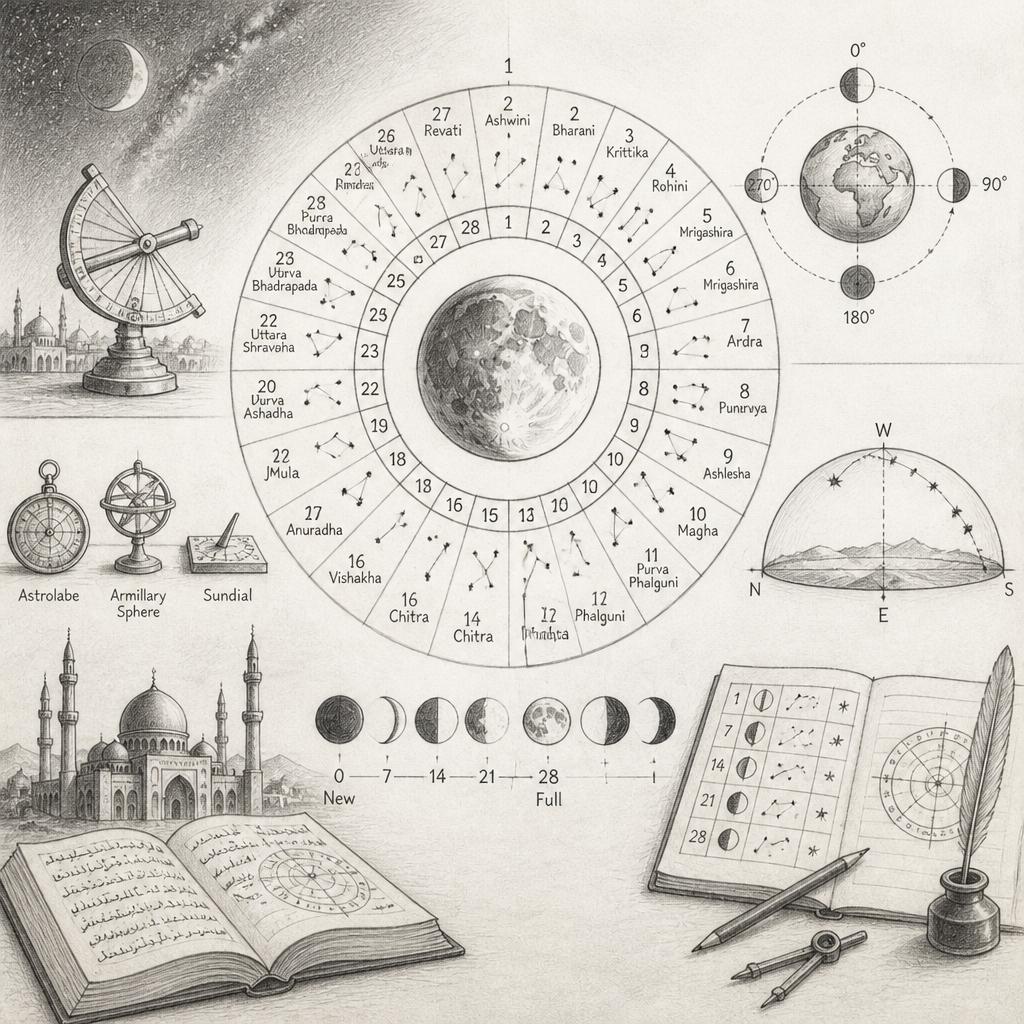
- The 28 lunar mansions represent the Moon's monthly journey divided into distinct stations, each with specific characteristics that influence timing decisions.
- Planetary hours divide each day into 24 segments ruled by different planets, allowing you to narrow an auspicious date to a specific hour.
- Classical electional astrology prioritizes planetary dignity, ensuring key planets are in positions of strength rather than weakness for your event type.
- A favorable date requires alignment between the lunar mansion, key planetary positions, and the planetary hour ruler that supports your specific goal.
- You don't need perfect alignment of every factor; a date where two or three key factors are strong is workable for your event.
Table of Contents
- What Classical Electional Astrology Timing Is and How It Works
- Understanding the 28 Lunar Mansions and Their Influences
- How to Choose an Auspicious Date for Your Event
- Using a Lunar Mansion Calculator to Refine Your Timing
- Planetary Hours Calculator: Narrowing Your Timing Window
- Classical Rules, Essential Dignities, and Practical Trade-Offs
- Planning Your First Electional Chart
- Frequently Asked Questions
What Classical Electional Astrology Timing Is and How It Works
Classical electional astrology timing is the practice of selecting an auspicious moment to begin an important event by analyzing planetary positions and lunar cycles. Rather than waiting for circumstances to align by chance, practitioners deliberately choose when to act, when to launch a business, schedule a wedding, sign a contract, or undertake any significant endeavor.
The foundation rests on a simple premise: the moment an event begins imprints its energetic signature onto that event's entire trajectory. A business incorporated at noon on one date carries different influences than the same business incorporated at midnight on another. Classical sources like the Picatrix, a 10th-century treatise on planetary magic, codified these principles into systematic rules that practitioners still apply today.
Moon Mansion Calculator makes this ancient system accessible by combining precise astronomical algorithms with classical guidance. The platform maps the Moon's position across the 28 lunar mansions of Islamic astronomy, each with distinct characteristics that influence timing decisions.
Understanding the 28 Lunar Mansions and Their Influences
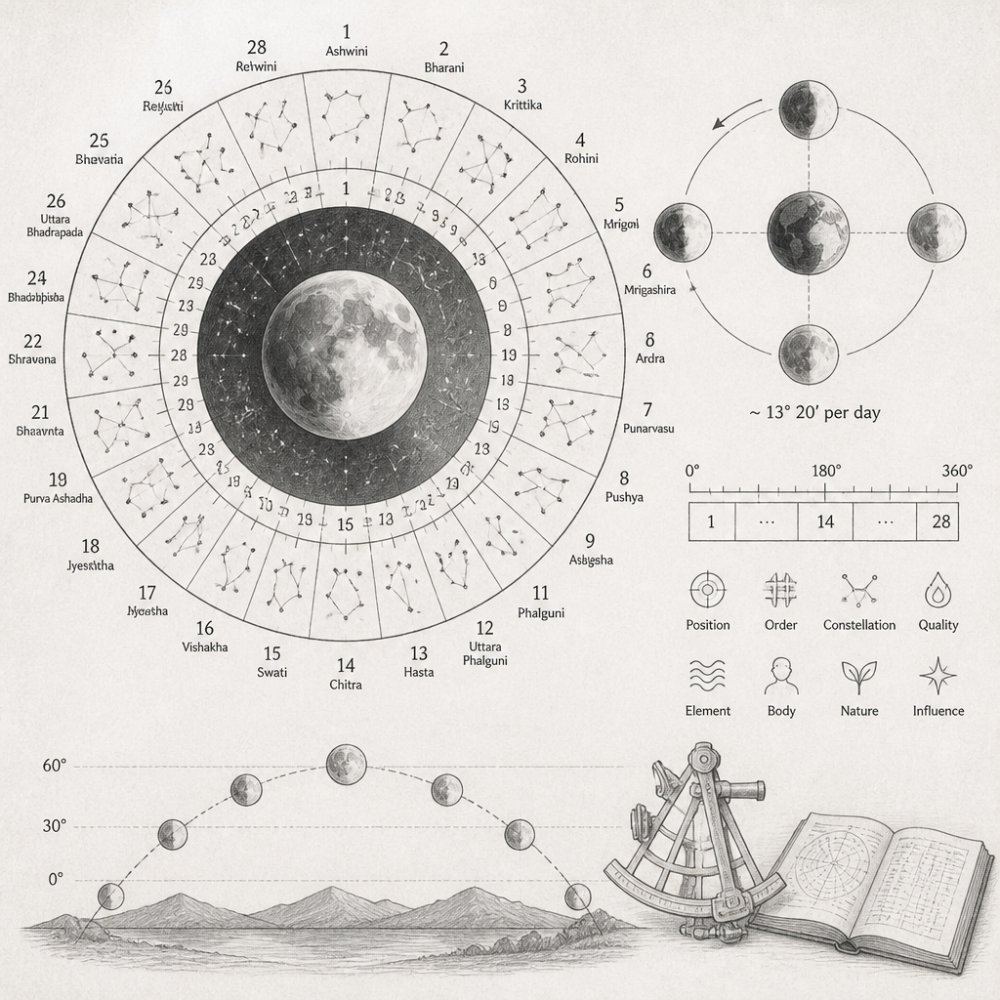
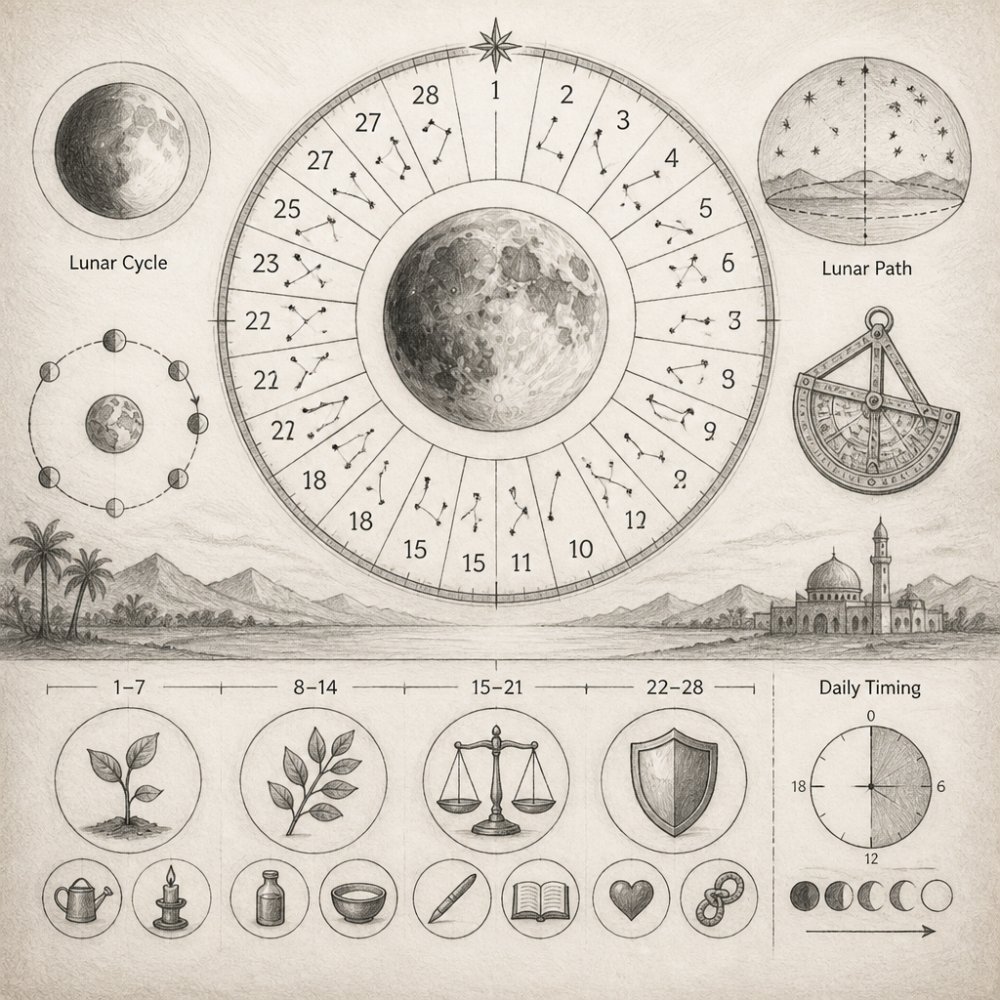
The 28 lunar mansions represent the Moon's monthly journey divided into 28 distinct stations, each spanning roughly 12-13 degrees of the zodiac. These are not the same as the 12 zodiac signs; they are a finer division used in classical Islamic astronomy.
Classical texts assign each mansion particular attributes. Some mansions are considered fortunate for starting ventures; others are better for healing work, spiritual practice, or administrative tasks. The Picatrix and similar sources provide detailed descriptions of each mansion's nature and appropriate uses. Understanding these distinctions allows practitioners to time activities with intention rather than guesswork.
Explore the meaning of the 28 lunar mansions, their cultural origins, and how to use them for timing.
The Moon's speed through these mansions is predictable: it advances roughly one mansion per day. This regularity makes planning feasible. A practitioner can identify which mansions are active in coming weeks and align important events with favorable positions. The calculation requires precision, lunar positions shift by the hour, which is why astronomical tools matter.
How to Choose an Auspicious Date for Your Event
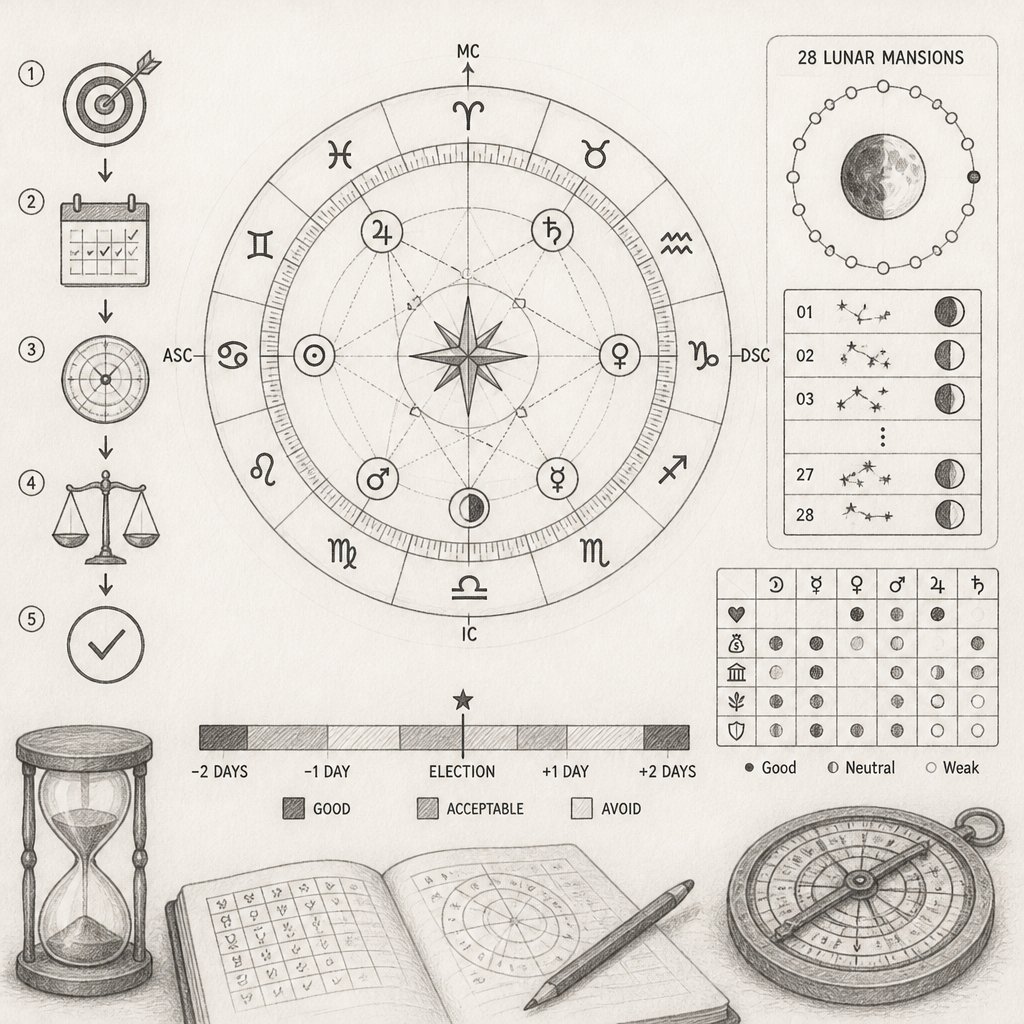
Choosing an auspicious date begins with clarity about your event's nature and intent. A wedding, a business launch, and a medical procedure each have different timing needs. The first step is defining what you want the event to accomplish and what qualities would support that outcome. Does your event require boldness and rapid growth? Stability and endurance? Careful planning and detail?
Once you've identified the core quality needed, you can filter available dates by which lunar mansions or planetary positions align with that quality.
The process involves cross-referencing several layers: the lunar mansion active on each candidate date, the planetary positions and aspects, the planetary hours available during your event window, and any personal factors from your natal chart. Not all layers carry equal weight in every situation.
Choose the best day to begin one important event with an Elected Date Report. This service applies the full classical framework to your specific event, returning options you can evaluate against your practical constraints.
Using a Lunar Mansion Calculator to Refine Your Timing
A lunar mansion calculator removes the computational barrier from electional work. Instead of consulting ephemerides or performing manual calculations, you input a date range and receive immediate information about which mansions are active, their characteristics, and how the Moon's position evolves across your window of interest.
The best lunar mansion calculators combine astronomical accuracy with classical interpretation. Moon Mansion Calculator pairs precise browser-based calculations with traditional guidance, showing not just where the Moon is but what that position means for timing decisions. The tool displays moonrise and moonset times, phase information, illumination percentage, and mansion position, data points that classical rules reference directly.
Using the calculator effectively means understanding what you're looking for. Are you scanning for any favorable date in the next month? You might run the calculator across a broad range and note which dates show strong mansion signatures. Are you trying to refine a specific date you've already chosen? You can check that date's lunar mansion and planetary hours to identify the optimal moment within your event window. The calculator's speed makes iteration practical, you can test multiple scenarios in minutes rather than hours.
Planetary Hours Calculator: Narrowing Your Timing Window
Planetary hours provide a finer grain of timing than the daily lunar mansion. While a mansion governs roughly a full day, planetary hours divide each day into 24 segments, each ruled by a different planet. This allows practitioners to narrow an auspicious date down to a specific hour, sometimes even a 30-minute window.
Planetary hours follow a fixed sequence based on classical planetary order. The sequence repeats daily but begins at different local times depending on sunrise and sunset.
Classical rules assign each planet particular strengths and associations. You can receive ranked dates for your event using a Best Dates Report. Some hours favor communication, others commerce, others spiritual work or rest.
The interaction between mansion and hour adds depth to timing decisions. A good mansion with an unfavorable hour is workable but not ideal. A less-ideal mansion with a strongly favorable hour might still serve your purpose. Experienced practitioners learn to weigh these trade-offs based on their tradition and intuition.
Find Your Natal Moon Mansion →
Classical Rules, Essential Dignities, and Practical Trade-Offs
Classical electional astrology rests on the concept of planetary dignity, the idea that planets are stronger in some positions than others. A planet in its rulership (the sign it governs) is strong. A planet in its exaltation (a secondary position of strength) is also favorable.
These dignities matter because they determine which planets can reliably support your event. If you need Jupiter's expansive energy for a business launch, you want Jupiter in a position of strength, ideally in Sagittarius or Pisces (rulership or exaltation).
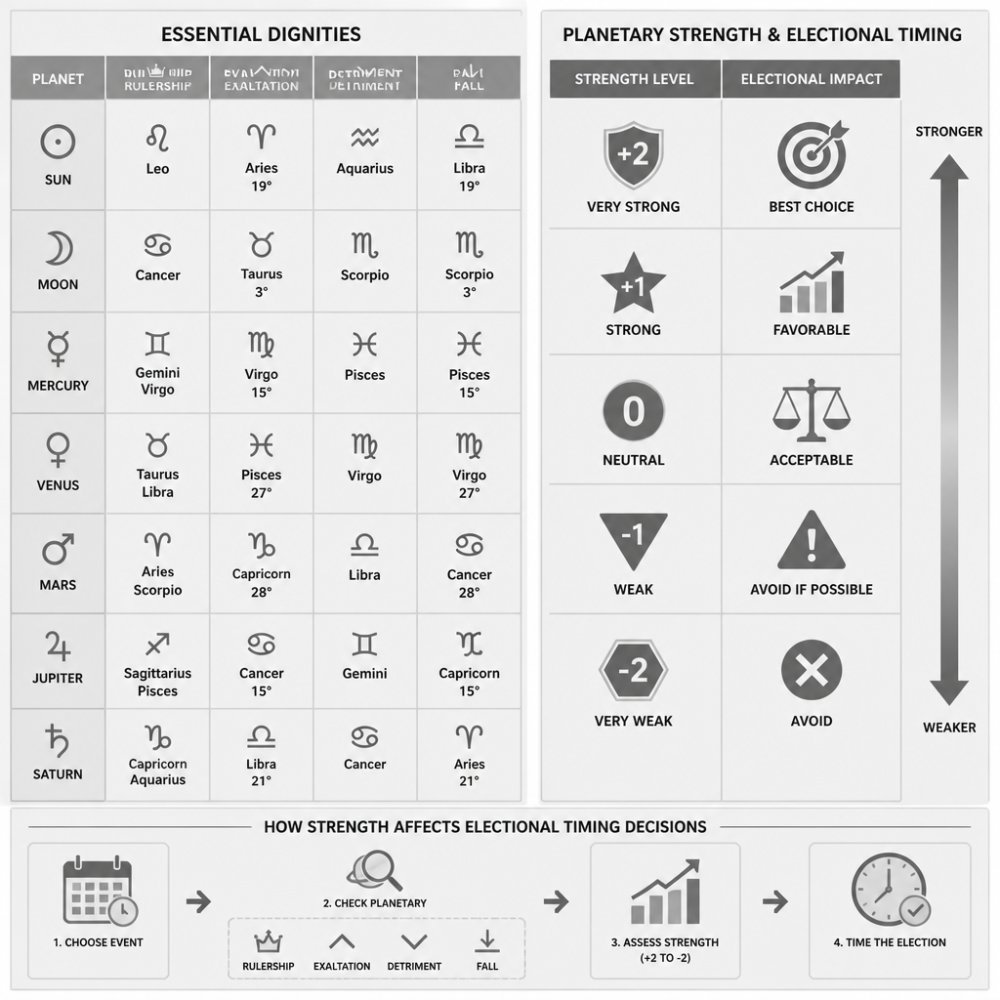
The challenge is that no date offers perfect dignity for every planet. Trade-offs are inevitable. A practitioner might find a date where Jupiter is strong but the Moon is in fall, or where the lunar mansion is excellent but Mercury is weak.
Understanding these priorities prevents analysis paralysis. You're not seeking perfection, you're seeking alignment between the event's nature and the strongest available planetary support.
Planning Your First Electional Chart
Building your first electional chart is manageable if you break the process into steps.
Next, identify the key planetary energies that support your goal. For a business launch, that's typically Jupiter (growth, opportunity) and Mercury (communication, contracts, commerce). For a wedding, Venus (love, partnership) and the Moon (emotion, bonding).
Now use Moon Mansion Calculator or another reliable tool to scan your available date range. Look for dates where:
- The lunar mansion is favorable for your event type
- Key planets are in positions of dignity (or at least not in fall)
- The planetary hour ruler supports your goal
- Practical constraints (your schedule, others' availability) can be met
You don't need every factor to align perfectly. A date where two or three key factors are strong is workable. Write down your top three candidate dates and their key characteristics.
When you're ready to move forward, implement your chosen timing. If your event is a business incorporation, file papers during your chosen hour.
Timing important events with classical electional astrology requires learning a system, but the payoff is clarity. Rather than hoping circumstances align, you're actively choosing moments when celestial conditions support your specific goal.
Frequently Asked Questions
What is electional astrology timing and why would someone use it?
Electional astrology timing is the practice of selecting auspicious dates and times to begin important events, weddings, business launches, journeys, or rituals, based on planetary positions and lunar cycles. People use it to align their activities with favorable celestial conditions, working from the classical principle that certain moments carry stronger energy for specific intentions. The system draws from medieval Islamic astronomy and classical sources like the Picatrix, combining precise astronomical calculation with traditional timing rules.
How do the 28 lunar mansions work in electional timing?
The 28 lunar mansions are divisions of the Moon's monthly path through the sky, each with distinct qualities and rulerships. As the Moon moves through each mansion over approximately 13 days, it carries different energetic signatures. Classical sources assign each mansion to specific activities: some favor beginnings and growth, others support completion or protection. Understanding which mansion the Moon occupies helps you select timing that resonates with your intention, whether you're starting a venture or completing a cycle.
How accurate are lunar mansion calculators, and how do I verify the data?
Reliable lunar mansion calculators use precise astronomical algorithms to compute the Moon's exact position in the sky. Moon Mansion Calculator, for example, combines astronomical computation with classical timing guidance from sources like the Picatrix, running calculations entirely in the browser for transparency. To verify accuracy, check that the tool displays moonrise, moonset, phase, and illumination data you can cross-reference with other astronomical sources. A calculator that cites its classical sources and shows its mathematical work is more trustworthy than one that keeps its methods hidden.
Can I actually use electional astrology in my daily life, or is it only for major events?
You can use electional timing for both major milestones and daily activities. For significant events like weddings or business launches, you'd spend time selecting an optimal date and hour. For everyday decisions, starting a project, scheduling a difficult conversation, or planning travel, you can check the current lunar mansion and planetary hours to choose a supportive moment. The key is matching the scale of timing effort to the importance of the activity. A free lunar mansion calculator lets you quickly check conditions before routine tasks without complex calculation.
What's the difference between planetary hours and lunar mansions in timing?
Lunar mansions operate on a monthly cycle, showing the Moon's position and its qualities over roughly 13 days each. Planetary hours divide each day into 24 unequal hours, each ruled by a different planet, allowing you to refine timing within a single day. Together, they create a two-level system: first, select a favorable day using lunar mansions; then, narrow to a specific hour using planetary hours. This combination gives you both broad timing (which day) and precise timing (which hour) for your event.
Do I need a background in astrology to use a lunar mansion calculator?
No. A well-designed lunar mansion calculator translates classical concepts into accessible information. You don't need to study Islamic astronomy or medieval texts to benefit from the tool, it handles the astronomical computation and presents the mansion data in clear, visual form. Reading the classical meanings assigned to each mansion requires some familiarity with astrology, but most modern calculators explain what each mansion supports. Starting with simple activities (planning a journey, timing a ritual) helps you build intuition without needing formal training first.
How do I know if a date is truly auspicious, or am I just seeing patterns I want to see?
Classical electional astrology is based on systematic rules developed over centuries, not random pattern-matching. These rules examine planetary positions, essential dignities (whether planets are strong or weak), lunar mansion qualities, and planetary hours, all measurable celestial data. That said, no timing system guarantees outcomes; astrology works best as a framework for intention-setting and decision-making. The value lies in aligning your actions with a coherent system of timing, which can clarify your thinking and increase your commitment to the activity you've chosen to begin.