 listicle
User-Friendly Islamic Lunar Mansion Tools for 2026
Table of Contents
- Why Most Lunar Mansion Tools Feel Too Technical
- What to Look For in Beginner-Friendly Lunar Mansion Tools
- How to Calculate Lunar Mansions Without a Math Background
- Lunar Mansion Cycle Duration and What It Means for Planning
- A Lunar Mansion Timing Guide for Everyday Activities
- Free Web Tools vs. Paid Apps: Which Fits Your Practice?
- Frequently Asked Questions
Last Updated: September 24, 2026
Why Most Lunar Mansion Tools Feel Too Technical
The biggest barrier to using lunar mansion tools isn't the astronomy. It's the interface. Most existing calculators assume you already know what a celestial longitude is, and can convert between sidereal and tropical coordinates without breaking a sweat.
That assumption shuts out almost everyone. According to Sirauysal.com's overview of the [28 lunar(https://blog.moonmansioncalculator.com/what-are-the-28-lunar-mansions) stations | sirauysal.com], traditional systems recognize 28 distinct lunar mansions, each with its own determinant star and interpretive layer. A beginner-friendly tool has to present that complexity without drowning you in it.
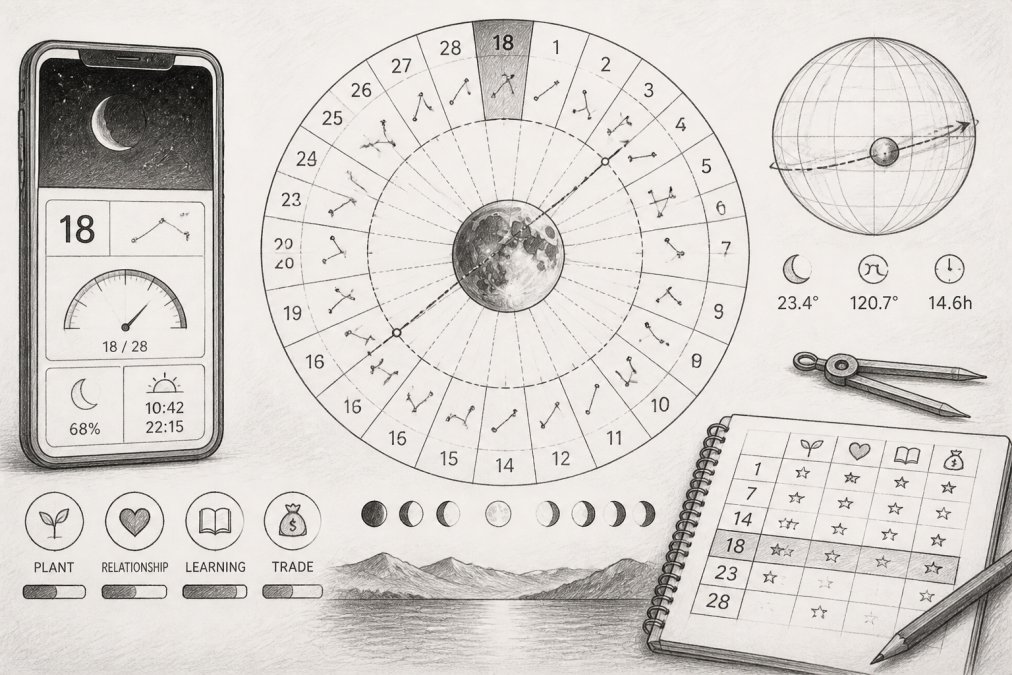
The Moon Mansion Calculator team built its browser-based tool specifically to close that gap. It runs precise astronomical algorithms in the background and shows you the current mansion, moonrise, moonset, phase, and illumination data in plain language. No sign-up, no math degree.
What to Look For in Beginner-Friendly Lunar Mansion Tools
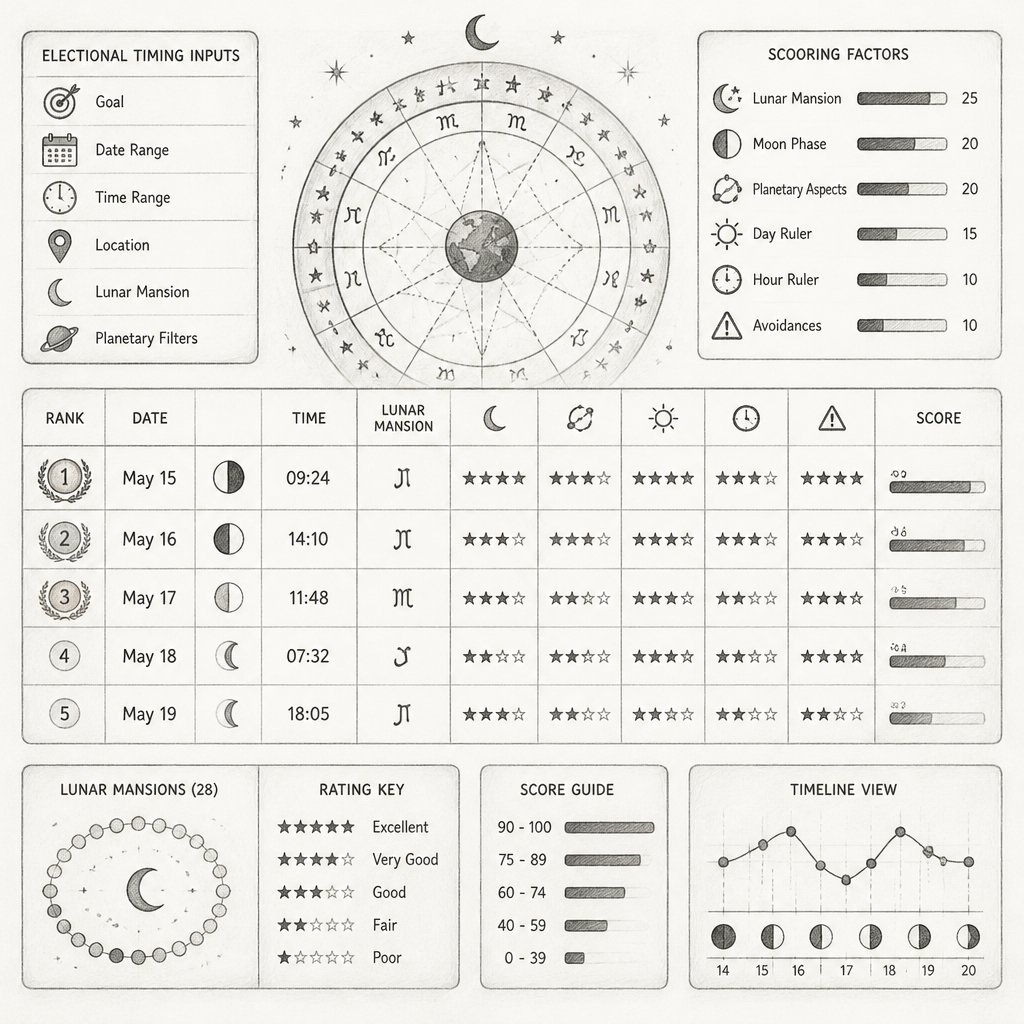
Three criteria separate a usable tool from a frustrating one: mobile-first design, no-account access, and visual aids that explain what you're seeing. But criteria alone don't help you choose. Here's how the most accessible options actually perform against each one.
Mobile-First Design and No-Account Access
The shift toward digital-first tools is real. Apps like the [Arab Lunar Mansions(https://blog.moonmansioncalculator.com/how-to-use-lunar-mansions-for-daily-planning) app on Google Play | play.google.com] prioritize fast access without requiring registration, and that matters when you want a quick answer at 6 a.m. before a meeting or a ritual.
A tool that demands an email address before showing you the current mansion has already failed. Look for:
- Loads in under three seconds on a phone
- Shows the current mansion on the first screen
- Works without login, payment, or a download
- Displays moonrise and moonset in your local time
Here's how the most commonly recommended tools stack up on those four points:
| Tool | Loads Under 3s | Mansion on First Screen | No Login Required | Local Moonrise/Moonset |
|---|---|---|---|---|
| Moon Mansion Calculator | Yes | Yes | Yes | Yes |
| Arab Lunar Mansions app | Yes | Yes | Yes | Yes |
| Astro-Seek Arabic Moon Mansion Calendar | Yes | No, requires date entry first | Yes | Partial |
| Augurine calculator | Yes | Yes | Yes | No |
A common pattern among beginners is abandoning a tool within the first thirty seconds if the current mansion isn't visible without interaction.
Calendar Integration and Visual Cheat Sheets
Most calculators stop at the number. Better ones show you the cycle. A visual cheat sheet that maps all 28 mansions across the lunar month lets you plan ahead instead of checking daily.
What Separates a Good Tool from a Great One
Beyond the basics, three details signal a tool worth returning to:
- Stated source. The tool names its ephemeris or classical reference (e.g., the Picatrix) so you can verify output.
- Plain-language descriptions. Each mansion gets a short, non-technical summary, not just a name and a degree range.
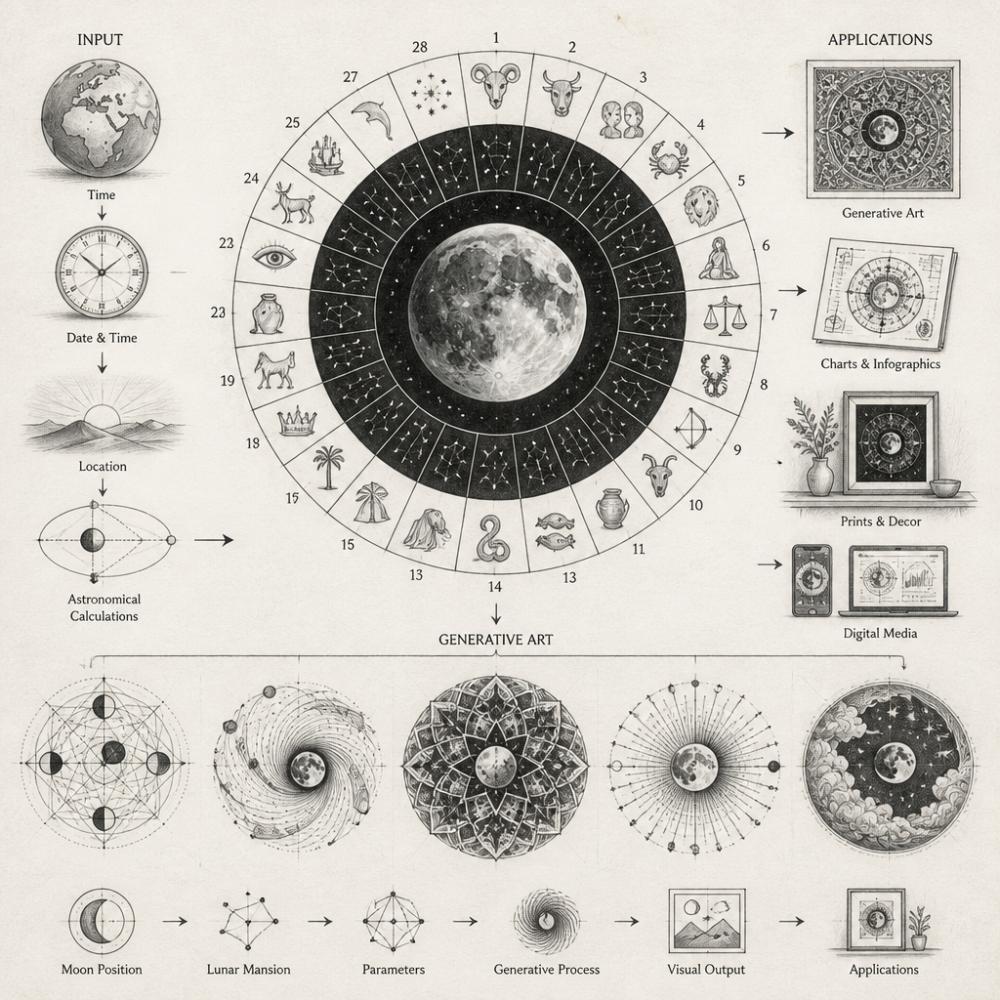
- Visual identity per mansion. Artwork, a symbol, or a color code for each of the 28 stations makes them memorable and speeds up recognition.
How to Calculate Lunar Mansions Without a Math Background
You don't need to calculate anything by hand. Modern tools handle the astronomy, and here's the process they follow:
- Determine the Moon's current ecliptic longitude
- Divide that longitude by 12°51'25.7" (the width of one mansion)
- Identify which of the 28 lunar stations the result falls into
- Cross-reference the determinant star and planetary ruler
- Apply classical timing guidance from sources like the Picatrix
Lunar Mansion Cycle Duration and What It Means for Planning
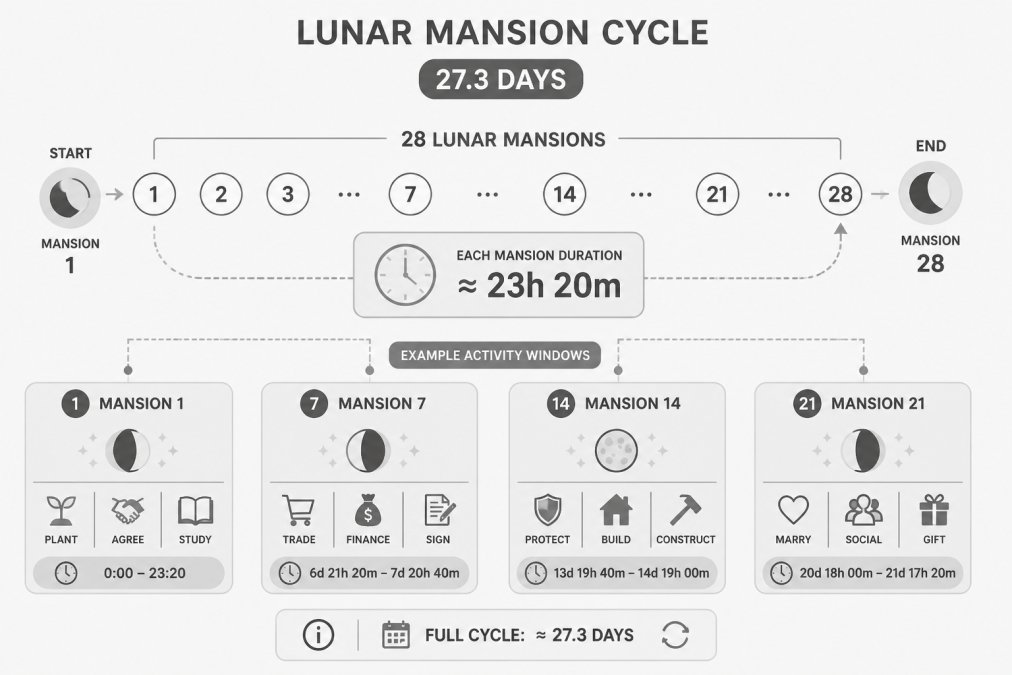
The full lunar mansion cycle runs about 27.3 days, with the Moon spending roughly 23 hours and 20 minutes in each of the 28 stations.
A Lunar Mansion Timing Guide for Everyday Activities
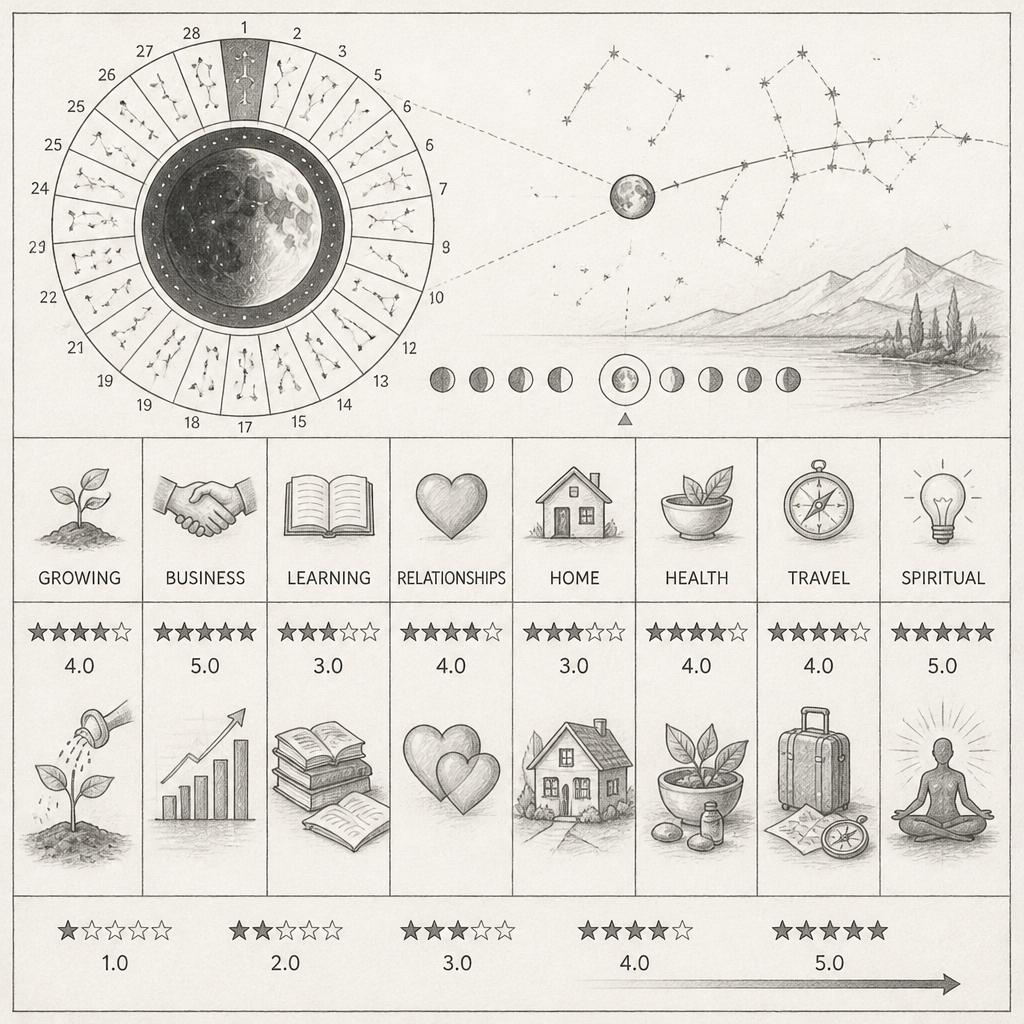
Traditional sources assign different activities to different mansions. The chart below groups common decisions by the type of mansion that suits them.
| Activity Type | Suitable Mansion Character | Best Timing Window | Example |
|---|---|---|---|
| Beginnings | Auspicious, favorable stations | First hours after moonrise | Launching a project |
| Travel and journeys | Stations linked to movement | Before the mansion changes | Booking a trip |
| Contracts and agreements | Stable, fixed stations | Mid-mansion | Signing an agreement |
| Rest and reflection | Stations tied to retreat | Evening hours | Pausing a decision |
| Ritual work | Stations with strong classical guidance | Exact mansion hour | Ceremonial timing |
Free Web Tools vs. Paid Apps: Which Fits Your Practice?
Free browser tools win for most people. They load instantly, require no purchase, and cover the core need: what mansion is the Moon in right now, and what does it mean for today.
A Decision Framework, Not a Feature List
Most comparisons of lunar mansion tools list features without helping you decide. Here's a simpler approach, answer three questions:
- Do you need offline access? If you travel frequently or have unreliable connectivity, a paid app with downloaded ephemeris data is worth considering. If you're always online, a browser tool covers everything.
- Do you want passive reminders? Home-screen widgets and push notifications are the main feature browser tools can't replicate. If checking a website each morning feels like friction, a widget solves that.
- Do you need professional-grade precision? If you're cross-referencing mansion positions against other astronomical data, a tool that exposes its raw ephemeris output matters. For daily planning, it doesn't.
What Free Browser Tools Actually Cover
For anyone just starting, the browser route removes every obstacle. Calculations run locally, no account is required, and the visual artwork for each mansion gives you something concrete to remember it by. When you're ready to go deeper, tools like the Augurine lunar mansion calculator add interpretive frameworks for users who want them.
Where Paid Apps Add Real Value
Paid apps justify their cost in three specific scenarios:
- Offline use. Downloaded ephemeris data means the tool works on a plane, in a remote area, or anywhere without signal.
- Widgets and notifications. A home-screen widget showing the current mansion removes the need to open anything. Push notifications when a mansion changes are useful for timing-sensitive activities.
- Advanced charting. Some paid apps let you overlay mansion positions on a birth chart or track mansion transits over time, features that browser tools rarely offer.
What paid apps rarely improve is the core daily use case: checking the current mansion and reading a plain-language description. That experience is already well-served by free tools.
The Unique Angle: Ease-of-Use Ratings
Most comparisons rate tools on features. A more useful measure for beginners is time-to-first-answer, how many seconds pass between opening the tool and seeing the current mansion.
Based on that measure:
| Tool | Time to First Answer | Account Required | Offline | Widget |
|---|---|---|---|---|
| Moon Mansion Calculator | Under 2 seconds | No | No | No |
| Arab Lunar Mansions app | Under 2 seconds | No | Yes | Yes |
| Astro-Seek | 5-10 seconds (date entry) | No | No | No |
| Augurine | Under 2 seconds | No | No | No |
Frequently Asked Questions
Are there simple digital tools for tracking Manāzil al-Qamar?
Yes. Browser-based calculators and mobile apps now handle the astronomy for you, so you only read the result. A free web calculator maps the Moon's current position across all 28 mansions and shows moonrise, moonset, phase, and illumination data on one screen. Mobile options work offline or send notifications. None of these require an astronomy background, and most need no account at all.
How do I calculate my birth lunar mansion without doing the math myself?
Enter your birth date, time, and location into a mansion calculator and it returns the manzil the Moon occupied at that moment. The tool converts your birth data into celestial longitude and matches it against the 28 stations, which is the part that used to require an ephemeris and patience. Moon Mansion Calculator does this in the browser. Write the result down; you will track the Moon's monthly return to that mansion later.
How long does the Moon stay in each lunar mansion?
The Moon passes through all 28 mansions in about 27.3 days, so each mansion lasts roughly 23 hours and 20 minutes. That is short enough that timing shifts daily, which is why a calculator beats a printed table. If you want to schedule something during a specific mansion, check the tool the same week, not the same month, because the window moves fast.
Is the generative artwork in these tools useful or just decorative?
It serves a practical purpose. Each of the 28 mansions gets its own visual identity, so you start recognizing a mansion by its image before you recall its name or number. That shortens the learning curve for beginners who have not memorized the sequence. The artwork does not change the calculation, but it makes the cycle easier to remember and more pleasant to check daily.
The hardest part of working with lunar mansions has never been the astronomy. It's finding a tool that respects your time and explains what you're looking at. Moon Mansion Calculator handles the calculations in the browser, maps the Moon across all 28 mansions, and pairs each one with classical Picatrix timing guidance and generative artwork. Find your natal mansion and start planning your days around the cycle.