 how-to
Verify Lunar Mansion Data Accuracy: A Step-by-Step Guide
Table of Contents
- Why Verifying Lunar Mansion Data Matters
- Step 1: Gather and Validate Your Birth Data
- Step 2: Understanding Ayanamsa and Sidereal Systems
- Step 3: Cross-Verify Using Astronomical Ephemeris Data
- Step 4: Validate Divisional Charts and Planetary Degrees
- Best Astrology Calculators for Lunar Mansion Verification
- Lunar Mansion Calculation Algorithms: Manual vs. Software
- Common Verification Mistakes to Avoid
- Frequently Asked Questions
Last Updated: September 29, 2026
Why Verifying Lunar Mansion Data Matters
To verify lunar mansion data accuracy, accurate lunar mansion calculations must form the foundation of meaningful celestial timing work. When the Moon's position is wrong, everything built on that data, from activity planning to ritual timing, loses its reliability.
The consequences of inaccurate data extend beyond simple miscalculation. A small error in birth time, location coordinates, or Ayanamsa selection can shift a lunar mansion assignment by an entire mansion or more. This means the timing guidance becomes misaligned with actual celestial conditions. For practitioners relying on classical sources like the Picatrix for electional timing, this misalignment undermines the entire practice.
To verify lunar mansion data accuracy is not optional for serious work. It requires understanding several interconnected systems: how birth data precision affects calculations, why Ayanamsa selection matters, and how to cross-check results using multiple methods. Moon Mansion Calculator integrates precise astronomical algorithms with these verification principles, allowing users to confirm their data before making decisions based on lunar mansion positions.
Step 1: Gather and Validate Your Birth Data
Accurate birth data is the starting point for all lunar mansion calculations. Three elements must be correct: the date, the time, and the location. Any weakness here cascades through every subsequent calculation.
Birth Time Precision and Its Impact
Birth time accuracy directly determines how precisely a lunar mansion can be calculated. The Moon moves approximately 12-13 degrees per day through the zodiac, which translates to roughly one lunar mansion every 2.14 days. This means the Moon can shift to a different mansion in just a few hours.
A birth time error of even 30 minutes can produce a different lunar mansion assignment. For practitioners working with lunar mansion timing, this represents the difference between correct guidance and misleading information.
Gathering accurate birth time requires checking multiple sources:
- Hospital or birth certificate records (most reliable)
- Family records or parent recollection (often approximate)
- Astrological rectification (complex, used when exact time is unavailable)
When exact birth time is unavailable, document this limitation. Some practitioners work with noon positions as a placeholder, but this introduces known error into the system. Being transparent about data limitations is more valuable than pretending precision exists where it doesn't.
Geographic Coordinates and Location Accuracy
The Moon's position depends on the observer's location on Earth. Different geographic coordinates produce different lunar mansion calculations, particularly for people born near the boundaries between mansions.
Latitude and longitude must be accurate to at least the nearest minute of arc for reliable mansion determination. City-level coordinates often lack this precision. Using a city center instead of the actual birth location can introduce errors.
Obtain precise coordinates through these methods:
- GPS coordinates from the birth location (most accurate)
- Online coordinate databases using the specific hospital or location name
- Mapping services that provide latitude and longitude to several decimal places
- Verification against multiple sources to catch transcription errors
Record coordinates to at least four decimal places (approximately 11 meters precision). When birth location is uncertain, acknowledge this in your records. Some practitioners note a coordinate range rather than a single point when exact location is unknown.
Step 2: Understanding Ayanamsa and Sidereal Systems
Ayanamsa is the difference between the tropical zodiac (used in Western astrology) and the sidereal zodiac (used in Vedic and traditional Islamic astronomy). It represents the precession of Earth's axis over centuries, which shifts the apparent position of stars relative to the zodiac.
Different Ayanamsa systems produce different planetary degree positions and therefore different lunar mansion assignments. This is not an error, it reflects different historical reference points and calculation methods. The three most commonly used systems are:
- Lahiri Ayanamsa: Standard in most Vedic astrology software
- Fagan-Bradley Ayanamsa: Used in some Western sidereal traditions
- Raman Ayanamsa: An alternative calculation method
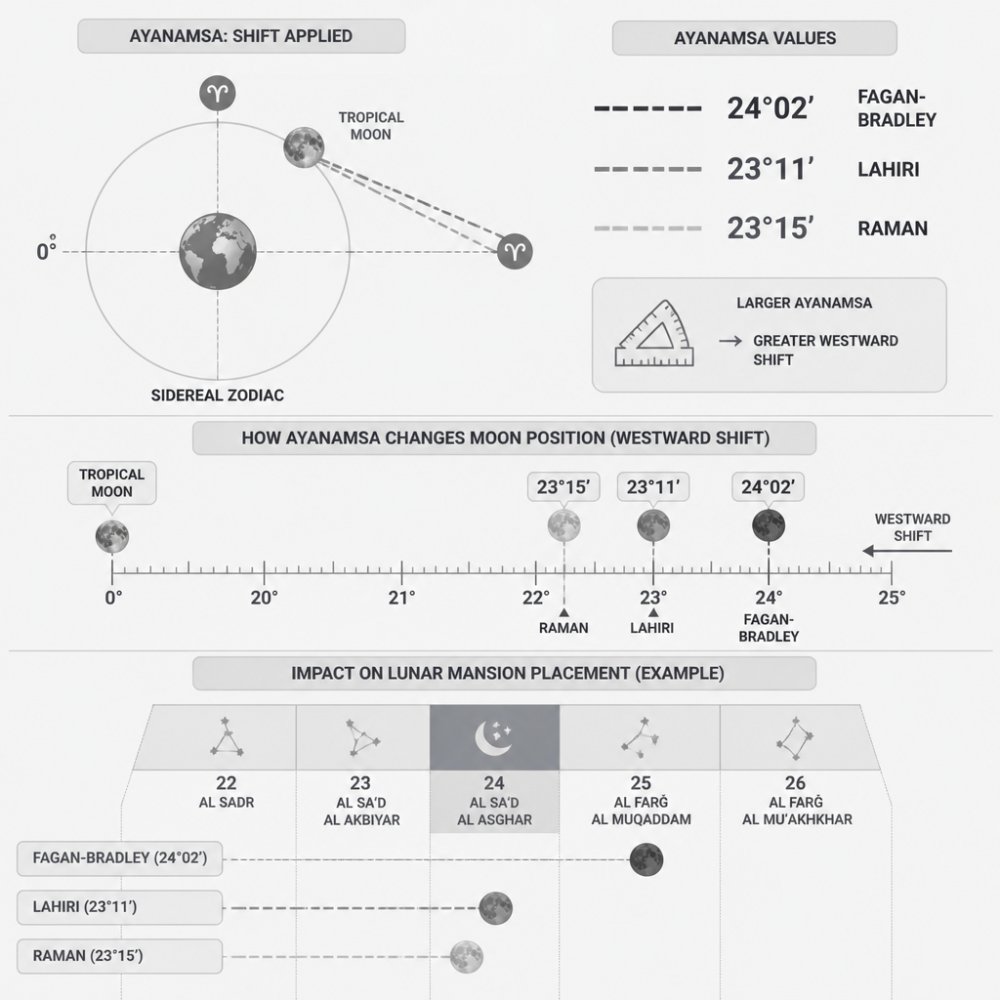
Selecting the correct Ayanamsa depends on the tradition being followed. Traditional Islamic astronomy, as documented in classical sources, typically aligns with specific historical reference points. Moon Mansion Calculator uses a default Ayanamsa that corresponds to widely adopted standards in sidereal calculations.
Find Your Natal Moon Mansion →
The impact of Ayanamsa selection is real and measurable. Switching from Lahiri to Fagan-Bradley can shift a planetary position by approximately 0.75 degrees. At the lunar mansion scale, where each mansion spans 12.86 degrees, this difference may or may not cross a mansion boundary depending on where the Moon sits within its current mansion.
Document which Ayanamsa system is being used. When comparing calculations across different tools or practitioners, verify they use the same Ayanamsa. Mismatched systems are a primary source of conflicting results.
Step 3: Cross-Verify Using Astronomical Ephemeris Data
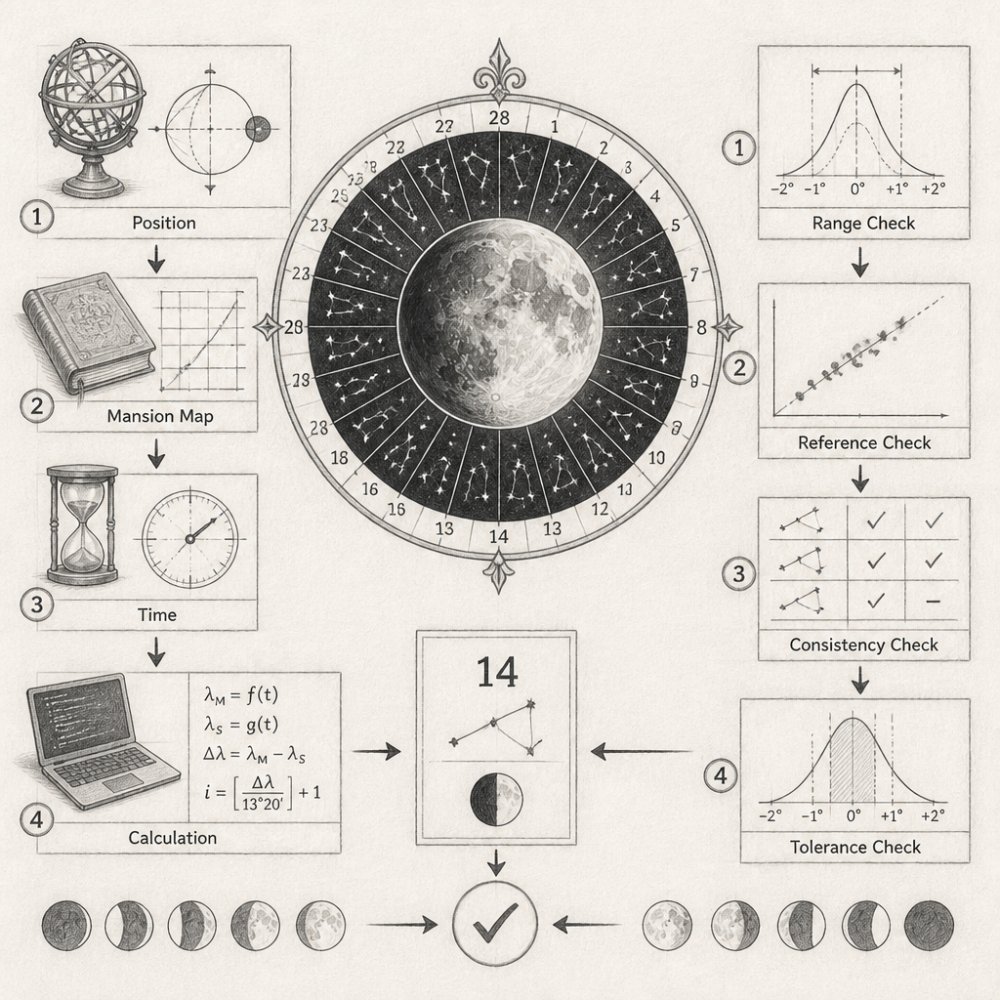
Ephemeris data provides the precise astronomical positions of celestial bodies at specific times. Cross-verifying lunar mansion calculations against ephemeris data confirms that calculations are based on actual celestial positions rather than software errors or incorrect settings.
The verification process involves three steps:
- Extract the Moon's longitude from an ephemeris for the birth date and time
- Apply the chosen Ayanamsa to convert tropical longitude to sidereal longitude
- Determine which lunar mansion corresponds to that sidereal longitude
Reliable ephemeris sources include:
- NASA JPL Horizons System (free, highly accurate)
- Swiss Ephemeris (standard in astrology software)
- Astronomical Almanac (official U.S. government publication)
Step 4: Validate Divisional Charts and Planetary Degrees
Divisional charts subdivide the zodiac into smaller sections, providing more granular astrological analysis.
The verification process involves:
- Confirming the Moon's exact sidereal longitude (to one decimal place minimum)
- Determining the lunar mansion (1-28) from this longitude
- Cross-checking against reference tables or alternative calculation methods
Best Astrology Calculators for Lunar Mansion Verification
Several tools support lunar mansion calculation and verification. The selection depends on whether you need real-time current mansion data, natal mansion calculation, or detailed verification features.
- Allows Ayanamsa selection (or clearly states which one is used)
- Displays the Moon's exact sidereal longitude
- Includes verification features or multiple calculation methods
- Uses current, high-precision ephemeris data
Lunar Mansion Calculation Algorithms: Manual vs. Software
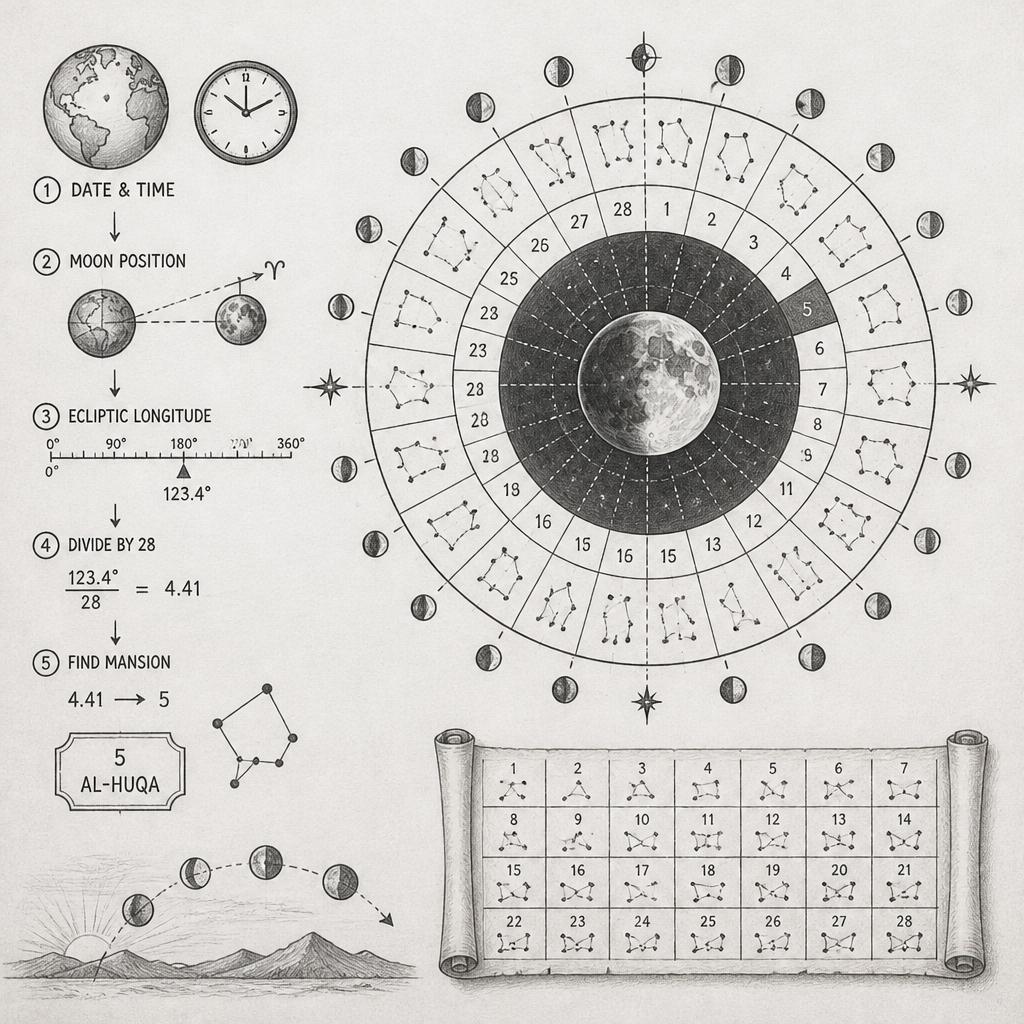
Manual calculation of lunar mansion position involves mathematical steps that software performs automatically. Understanding the manual process builds confidence in software results and enables verification.
The manual process follows this sequence:
- Obtain the Moon's tropical longitude from an ephemeris
- Look up the Ayanamsa value for the birth date
- Subtract Ayanamsa from tropical longitude to get sidereal longitude
- Divide sidereal longitude by 12.857 (degrees per mansion) to find the mansion number
Common Verification Mistakes to Avoid
Several errors systematically undermine lunar mansion verification work. Recognizing these patterns prevents wasted effort and incorrect conclusions.
| Verification Step | Common Error | How to Avoid |
|---|---|---|
| Birth data gathering | Using approximate time without noting it | Document all data sources and limitations |
| Ayanamsa selection | Mixing different Ayanamsa systems | Choose one system and use it consistently |
| Ephemeris lookup | Using outdated or low-precision data | Verify against NASA JPL or Swiss Ephemeris |
| Coordinate entry | Using city center instead of exact location | Look up precise coordinates for birth location |
| Time zone conversion | Forgetting daylight saving time adjustments | Verify time zone rules for birth date and location |
| Cross-verification | Comparing results from only one other source | Use at least two independent verification methods |
Frequently Asked Questions
What astronomical data is required to verify lunar mansion calculations?
Accurate lunar mansion verification requires three core data points: exact birth time (down to the minute), geographic coordinates (latitude and longitude), and the Ayanamsa system being used. Birth time directly determines the Moon's precise position in the zodiac. Geographic coordinates affect how celestial positions translate to local time. Ayanamsa, the offset between tropical and sidereal zodiac systems, shifts all planetary positions by several degrees. Without all three, your lunar mansion placement will be unreliable. Cross-reference these against NASA ephemeris data or astronomical software to confirm accuracy.
How do I know if a lunar mansion calculator is accurate?
Test any calculator by running the same birth data through multiple sources and comparing results. Accurate lunar mansion calculators will show consistent planetary degrees across platforms when using the same Ayanamsa. Check whether the tool discloses which Ayanamsa it uses, transparent calculators list this clearly. Verify that moonrise, moonset, and illumination data match NASA's Horizons System or established ephemeris tables. Poor calculators hide their methodology or produce wildly different results for identical input. The Moon Mansion Calculator uses precise astronomical algorithms and classical Islamic astronomy principles, making it a reliable reference point for comparison.
What is the difference between tropical and sidereal lunar mansion systems?
Tropical systems measure the Moon's position from the vernal equinox (where the Sun appears on the spring equinox), while sidereal systems measure from fixed stars. This creates a gap of roughly 24 degrees, the Ayanamsa, that grows slightly each year. Sidereal systems align with classical Islamic astronomy, including the 28 lunar mansions. Tropical systems are common in Western astrology but don't correspond to actual constellations. For lunar mansion work rooted in classical sources like the Picatrix, sidereal calculations are essential. Switching between systems will shift your lunar mansion placement by one or more mansions entirely, so always confirm which your calculator uses.
How can I cross-reference lunar mansion positions with NASA data?
Use NASA's Horizons System (https://ssd.jpl.nasa.gov/horizons/) to obtain precise Moon ephemeris data for your birth date and time. Input your geographic coordinates and request Moon longitude and latitude output. Convert the tropical longitude to sidereal by subtracting the appropriate Ayanamsa value. Divide the result by 12.857 (the degrees per lunar mansion) to identify which mansion the Moon occupied. Compare this with your calculator's result. Discrepancies usually point to incorrect birth time, wrong Ayanamsa setting, or coordinate entry errors. This manual verification process confirms whether your calculator's algorithms align with established astronomical data.