 how-to
Apply Picatrix Timing in Modern Life: A Practical Guide
Table of Contents
- What Picatrix Timing Is and Why It Matters
- Understanding the 28 Lunar Mansions
- How a Lunar Mansion Calculator Simplifies Timing
- Picatrix Lunar Mansions and Planetary Correspondences
- Lunar Timing for Activities: A Step-by-Step Workflow
- Adapting Picatrix Timing to Your Modern Schedule
- Common Mistakes and How to Avoid Them
- Frequently Asked Questions
Last Updated: October 5, 2026
What Picatrix Timing Is and Why It Matters
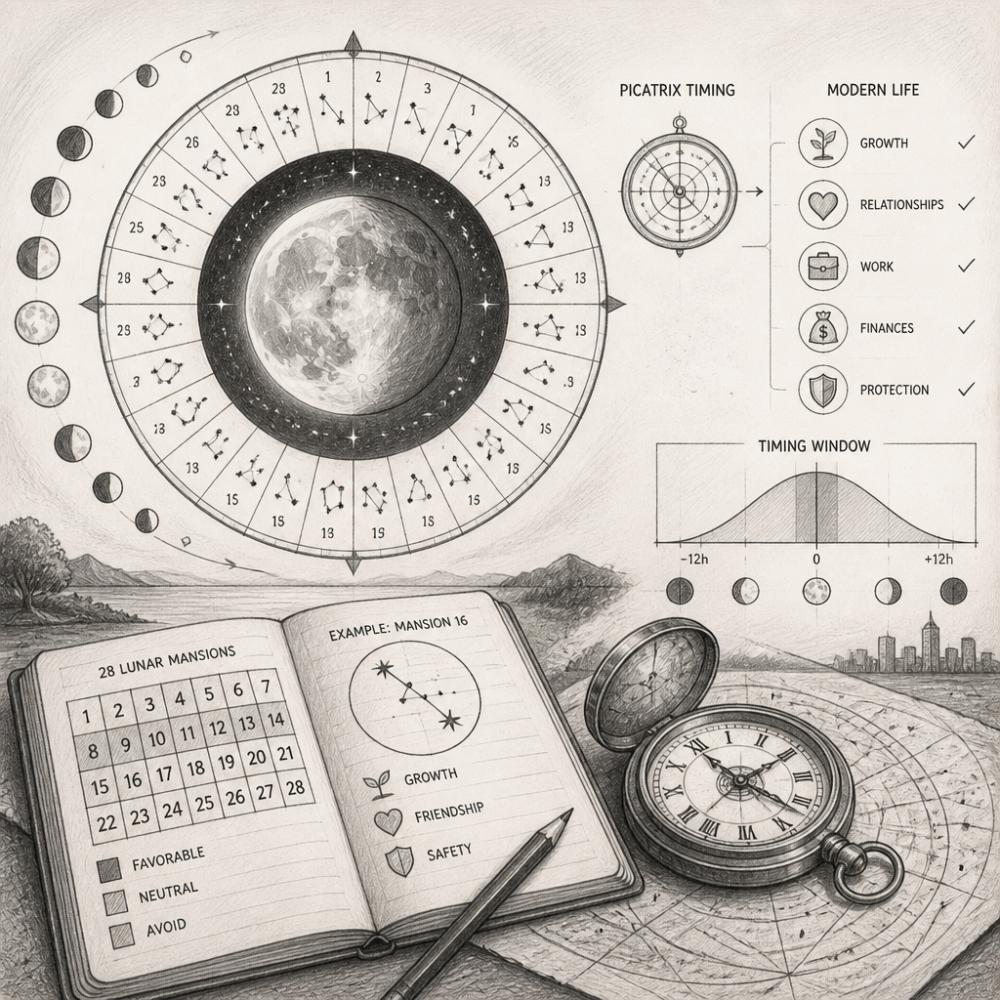
Picatrix timing is the practice of selecting auspicious moments for activities based on the classical Islamic astronomical principles in the medieval text Picatrix. It maps human activities to celestial cycles, particularly the Moon's position through the 28 lunar mansions, so practitioners align their intentions with specific lunar phases and planetary conditions rather than relying on chance.
The core idea is straightforward: certain times suit certain activities better. Starting a business during a waning moon differs from launching during a waxing phase. This is a structured method for working with natural cycles.
For modern practitioners, Picatrix timing bridges ancient wisdom with personal agency. Instead of feeling at the mercy of random timing, you can consult planetary positions and lunar mansion placements before committing to significant actions, a job interview, creative project launch, or relationship milestone can be timed intentionally rather than by default.
The Moon Mansion Calculator makes this accessible by providing precise, real-time calculations of where the Moon sits among the 28 mansions at any given moment, paired with guidance on which activities align best with each mansion's traditional correspondences.
Understanding the 28 Lunar Mansions
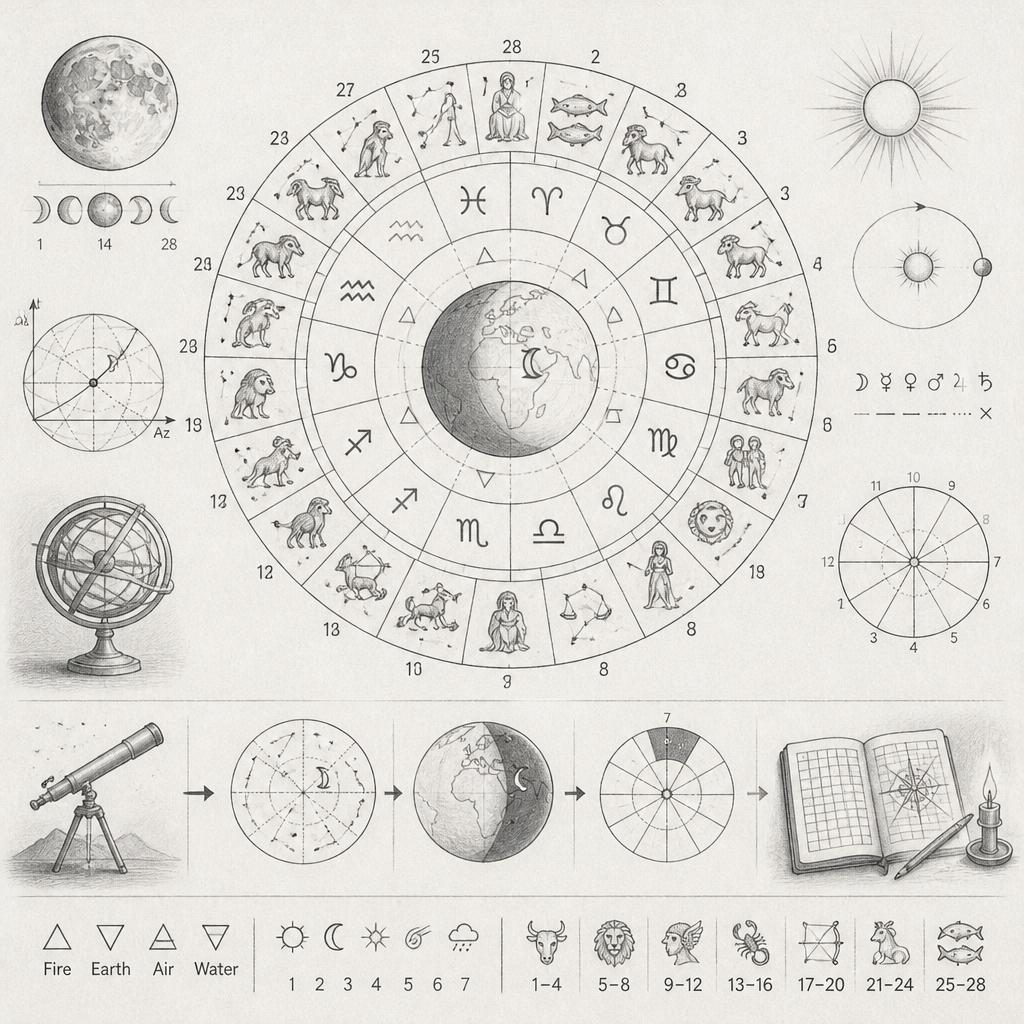
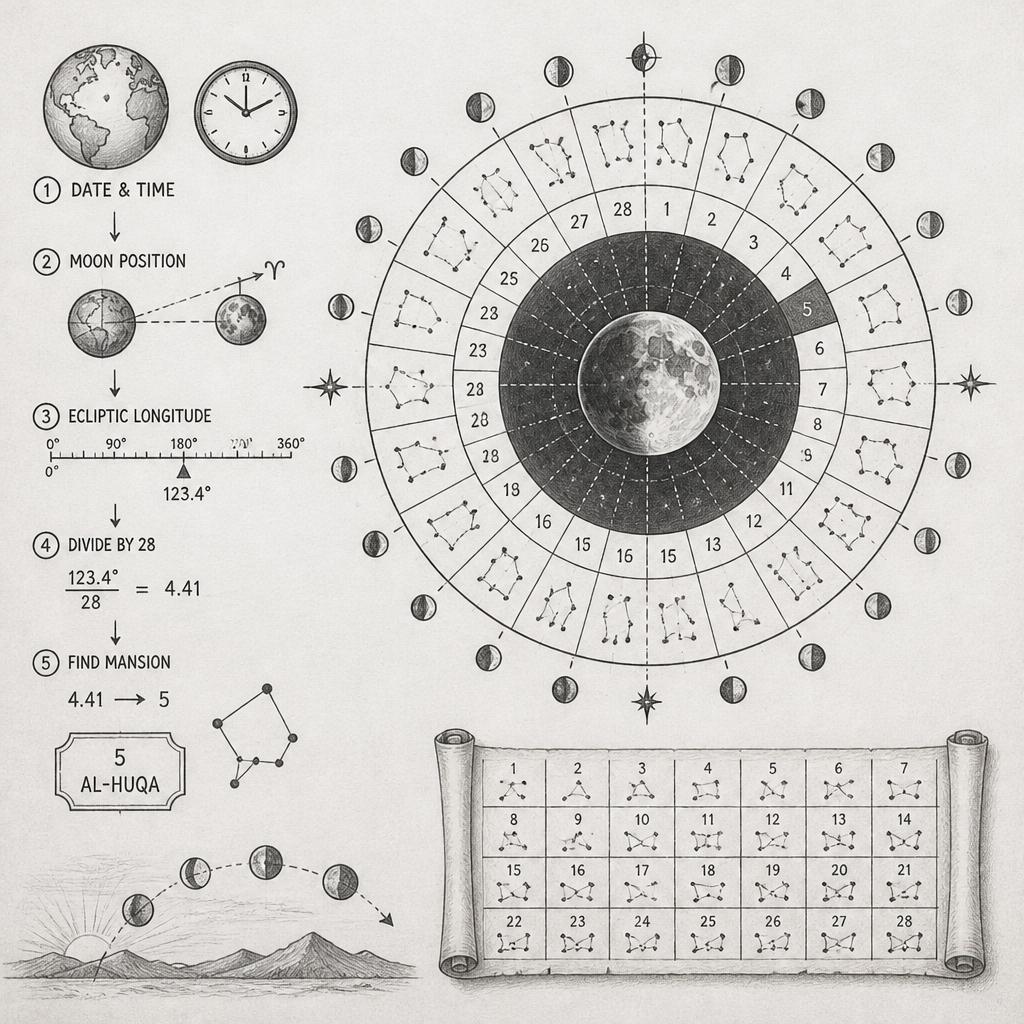
The 28 lunar mansions form the foundation of classical Islamic astronomy and the Picatrix system. Each mansion spans approximately 12.86 degrees of the Moon's monthly journey through the zodiac, marking natural waypoints in its orbit.
Each mansion carries distinct qualities and traditional associations: some favor beginnings, others completion and rest, a few emphasize communication or healing. Understanding this framework lets practitioners match activities to lunar conditions rather than work against them.
The mansions are numbered sequentially and carry names from the Islamic astronomical tradition. Moon Mansion Calculator displays these names alongside contemporary descriptions of their uses, honoring the historical sources while remaining accessible to modern users.
The system rests on observable celestial mechanics: the Moon moves through predictable positions, planetary alignments shift, and lunar phases cycle. Tracking these movements gives practitioners timing information grounded in reality rather than arbitrary. Aligning personal intention with these cosmic rhythms requires a stable internal anchor, making it essential to ground yourself daily as you integrate these ancient temporal patterns into your own routine.
How a Lunar Mansion Calculator Simplifies Timing
Manual calculation of lunar mansion positions requires astronomical algorithms, precise birth data or time coordinates, and calendar conversions, skills most people lack or don't want to develop. This is where a lunar mansion calculator becomes invaluable.
Moon Mansion Calculator eliminates the technical barrier: enter your birth date or the current date, and the tool instantly displays which mansion the Moon occupies, no math, software, or time-zone confusion required.
The calculator also provides moonrise and moonset times, lunar phase and illumination data, so practitioners can make informed timing decisions without cross-referencing multiple sources or interpreting complex charts.
For beginners especially, a calculator removes the intimidation factor: someone new to Picatrix timing can immediately see their natal mansion and current lunar position, then consult traditional guidance on suitable activities, democratizing a system that once required specialized training.
Picatrix Lunar Mansions and Planetary Correspondences
Each lunar mansion in the Picatrix system connects to specific planetary influences that determine which activities align best with its energy.
Mars mansions favor assertive action, conflict resolution, or overcoming obstacles; Venus mansions support relationship work, creative expression, or financial matters; Mercury mansions favor communication, learning, and negotiation; the Sun's mansions support leadership and visibility; the Moon's own mansions emphasize intuition and emotional work.
The 28 mansions distribute across the zodiac, with multiple mansions in each sign, so timing depends not just on the Moon's zodiac sign but specifically which of the 28 positions it holds.
Understanding these correspondences allows practitioners to ask targeted questions: "What mansion is best for starting a creative project?" or "When should I schedule a difficult conversation?" The answer comes from consulting which mansion's traditional associations match the activity's nature.
Moon Mansion Calculator displays these correspondences clearly, so you don't need to memorize all 28 mansions, just look up the current one and see its recommended uses.
Lunar Timing for Activities: A Step-by-Step Workflow
Applying Picatrix timing works best as a repeatable sequence rather than a one-off lookup. This workflow is built for someone who has never calculated a planetary hour and needs a defensible answer in under fifteen minutes.
Step 2: Establish the planetary day. Each weekday carries a traditional planetary ruler: Sunday/Sun, Monday/Moon, Tuesday/Mars, Wednesday/Mercury, Thursday/Jupiter, Friday/Venus, Saturday/Saturn.
Step 3: Check the current lunar mansion. Open Moon Mansion Calculator and enter the date and local time of the operation. Record the mansion number (1-28), its name as listed on the site, and its traditional associations.
Step 4: Verify the planetary hour. Divide local sunrise-to-sunset into twelve equal daytime hours, and sunset-to-sunrise into twelve nighttime hours. The first daytime hour belongs to the day's ruler, and the sequence follows the Chaldean order (Saturn, Jupiter, Mars, Sun, Venus, Mercury, Moon) repeating.
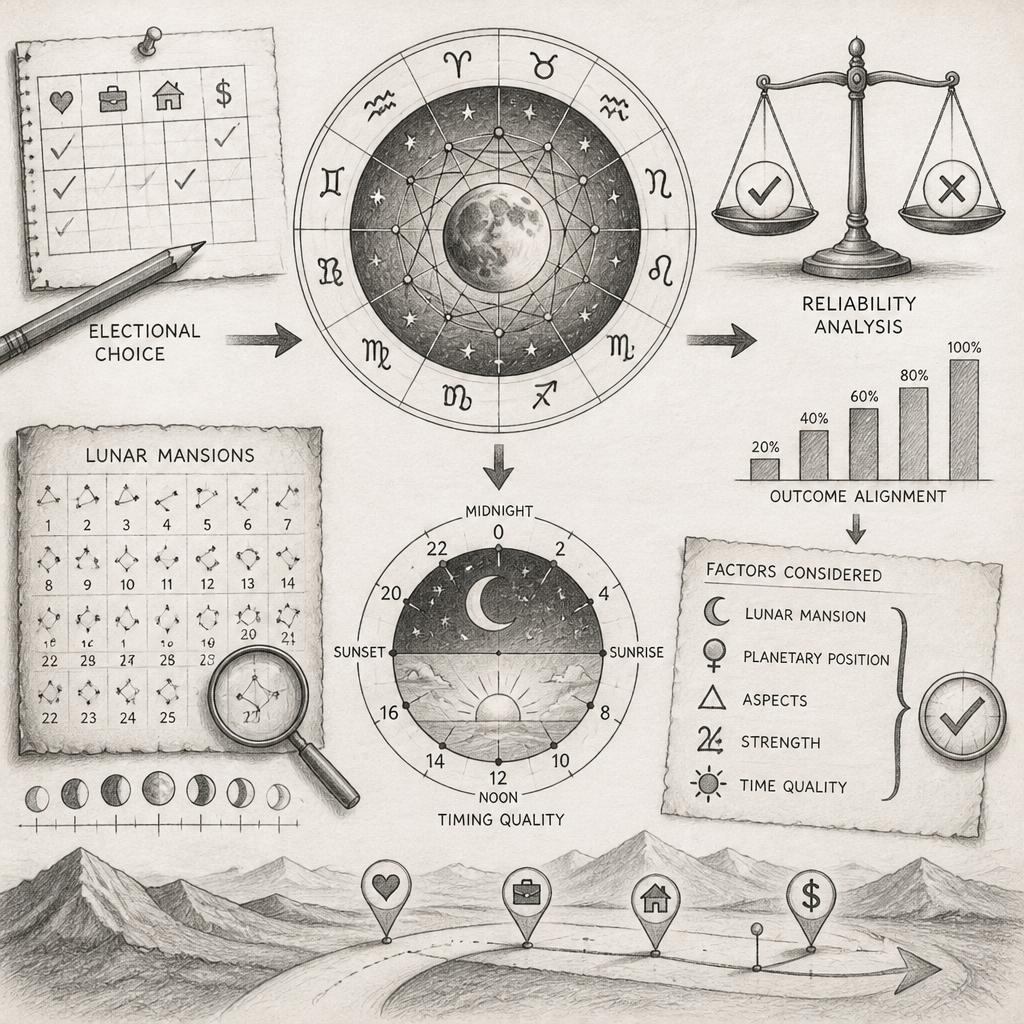
Step 5: Resolve conflicts with a fixed hierarchy. Ideal elections are rare. When conditions disagree, weigh them in this order:
Find Your Natal Moon Mansion →
- Mansion correspondence, the strongest signal in this system; if the mansion's traditional uses do not match your category, the timing is wrong regardless of everything else.
- Planetary day, a supportive weekday reinforces the mansion; an opposing one weakens it.
- Planetary hour, a supportive hour sharpens the window; treat it as a tiebreaker, not a veto.
- Lunar phase, waxing favors growth and initiation; waning favors release, closure, and removal.
- Practical availability, if the first four align but you cannot act, the alignment is theoretical.
Step 6: Execute and log. Perform the operation within the confirmed window and record the mansion number, planetary day, planetary hour, and a one-line outcome note. After ten to fifteen entries, your own log becomes more useful than any general table.
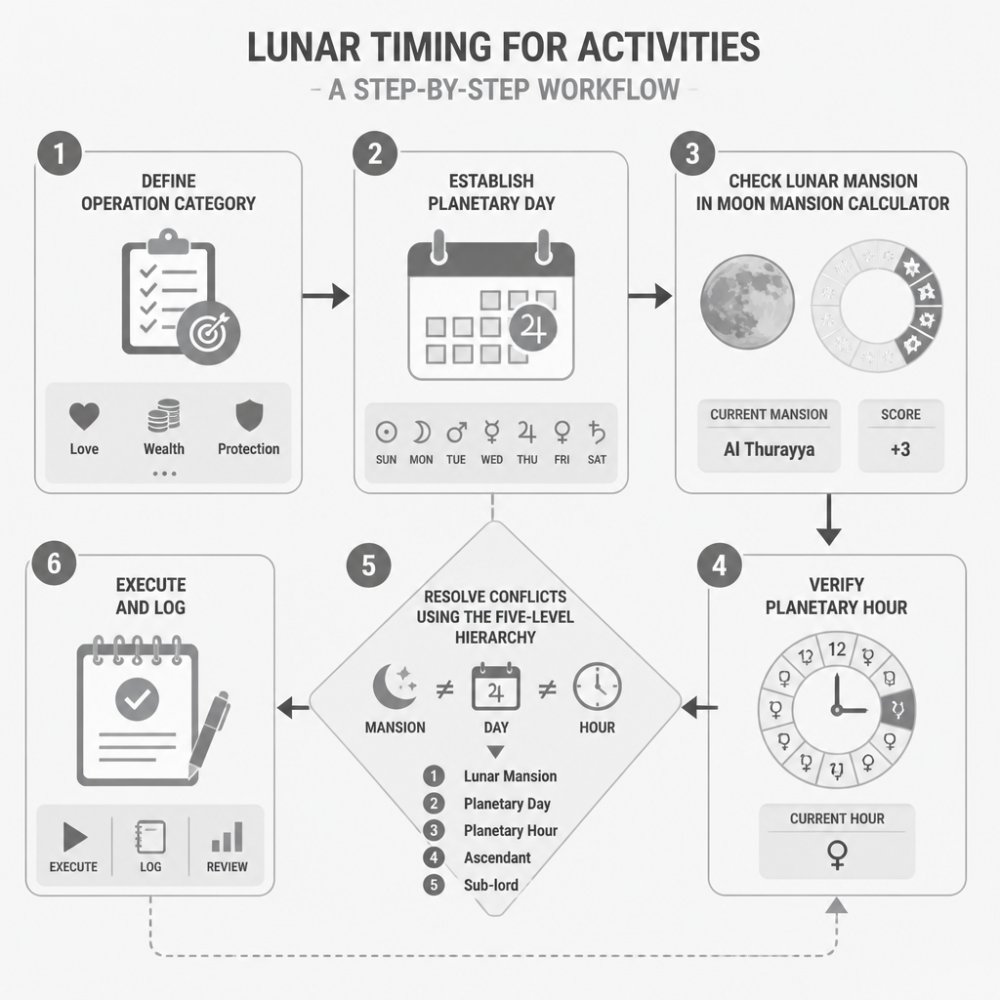
The full sequence takes time the first time and less once you know your categories. The value isn't a perfect election, it's having a consistent, documented method you can refine against your own results.
Adapting Picatrix Timing to Your Modern Schedule
The classical text assumes a practitioner who can wait weeks for an ideal election; most people cannot. The adaptations below are contemporary compromises, not historical procedure, label them as such in your records so you don't mistake a workaround for a traditional election.
Handle time zones and daylight saving correctly. Lunar mansion and planetary hour calculations depend on local sunrise and sunset, not a fixed clock. Three rules prevent the most common errors:
- Use the local time where the operation physically happens, not your own time zone. For a call with someone in another region, the relevant sunrise and sunset are theirs.
- During daylight saving, the clock shifts but the Sun does not. Recalculate sunrise and sunset for the actual date rather than reusing last month's clock times.
- If you travel, re-enter the new location in Moon Mansion Calculator. A mansion active at 9:00 a.m. at home may not be active at 9:00 a.m. where you land.
Work within business hours. Most operations, interviews, meetings, launches, filings, happen between 9:00 a.m. and 6:00 p.m. on weekdays, leaving roughly five planetary days and about nine daytime planetary hours per day. Instead of hunting a perfect window, scan the week ahead, mark the two or three windows where mansion correspondence and planetary day agree, and schedule into the best available one.
Use recurring windows instead of one-shot elections. Many mansion correspondences repeat on a roughly 27-to-28-day cycle as the Moon returns to the same position, so if this week's window is unusable, the next comparable one is about four weeks out. For non-urgent operations, a website launch, a proposal, a first appointment, waiting one cycle often beats forcing a poor fit.
Simplify the operation when timing is fixed. Some events cannot move: a court date, a surgery, a flight, a deadline. Reduce the timing variables you try to satisfy, keep the mansion check, drop the planetary hour requirement, and log the result. A simplified operation performed consciously beats an abandoned one.
Decide in advance how strict you will be. Two postures work:
- Loose: check the mansion, confirm it isn't directly opposed to your category, and proceed. Suitable for routine or low-stakes actions.
- Strict: require agreement between mansion, planetary day, and planetary hour before acting. Suitable for high-stakes or hard-to-repeat operations.
Pick one posture per category and write it down. The failure mode isn't being too loose or too strict, it's switching standards after the fact to justify whatever you already did.
What to skip entirely. Routine tasks, email, errands, exercise, administrative work, don't need timing. Reserve the workflow for operations where the outcome matters and timing is at least partly under your control; applying it to everything dilutes your attention and your data.
Common Mistakes and How to Avoid Them
Practitioners new to Picatrix timing often stumble on predictable issues. Knowing them prevents frustration and improves results.
Mistake 1: Waiting for perfect conditions indefinitely. Some practitioners see suboptimal timing and delay repeatedly until the opportunity window closes. "Good enough" timing beats missed opportunities, if a mansion's associations loosely match your activity, proceed.
Mistake 2: Confusing lunar mansions with zodiac signs. The 28 mansions are not the 12 zodiac signs, a mansion might span part of Aries, all of Taurus, and part of Gemini. Always check the specific mansion, not just the sign.
Mistake 3: Ignoring practical constraints. The ideal mansion might appear at an inconvenient time; losing sleep or disrupting your week undermines any benefit. Work with your actual life, not against it.
Mistake 4: Treating timing as destiny. Favorable timing supports your efforts, it doesn't guarantee outcomes. A job interview scheduled during an excellent mansion still requires preparation and genuine qualification. Timing is one factor among many.
Mistake 5: Neglecting to track results. The only way to know if Picatrix timing works for you is to notice outcomes. Keep a simple log, activity, mansion used, result, and over time patterns emerge: certain mansions may consistently support your goals while others feel less impactful.
Applying Picatrix timing in modern life bridges ancient astronomical wisdom with contemporary needs. Treat it as a practical tool for intentional action rather than rigid dogma.
Frequently Asked Questions
How do I find the Moon's current lunar mansion?
Use a lunar mansion calculator to check the Moon's position in real time. The calculator maps the Moon across the 28 lunar mansions and shows which mansion is active now. You input your location and time zone, and the tool instantly identifies the current mansion and its planetary correspondences. This eliminates manual calculations and ensures accuracy for planning your activities.
Can I use Picatrix timing if I've never studied Islamic astronomy before?
Yes. Picatrix timing doesn't require deep historical knowledge to use effectively. A lunar mansion calculator handles the technical calculations, you simply identify your activity type, check which mansion is active, and plan accordingly. Start with one activity type (like beginning a project or travel) and track the results. Over time, you'll recognize patterns without needing to understand the underlying astronomy.
What should I do when Picatrix timing conflicts with my schedule?
Prioritize the timing factors most relevant to your activity. Document what you prioritized and the outcome. This helps you refine your personal approach and shows which factors genuinely influence your results.
How far in advance should I plan using lunar mansion timing?
Plan at least 2-4 weeks ahead for major activities like travel or significant projects. The Moon cycles through all 28 mansions in about 27 days, so looking ahead one full cycle gives you multiple favorable windows. For smaller daily tasks, checking the current mansion a few days in advance is sufficient. Longer planning horizons let you align multiple factors, lunar mansion, planetary hour, and your personal schedule.